

Fish identification archive / Mutton Snapper
Mutton Snapper
Lutjanus analis
I saw this
Spotted this fish? Share the guide with your dive buddies. Review your caption before posting.
For Instagram, copy the caption and link into your own post or message. Nothing is posted automatically and this does not record a verified sighting.
Fun facts for your next surface interval
- The same mutton snapper can look plain or barred: its wardrobe is more flexible than the portrait.
- A black spot is only the beginning of the identification puzzle; the cheek lines and anal fin finish the story.
- Juveniles and adults use different neighborhoods, from sheltered vegetation to reefs.
Palm Beach connection
Lake Worth Lagoon / Blue Heron Bridge, Palm Beach County: Verified species row (x).
Documented regional presence is not a guarantee of an encounter or a measure of how common this fish is at your dive site.
How to recognize this fish
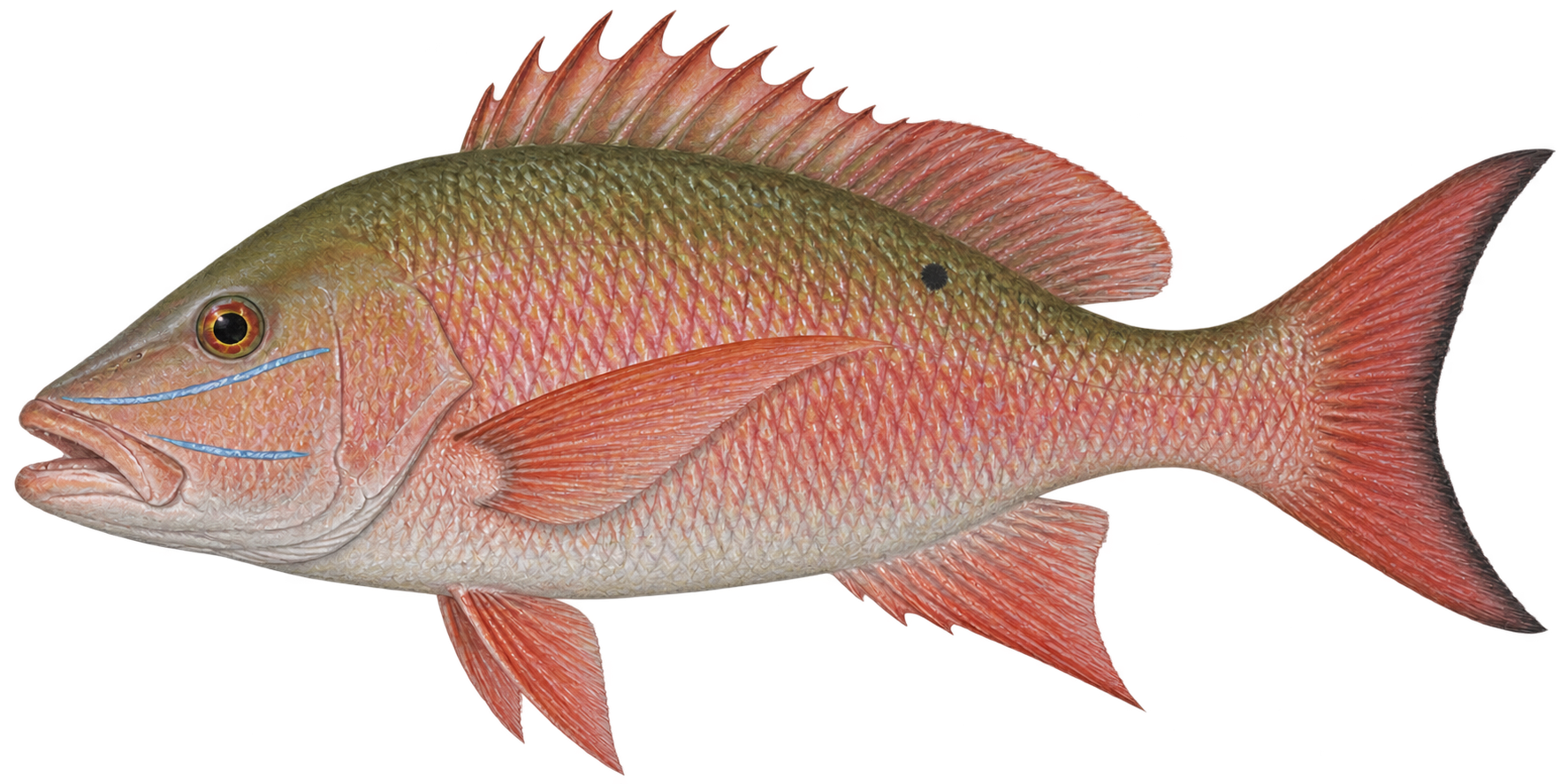
The most useful combination is an olive upper body, pinkish or reddish lower sides, blue lines on the cheek and a dark spot high on the flank. The anal fin ends in a clear point. Body color can change, so do not depend on a uniformly red fish. Preserve the cheek and rear fins in identification photographs.
Size and life stages
Around 50 centimeters, or 20 inches, is a commonly cited length; large individuals may exceed 90 centimeters. Juveniles are much smaller and can show patterns that differ from the adult portrait. Estimate body length without including a guess at age. A small fish in a nursery habitat and a large reef adult belong to the same species.
Habitat and where to look
Adult mutton snappers use reefs, rocks and neighboring open bottom. Juveniles occupy sheltered inshore habitats, including vegetated sand and seagrass. Scan the transition between cover and open space rather than concentrating only on a reef’s most colorful surface. Keep fins above vegetation and avoid resting on the bottom to wait for a fish.
Range and local context
This western Atlantic snapper ranges through Florida, the Bahamas, the Caribbean and the Gulf region toward Brazil. A verified Lake Worth Lagoon occurrence supports its inclusion in the Palm Beach archive. That record does not mean every local sighting of a red snapper-shaped fish is this species. Identification still depends on the individual animal’s visible features.
What is on the menu?
The menu includes small fishes and bottom-dwelling animals such as shrimp, crabs, mollusks and cephalopods. Feeding can occur by day or night. A fish picking near the substrate may offer a longer view than one crossing open water. Observe from its side at a distance rather than moving between the animal and the patch it is investigating.
Daily habits and behavior
Mutton snappers may occur singly or in loose groups, and some daytime aggregations disperse at night. Their pattern can become more barred in certain circumstances. In a dive log, describe both the markings and the activity rather than assuming a different color means a different species. Brief observations cannot establish an individual’s usual territory or daily routine.
Mating and the next generation
Adults can form spawning aggregations, releasing eggs that drift in the water. Some populations repeatedly use particular spawning sites. Such gatherings deserve plenty of space, and a site’s reputation is not a reason to approach more closely. This guide does not transfer a spawning month from another Caribbean location into a promise about Palm Beach waters.
Look-alikes and identification traps
Lane snapper also has an upper-side dark spot, but normally shows conspicuous yellow horizontal stripes and a more rounded anal fin. Mutton snapper’s blue cheek lines and pointed anal fin help separate the two. A spot by itself is insufficient. If the fin outline is hidden, retain the photo for a later comparison rather than guessing.
Observe without disturbing
Watch quietly without following a retreating fish across the reef. Do not offer food, chase a group or interfere with a possible spawning aggregation. Maintain your buddy contact and buoyancy while looking sideways across open bottom. A useful shared sighting includes what you actually observed and, when appropriate, an identification confidence note rather than an unqualified species claim.
Harvest, protection and eating safety
Regulated recreational harvest; restrictions apply
Can it be hunted or harvested?
Minimum 18 inches total length; five per person daily within the ten-snapper aggregate in the usual Florida state and adjacent federal rules. These are recreational limits, not commercial trip limits. Biscayne National Park has additional size/aggregate restrictions.
Florida seasons and areas
No regular recreational seasonal closure is listed for Florida Atlantic/Palm Beach or Gulf waters. Spawning season does not itself create a statewide recreational closure. Check current notices, protected areas and your precise jurisdiction before fishing. Commercial spring trip restrictions are different from these recreational rules.
Can it be speared?
Allowed where lawful, for legal-sized fish within the applicable season and bag limits. Check the site before diving: beaches, piers, parks and parts of the Keys have exclusions. Florida state waters prohibit using rebreathers or powerheads to harvest this species.
Is it safe to eat?
Edible, but not automatically safe. Check Florida DOH consumption advisories for the catch location, especially for children and anyone who is or might become pregnant or is breastfeeding. Reef fish can carry ciguatoxin, which cannot be detected by taste or removed by cooking or freezing. Avoid the head, liver, intestines and roe, and do not eat reef fish from areas under a ciguatera advisory. Mercury meal limits and ciguatera precautions address different risks.
Before you act: This recreational overview is not permission to collect or spear at your dive site. Confirm the species, date, management area, state or federal waters, gear, licenses and current local closures. A fish illustration cannot establish an identification or guarantee seafood safety.
Official rules and health guidance
- FWC snapper recreational rules
- NOAA Gulf seasons and closures
- South Atlantic Council species regulations
- FWC spearing rules
- Florida DOH seafood poisoning
- Florida DOH local fish advisories
- FDA/EPA fish consumption guidance
- Florida Administrative Code: state-water diving gear
Reviewed 2026-11-10. Rules and advisories can change; check the linked authorities before harvesting or eating.
Sources and review
Reviewed 2026-11-10.
Make your next dive happen
Dive With Us
Explore local charters and plan a dive suited to your experience.
View dive calendarTrain With Us
Build your fish identification, buoyancy and diving skills.
Explore trainingTravel With Us
Discover upcoming dive adventures and trip details.
Explore dive travelShop With Us
Browse equipment for your diving and ask our team for help choosing.
Explore dive gearReview current dates, availability, prices, inclusions and requirements on each listing before booking or buying.
Call us now
Ask about fish identification training
Reef Fish Identification
Ask about dates, prerequisites or your next step. An inquiry does not reserve a place. Please provide your own contact details; do not include medical, payment or a child's personal information.
We use these details to respond to your inquiry. This form does not sign you up for marketing.
Explore more with Stuart Scuba
Open Water course options · Advanced Adventure training · Technical training · Professional training · All courses · Local dives · Dive trips · Facebook · Instagram · YouTube
Your surface-interval essentials
Questions for Stuart Scuba? info@stuartscuba.com
Check the Stuart Scuba Weather Center · Play scuba trivia
Weather and wildlife vary. Confirm current conditions, trip requirements and departure details with the operator.
Plan Your Next Dive with Stuart Scuba
Dive With Us
Explore upcoming local charters and choose a dive that fits your experience.
Before you book
Check the individual listing for departure time, requirements and availability.
Travel With Us
Find upcoming dive adventures and start planning your next trip.
Plan your trip
Review dates, inclusions and trip details on the travel calendar.
Stay Connected with Stuart Scuba
 Follow pageShare
YouTube
SubscribeWatch & shareFollow on InstagramView & share post
Follow company news, training updates, and dive stories.
Follow on LinkedInGoogle Reviews
See Stuart Scuba’s current Google rating and review count below. Open the listing in Google Maps to browse customer reviews.



