

Fish identification archive / Mottled Mojarra
Mottled Mojarra
Ulaema lefroyi
Fun facts for your next surface interval
- Its mouth can extend downward, turning a small-looking mouth into a useful bottom-feeding tool. [source] [source]
- Two scientific combinations appear in reputable sources, but Ulaema lefroyi and Eucinostomus lefroyi are not two entries for the species count. [source] [source]
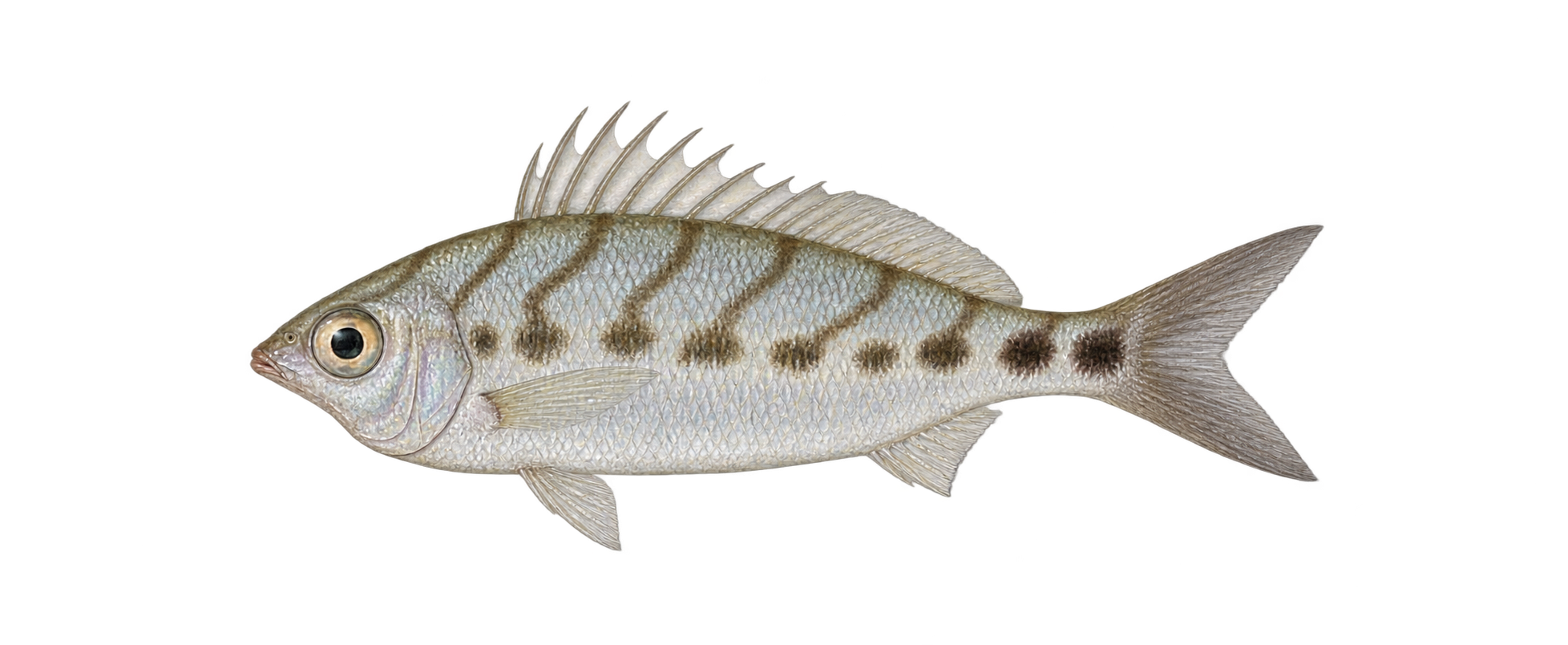
- The darkest flank blotches are near the tail base, so a complete side view is especially valuable. [source] [source]
Florida and local context
REEF's cumulative diver-survey report lists Eucinostomus lefroyi at Blue Heron Bridge (WPB), Phil Foster Park. This is a species-level citizen-science report, not an independently reidentified specimen or a prediction of present-day abundance.
A documented past record does not establish present abundance or guarantee an encounter.
Sources: REEF: Blue Heron Bridge cumulative diver-survey species report
How to recognize this animal
A slim silver fish with wavy, slanting bars that meet dark mid-side blotches; the last blotches near the tail base are especially dark. Its lower head outline is concave, the tail deeply forked and the mouth strongly extensible downward. The tip of the spiny dorsal fin is usually clear. These details separate it from a generic “little silver fish.”
Sources: Smithsonian Tropical Research Institute: mottled mojarra, listed as Eucinostomus lefroyi; FAO: Western Central Atlantic identification guide, mojarras
Size and life stages
Reported lengths differ: FAO’s older account gives 15 cm, Florent’s guide 17 cm, and Smithsonian 23 cm (about 9 inches). We retain the 23 cm regional maximum while displaying that disagreement. None of these values is a typical size guaranteed at Blue Heron Bridge, and markings do not supply an exact age.
Sources: Smithsonian Tropical Research Institute: mottled mojarra, listed as Eucinostomus lefroyi; FAO: Western Central Atlantic identification guide, mojarras; Florent’s Guide: mottled mojarra photographed at Blue Heron Bridge
Habitat and where to look
FAO describes exposed sandy beaches, ocean inlets and passes. Smithsonian also emphasizes energetic sand-bottom marine habitat rather than brackish estuaries. Do not assume that all mojarras have the same salinity preference. On a dive, observe over clear sand without resting on it or stirring sediment to make the fish feed.
Sources: Smithsonian Tropical Research Institute: mottled mojarra, listed as Eucinostomus lefroyi; FAO: Western Central Atlantic identification guide, mojarras
Range and local context
This guide follows WoRMS in using Ulaema lefroyi. Many well-established references and the local REEF row use Eucinostomus lefroyi for the same fish. The broad western Atlantic range reaches from the southeastern United States toward Brazil. Florent’s species photograph specifically names Blue Heron Bridge, independently supporting the survey locality.
Sources: California Academy of Sciences: Catalog of Fishes, lefroyi; Florent’s Guide: mottled mojarra photographed at Blue Heron Bridge
What is on the menu?
It feeds on bottom-dwelling invertebrates, including crustaceans and worms in the Smithsonian compilation. The projecting mouth is an important feeding adaptation. If you record it extending the mouth toward sediment, describe that visible action; a photo usually cannot identify the tiny food item being taken.
Sources: Smithsonian Tropical Research Institute: mottled mojarra, listed as Eucinostomus lefroyi; FAO: Western Central Atlantic identification guide, mojarras
Daily habits and behavior
A close view of undisturbed feeding is more informative than a chase through a school. Watch from one position and allow the fish to enter the frame. The reviewed sources do not establish a species-specific local schooling size or daily migration schedule, so group formation should be recorded as an observation rather than a fixed rule.
Sources: FAO: Western Central Atlantic identification guide, mojarras
Mating and the next generation
Smithsonian lists pelagic eggs and larvae. That identifies an early water-column stage but does not establish a Palm Beach spawning month, egg count or maturity size. The fish’s current genus placement also differs across references, so check that any future reproductive paper truly concerns this species before transferring its findings.
Sources: Smithsonian Tropical Research Institute: mottled mojarra, listed as Eucinostomus lefroyi
Look-alikes and identification traps
Slender mojarra can also show oblique markings, but FAO describes a distinct dark V on its snout. Flagfin mojarra has a prominent black-and-white pattern on the spiny dorsal fin. Mottled mojarra’s combination of wavy bars, dark rear-side blotches and usually clear dorsal tip is a stronger field clue than one isolated mark.
Sources: FAO: Western Central Atlantic identification guide, mojarras
Observe without disturbing
Keep neutral buoyancy above the sand and avoid surrounding a group with photographers. Do not lift vegetation, rake the bottom or offer food. A side photograph that includes the snout, dorsal tip and tail-base pattern is the best practical record; leave fin-spine counts to suitable imagery or expert examination.
Sources: Smithsonian Tropical Research Institute: mottled mojarra, listed as Eucinostomus lefroyi; FAO: Western Central Atlantic identification guide, mojarras
Harvest, protection and eating safety
Unknown: exact harvest rules need verification
The neutral gray status means the rules or scope have not been fully verified. No affirmative species-specific season or complete take allowance for Ulaema lefroyi was established in this review. Florida default limits are conditional background, not permission for every species, jurisdiction or site. Ulaema lefroyi is also recorded under the historical name Eucinostomus lefroyi; do not substitute other mojarra species limits. Omitted closed months are not evidence of a year-round open season. Food safety and menu presence remain unverified.
This color is a qualified summary, not permission to collect or a guarantee that a particular animal is safe to eat.
Can it be hunted or harvested?
The reviewed FWC lists do not establish a species-specific recreational size, bag or season rule for Ulaema lefroyi. FWC’s statewide default for species without specific limits is two fish or 100 pounds per person per day, whichever is greater, but that default is not a substitute for confirming this exact species, jurisdiction and location. This guide withholds a species-specific take recommendation.
Florida seasons and areas
These statewide default rules do not establish permission at a particular dive site or in federal waters. At Phil Foster Park, designated sport-fishing areas and the separate mapped tropical-ornamental collection closure must be distinguished; this guide does not authorize taking this animal on a Blue Heron Bridge dive. Monroe County, Gulf waters, parks, refuges and Florida Keys sanctuary zones require their own location-specific check. No annual statewide season is claimed here.
Can it be speared?
Neither this species nor its family is identified on FWC’s published species-prohibited list. This is not a spearfishing clearance: FWC prohibits spearfishing near public swimming beaches, public fishing piers and fishing bridges, and in other specified areas. The Blue Heron Bridge/Phil Foster setting is not a general offshore spearfishing site.
Is it safe to eat?
No species-specific safe meal allowance is established here. Legal harvest does not establish food safety. Check current Florida Department of Health advice for the exact fish, capture waters and consumer, especially pregnancy and children. Cooking cannot eliminate every marine toxin. No recipe is supplied.
WoRMS accepts Ulaema lefroyi; Eucinostomus lefroyi is the historical name used in the local REEF survey. Do not substitute silver-jenny or other mojarra rules by common-name similarity.
Palm Beach is Atlantic Florida. Do not transfer Atlantic guidance to the Gulf, Monroe County, or federal waters without checking the applicable rules.
Before you act: Confirm the species, date, exact management area, state or federal waters, gear, licenses and current local closures. A local occurrence record never grants permission to take an animal.
Official rules and health guidance
- FWC: default recreational rules for species without specific limits
- FWC recreational marine-life requirements and species list
- Florida Rule 68B-42.001: listed marine-life species
- Palm Beach County: Phil Foster Park fishing and collection notice
- FWC spearing restrictions
- Florida Department of Health: current seafood consumption advice
- Florida Department of Health: seafood toxin warnings
- NOAA: Florida Keys sanctuary zones
Reviewed 2026-11-11. Rules and advisories can change; check the linked authorities before acting.
Identification and source cautions
- WoRMS accepts Ulaema; some other authoritative catalogs still use Eucinostomus. Both names map to the same accepted AphiaID in this project.
- Maximum lengths differ among sources: 15, 17 and 23 cm.
- No verified local reproductive schedule.
Sources and review
Biology and taxonomy reviewed 2026-11-11. Photographs on cited sites are reference material and are not reproduced here.
- Smithsonian Tropical Research Institute: mottled mojarra, listed as Eucinostomus lefroyi
- FAO: Western Central Atlantic identification guide, mojarras
- Florent’s Guide: mottled mojarra photographed at Blue Heron Bridge
- California Academy of Sciences: Catalog of Fishes, lefroyi
- WoRMS: accepted taxonomy
- REEF: Blue Heron Bridge cumulative diver-survey species report
Make your next dive happen
Dive With Us
Explore local charters and plan a dive suited to your experience.
View dive calendarTrain With Us
Build your fish identification, buoyancy and diving skills.
Explore trainingTravel With Us
Discover upcoming dive adventures and trip details.
Explore dive travelShop With Us
Browse equipment for your diving and ask our team for help choosing.
Explore dive gearReview current dates, availability, prices, inclusions and requirements on each listing before booking or buying.
Call us now
Ask about marine life identification
Marine Life Identification
Ask about dates, prerequisites or your next step. An inquiry does not reserve a place. Please provide your own contact details; do not include medical, payment or a child's personal information.
We use these details to respond to your inquiry. This form does not sign you up for marketing.
Explore more with Stuart Scuba
Open Water course options · Advanced Adventure training · Technical training · Professional training · All courses · Local dives · Dive trips · Facebook · Instagram · YouTube
Your surface-interval essentials
Questions for Stuart Scuba? info@stuartscuba.com
Check the Stuart Scuba Weather Center · Play scuba trivia
Weather and wildlife vary. Confirm current conditions, trip requirements and departure details with the operator.
Plan Your Next Dive with Stuart Scuba
Dive With Us
Explore upcoming local charters and choose a dive that fits your experience.
Before you book
Check the individual listing for departure time, requirements and availability.
Travel With Us
Find upcoming dive adventures and start planning your next trip.
Plan your trip
Review dates, inclusions and trip details on the travel calendar.
Stay Connected with Stuart Scuba
 Follow pageShare
YouTube
SubscribeWatch & shareFollow on InstagramView & share post
Follow company news, training updates, and dive stories.
Follow on LinkedInGoogle Reviews
See Stuart Scuba’s current Google rating and review count below. Open the listing in Google Maps to browse customer reviews.



