

Fish identification archive / Midnight Parrotfish
Midnight Parrotfish
Scarus coelestinus
I saw this
Spotted this marine animal? Share the guide with your dive buddies. Review your caption before posting.
For Instagram, copy the caption and link into your own post or message. Nothing is posted automatically and this does not record a verified sighting.
Fun facts for your next surface interval
- Midnight is a color scheme, not a curfew: the name does not make it a night-only fish.
- Blue teeth, no toothpaste endorsement: its dental plates are naturally blue-green.
- Mixed-company lunch: midnight parrotfish can graze alongside surgeonfishes.
Florida and local context
Lake Worth Lagoon / Palm Beach County; also Upper Florida Keys: Florida Museum inventory marks this species verified with named observer initials. NOAA also documents it in Key Largo reef research. These establish occurrence, not local abundance or a guaranteed encounter.
Documented regional presence is not a guarantee of an encounter or a measure of how common this animal is at your dive site.
How to recognize this animal
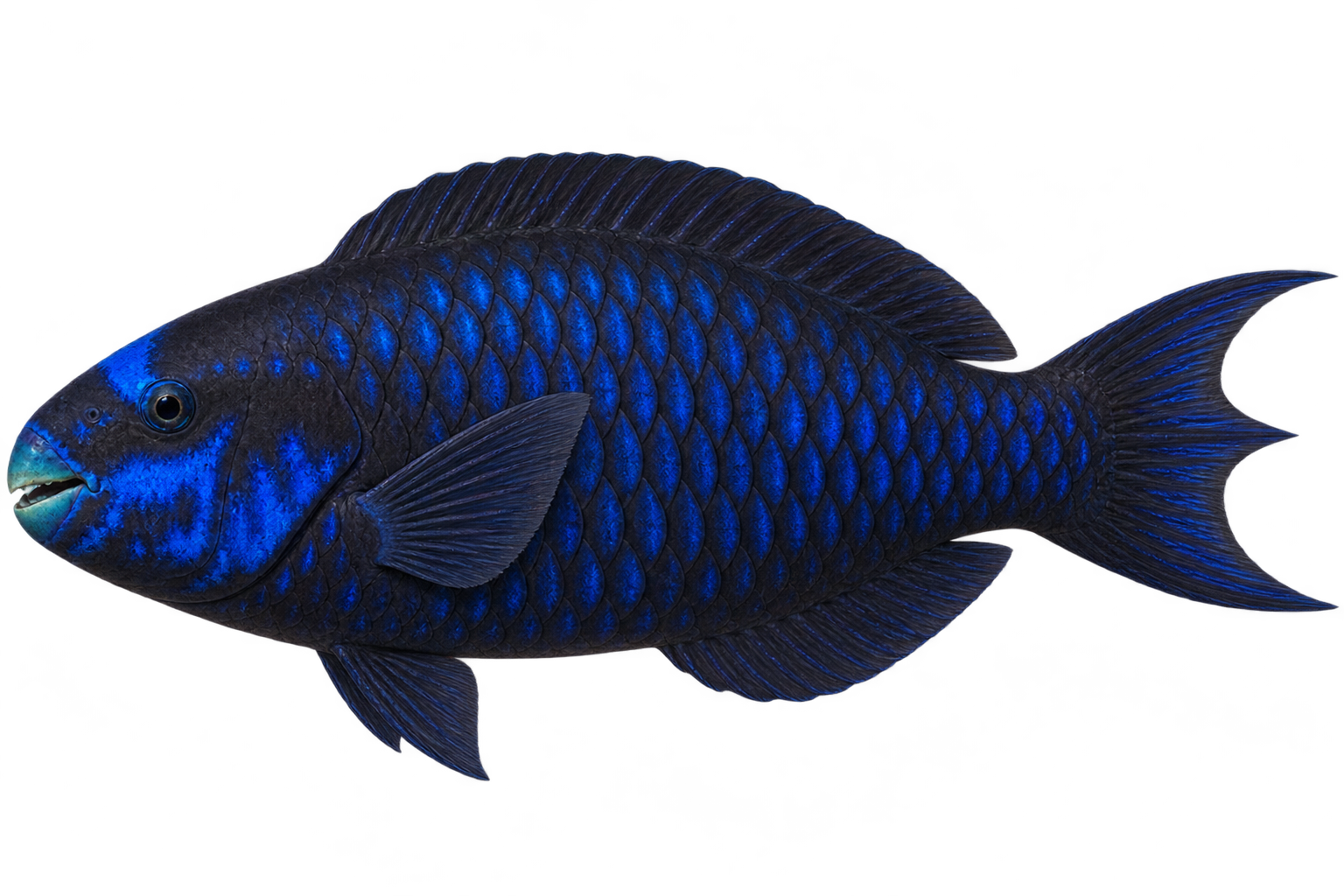
Midnight Parrotfish are dark, but not plain: bright blue centers punctuate the black body scales, and blue covers unscaled areas of the head. A blue bar crosses between the eyes, and the teeth are blue-green. Juveniles and adults share the basic color scheme, unlike parrotfishes whose initial and terminal phases seem to belong to different species.
Size and life stages
Both major species accounts give a maximum length of 77 cm, with FishBase listing about 50 cm as a common length. This can be an imposing reef grazer. Large adults develop elongated tail lobes and a more complex trailing edge than juveniles. A small fish should not be expected to match the complete outline of a large adult illustration.
Habitat and where to look
The species uses rocky coastal reefs and reefs farther offshore. Smithsonian reports that encounters are usually shallower than 20 m, although deeper records exist. Stay within your planned depth and scan the feeding surfaces ahead of you. There is no reason to extend a dive into deeper water simply because a species account includes a deep maximum record.
Range and local context
Florida Museum verifies Midnight Parrotfish in its Lake Worth Lagoon fish inventory, and NOAA included the species in Key Largo reef research. These records establish occurrence in Palm Beach County and the upper Florida Keys, not an encounter guarantee or a measure of local abundance. Keep the exact site, date and depth with any sighting of your own.
What is on the menu?
These fish scrape algae from rock and dead coral surfaces. FishBase describes them feeding in schools, sometimes alongside surgeonfishes. Sharing a patch does not make the two kinds of fish close relatives or identical feeders. Watch how the beaked parrotfish contacts the substrate, then compare it with the smaller-mouthed neighbors without trying to interrupt either animal.
Daily habits and behavior
A feeding school can be a useful place to observe the species, but the name does not mean it is a nocturnal specialist. The dark palette is an identification feature, not a timetable. Follow one fish with your eyes long enough to notice the blue scale centers, then look at the group as a whole rather than swimming between individuals.
Mating and the next generation
The species lays eggs, with distinct pairing reported during breeding. Its similar male and female coloration means a photograph alone is not a dependable way to assign sex. This guide does not supply an unverified Florida spawning season or infer reproductive activity from a school merely feeding together. Record a behavior only when you actually observe it.
Look-alikes and identification traps
Blue Parrotfish are much more uniformly blue; midnight fish have a distinctly dark background with blue scale centers and head markings. Rainbow Parrotfish combine bronze and green rather than this blue-black pattern. Poor light can flatten all those differences, so avoid deciding from a silhouette. Tail shape helps with age and overall form but is not sufficient by itself.
Observe without disturbing
Keep a school together by remaining outside its route and never chase the last fish for a photograph. A well-exposed side view should retain the dark body and blue centers rather than turning the entire animal bright cyan. Use a natural approach and let the fish continue grazing. Avoid contact with the substrate even when it appears to be dead coral.
Harvest, protection and eating safety
Restricted marine life: live collection only; no spearing
Can it be hunted or harvested?
Florida regulates all parrotfish as live ornamental marine life, not an ordinary food-fishing catch. Recreational collection requires a saltwater fishing license unless exempt, approved gear and suitable life-support equipment. Fish must be landed and kept alive. Maximum length is 12 inches total length. The daily limit is five of this species within 20 marine-life organisms; possession is limited to two days, no more than 10 of this species within 40 total. Recreational sale is prohibited.
Florida seasons and areas
No species-specific recreational closed months are listed in the reviewed marine-life rules. This does not mean collection is permitted at every site. The designated Blue Heron Bridge dive site is closed to marine-life harvest. Check sanctuary zones, parks, refuges and other closures before collecting. Florida marine-life regulations also apply in adjacent federal waters.
Can it be speared?
No. FWC expressly prohibits spearing parrotfish. The allowance for carefully regulated live ornamental collection does not authorize spearfishing or killing one for food.
Is it safe to eat?
Do not treat this species as a food target or as safe to eat. FDA identifies parrotfish among fishes associated with ciguatera poisoning. Appearance, taste and smell cannot establish safety, and cooking or freezing does not remove ciguatoxin. Follow current local health advisories; an identification photograph cannot clear a fish for consumption.
Before you act: This recreational overview is not permission to collect or spear at your dive site. Confirm the species, date, management area, state or federal waters, gear, licenses and current local closures. Identification artwork cannot establish an identification or guarantee seafood safety.
Official rules and health guidance
- FWC: Recreational Marine Life
- Florida Administrative Code: Marine Life, Chapter 68B-42
- FWC: Spearing
- NOAA: Florida Keys Sanctuary Marine Zones
- Florida Department of Health: Seafood Poisoning
- FDA: Seafood-Related Toxin Illnesses
Reviewed 2026-11-10. Rules and advisories can change; check the linked authorities before harvesting or eating.
Sources and review
Reviewed 2026-11-10.
Make your next dive happen
Dive With Us
Explore local charters and plan a dive suited to your experience.
View dive calendarTrain With Us
Build your fish identification, buoyancy and diving skills.
Explore trainingTravel With Us
Discover upcoming dive adventures and trip details.
Explore dive travelShop With Us
Browse equipment for your diving and ask our team for help choosing.
Explore dive gearReview current dates, availability, prices, inclusions and requirements on each listing before booking or buying.
Call us now
Ask about marine life identification
Marine Life Identification
Ask about dates, prerequisites or your next step. An inquiry does not reserve a place. Please provide your own contact details; do not include medical, payment or a child's personal information.
We use these details to respond to your inquiry. This form does not sign you up for marketing.
Explore more with Stuart Scuba
Open Water course options · Advanced Adventure training · Technical training · Professional training · All courses · Local dives · Dive trips · Facebook · Instagram · YouTube
Your surface-interval essentials
Questions for Stuart Scuba? info@stuartscuba.com
Check the Stuart Scuba Weather Center · Play scuba trivia
Weather and wildlife vary. Confirm current conditions, trip requirements and departure details with the operator.
Plan Your Next Dive with Stuart Scuba
Dive With Us
Explore upcoming local charters and choose a dive that fits your experience.
Before you book
Check the individual listing for departure time, requirements and availability.
Travel With Us
Find upcoming dive adventures and start planning your next trip.
Plan your trip
Review dates, inclusions and trip details on the travel calendar.
Stay Connected with Stuart Scuba
 Follow pageShare
YouTube
SubscribeWatch & shareFollow on InstagramView & share post
Follow company news, training updates, and dive stories.
Follow on LinkedInGoogle Reviews
See Stuart Scuba’s current Google rating and review count below. Open the listing in Google Maps to browse customer reviews.



