

Fish identification archive / Magnificent Feather Duster
Magnificent Feather Duster
Sabellastarte magnifica
I saw this
Spotted this marine animal? Share the guide with your dive buddies. Review your caption before posting.
For Instagram, copy the caption and link into your own post or message. Nothing is posted automatically and this does not record a verified sighting.
Fun facts for your next surface interval
- The underwater flower is a worm wearing its feeding equipment on the outside.
- Most of the animal is out of sight inside the tube, not in the showy fan.
- Its disappearing act is a rapid retreat, so repeated demonstrations interrupt dinner.
Florida and local context
South Florida, including Biscayne National Park: National Park Service species listing documents Florida occurrence; no Palm Beach-specific claim.
Documented regional presence is not a guarantee of an encounter or a measure of how common this animal is at your dive site.
How to recognize this animal
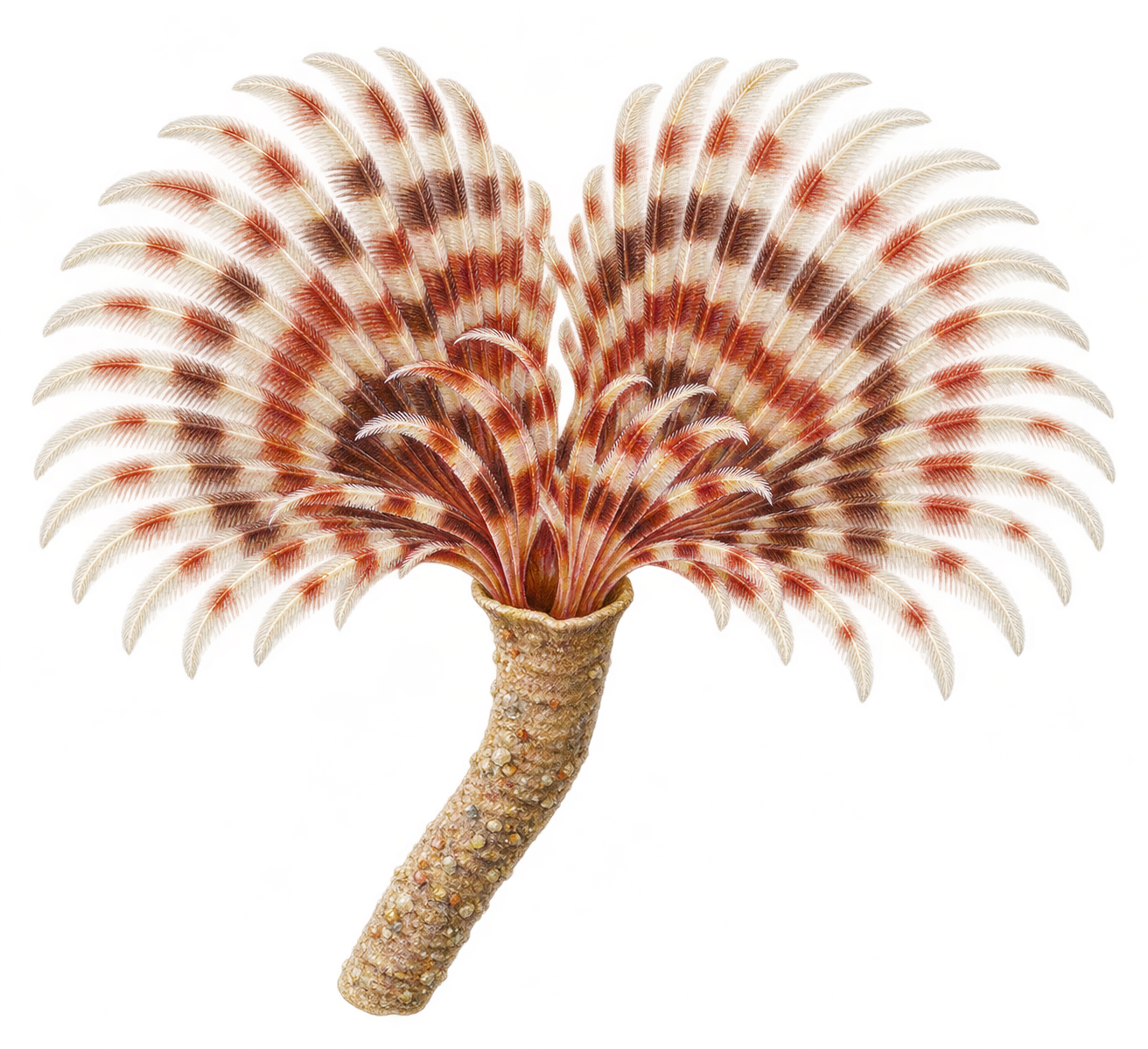
A broad double crown of fine, feathery radioles emerges from a flexible tube. Brown, cream and pale bands create a patterned fan that can resemble an underwater flower. The visible crown belongs to a segmented worm, with most of the body hidden from view.
Size and life stages
The expanded crown may approach 10 centimeters across. That measures the visible feeding structure, not the full length of the worm inside its tube. The apparent size changes dramatically when the crown folds, and a closed tube provides little information about the occupant’s actual dimensions.
Habitat and where to look
Reef surfaces and sheltered hard-bottom habitat support attached tubes. The worm depends on water moving past its exposed feeding crown. The tube is flexible and leathery rather than a rigid calcareous pipe. Mucus binds sediment and other particles into its structure, giving the hidden body a protective sleeve. The crown projects into flowing water while the body remains anchored inside. Tube material, crown arrangement and the animal’s attachment help separate a feather duster from a similarly flowerlike anemone.
Range and local context
The species occurs in the tropical western Atlantic, including Florida. Biscayne National Park lists it among local invertebrates. That is direct South Florida evidence, but a feather duster seen at Palm Beach still needs species-level identification rather than assignment from its general flowerlike appearance.
What is on the menu?
The radioles collect tiny suspended food particles from the water. Fine structures and ciliary action help move selected material toward the mouth. Its beauty is therefore functional: the fan is feeding equipment rather than petals or a decorative structure unrelated to survival.
Daily habits and behavior
The crown can retract rapidly into the tube when the animal is disturbed. A passing shadow or nearby movement may interrupt feeding. Remain still and patient rather than repeatedly waving at the fan to demonstrate how quickly it disappears.
Mating and the next generation
Magnificent feather dusters reproduce sexually by releasing eggs and sperm into seawater, where fertilization occurs externally. The early young are planktonic trochophore larvae, very different from the large fan-crowned adults. After metamorphosis, juveniles settle into a sedentary life. Thus, an animal that spends adulthood anchored inside a tube begins with a mobile stage in the water column.
Look-alikes and identification traps
Split-crown feather dusters and other fan worms also occur in Florida. Christmas tree worms have different paired spiral crowns and hard tubes associated with reef substrate. Crown structure and tube characters matter, but the animal should not be extracted to inspect hidden diagnostic details.
Observe without disturbing
Observe the direction of flow and the surrounding animals without shifting the tube, cleaning its surface or changing its position for a photograph. Keep fins and sediment away from the feeding fan. Do not touch the radioles or pull a tube from the reef. If the crown retracts, give the worm room to resume feeding; a patient view of an undisturbed animal is the goal, not a forced opening. Dive with Stuart Scuba to explore Florida marine life with an emphasis on careful observation. Ask about current conditions and an appropriate dive plan; wildlife sightings remain unpredictable.
Harvest, protection and eating safety
Restricted marine life: live collection only; Blue Heron Bridge closed
Can it be hunted or harvested?
Magnificent feather duster falls within regulated tropical ornamental marine life (featherduster worms in family Sabellidae). Where collection is legal, take no more than five of this species per person per day within the combined twenty-organism marine-life daily limit. The two-day possession limit is forty total organisms, no more than ten of one species. Animals must be landed and kept alive with adequately sized circulation, aeration or oxygenation. Hand collection and specified nets are allowed; no sale of recreational catch. A recreational saltwater fishing license is required unless exempt; a shoreline-only license does not cover collecting while diving.
Florida seasons and areas
No statewide recreational closed months are listed for this marine-life category. Collection is prohibited inside the designated Blue Heron Bridge Special Marine Life Area, which includes Phil Foster County Park and the waters bounded in FAC 68B-42.0036. This is not a blanket closure of all Palm Beach County waters. Possession there is also restricted, with narrowly defined motor-vessel transit and landing exceptions for animals lawfully collected elsewhere. The marine-life recreational bag rules also apply in adjacent federal waters in the absence of federal regulations for the species. Park, refuge and Florida Keys sanctuary zones can prohibit collection even where general state rules allow it. Check the exact site and current boundaries before any take.
Can it be speared?
No. This is a live-collection category: use the lawful nonlethal marine-life methods, not a spear. Do not break reef substrate or remove protected live rock to reach an animal.
Is it safe to eat?
Not recommended as a food target. These rules require live landing and continued live holding, not a food fishery. No species-specific safe-to-eat finding is made here. For any seafood, correct identity, legal sourcing, current health advisories and safe handling matter; cooking cannot remove all toxins.
Before you act: This recreational overview is not permission to collect or spear at your dive site. Confirm the species, date, management area, state or federal waters, gear, licenses and current local closures. Identification artwork cannot establish an identification or guarantee seafood safety.
Official rules and health guidance
- FWC: Recreational Marine Life
- Florida Administrative Code: Marine Life, Chapter 68B-42
- FAC 68B-42.001: restricted-species definitions (LII reproduction; current effective date checked against official FAC index)
- FWC: Saltwater Recreational Licenses and Permits
- NOAA: Florida Keys Sanctuary Marine Zones
- FDA: Selecting and Serving Seafood Safely
- Florida Department of Health: Seafood Poisoning
- FAC 68B-42.0036: Blue Heron Bridge boundaries and exceptions (LII reproduction)
- FAC 68B-42.005: marine-life recreational limits (LII reproduction)
Reviewed 2026-11-10. Rules and advisories can change; check the linked authorities before harvesting or eating.
Sources and review
Reviewed 2026-11-10.
- home.nps.gov: Magnificent Feather Duster
- Florida Fish and Wildlife Conservation Commission: Magnificent Feather Duster
- pierrewildlife.com: Magnificent Feather Duster
- Smithsonian: Magnificent Feather Duster natural-history video
- wetwebmedia.com: Magnificent Feather Duster
- Saltcorner: Sabellastarte magnifica tube and feeding structures
- DORIS / FFESSM: Sabellastarte magnifica, species-specific reproduction and larval development
- World Register of Marine Species: Magnificent Feather Duster
Make your next dive happen
Dive With Us
Explore local charters and plan a dive suited to your experience.
View dive calendarTrain With Us
Build your fish identification, buoyancy and diving skills.
Explore trainingTravel With Us
Discover upcoming dive adventures and trip details.
Explore dive travelShop With Us
Browse equipment for your diving and ask our team for help choosing.
Explore dive gearReview current dates, availability, prices, inclusions and requirements on each listing before booking or buying.
Call us now
Ask about marine life identification
Marine Life Identification
Ask about dates, prerequisites or your next step. An inquiry does not reserve a place. Please provide your own contact details; do not include medical, payment or a child's personal information.
We use these details to respond to your inquiry. This form does not sign you up for marketing.
Explore more with Stuart Scuba
Open Water course options · Advanced Adventure training · Technical training · Professional training · All courses · Local dives · Dive trips · Facebook · Instagram · YouTube
Your surface-interval essentials
Questions for Stuart Scuba? info@stuartscuba.com
Check the Stuart Scuba Weather Center · Play scuba trivia
Weather and wildlife vary. Confirm current conditions, trip requirements and departure details with the operator.
Plan Your Next Dive with Stuart Scuba
Dive With Us
Explore upcoming local charters and choose a dive that fits your experience.
Before you book
Check the individual listing for departure time, requirements and availability.
Travel With Us
Find upcoming dive adventures and start planning your next trip.
Plan your trip
Review dates, inclusions and trip details on the travel calendar.
Stay Connected with Stuart Scuba
 Follow pageShare
YouTube
SubscribeWatch & shareFollow on InstagramView & share post
Follow company news, training updates, and dive stories.
Follow on LinkedInGoogle Reviews
See Stuart Scuba’s current Google rating and review count below. Open the listing in Google Maps to browse customer reviews.



