

Fish identification archive / Lookdown
Lookdown
Selene vomer
I saw this
Spotted this fish? Share the guide with your dive buddies. Review your caption before posting.
For Instagram, copy the caption and link into your own post or message. Nothing is posted automatically and this does not record a verified sighting.
Fun facts for your next surface interval
- It looks like a silver dinner plate from the side and a much smaller target edge-on.
- The name fits its face: the mouth sits low beneath that steep forehead.
- This unusual silhouette belongs to the jack family, alongside more conventionally shaped swimmers.
Palm Beach connection
Lake Worth Lagoon / Blue Heron Bridge, Palm Beach County: Verified species row (x).
Documented regional presence is not a guarantee of an encounter or a measure of how common this fish is at your dive site.
How to recognize this fish
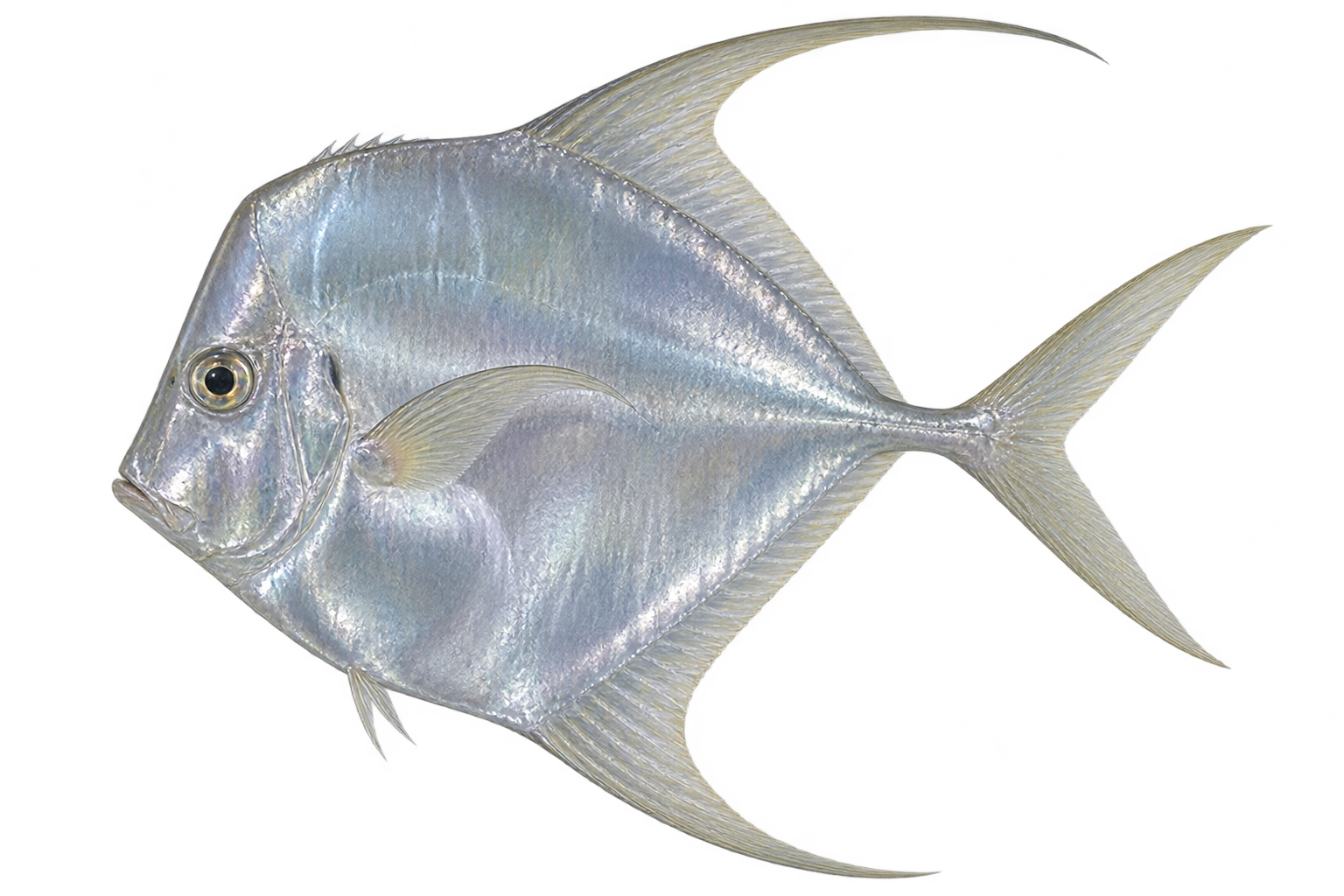
A lookdown has a startlingly thin, silvery body and a steep forehead that slopes toward a low-set mouth. The front of the soft dorsal and anal fins extends into long curved points. From the side it looks tall; when it turns edge-on, much of that apparent size disappears. Shape is more useful than reflected color.
Size and life stages
FishBase gives a common total length of about 35 centimeters, or 14 inches, and a reported maximum close to 48 centimeters. Juveniles carry especially long fin extensions, so the smallest fish can look the most theatrical. Include the body and fin outline in a photograph rather than judging size from the longest trailing fin ray.
Habitat and where to look
Adults use shallow coastal waters over sandy or hard bottoms. Younger fish may occur around beaches and estuaries, and bridge or piling settings can provide suitable viewing opportunities. Look across the sand as well as up toward structure. Do not confuse this habitat guidance with an instruction to enter boat channels or unsafe overhead spaces.
Range and local context
Lookdowns occur along the western Atlantic, including Florida and the Gulf region, with the range extending far to the north and south. Lake Worth Lagoon has a verified record. That local evidence justifies the archive entry but does not predict a school’s location today. Moving coastal fishes may appear briefly and then leave the area.
What is on the menu?
Small fishes, worms, shrimp and crabs are among the prey. The low mouth and body shape are worth noticing while the fish moves near the bottom. Observe natural feeding from a distance rather than disturbing sediment or presenting food. A fish facing downward is an identification clue, not proof that it is eating at that moment.
Daily habits and behavior
Lookdowns may travel in schools, small groups or pairs. Their reflective sides and coordinated turns can make a group seem to brighten and vanish as the viewing angle changes. Try holding a steady position and letting the fish turn naturally. A brief sequence of images can reveal the body outline more clearly than one dazzling silver frame.
Mating and the next generation
Females release eggs into the water column, and the eggs drift rather than being guarded on a reef nest. Details of wild reproductive behavior remain less well documented than the familiar adult appearance. This profile therefore does not assign a Palm Beach spawning calendar or treat every close-swimming pair as a reproductive event.
Look-alikes and identification traps
Atlantic moonfish are the main local comparison. Lookdowns have the especially steep head profile and long leading lobes on the rear dorsal and anal fins. Very young fish and incomplete views require care. A photograph that includes the forehead, mouth and full fin outline is more useful than a cropped silver flank or an isolated tail.
Observe without disturbing
Give the group room to pass and avoid surrounding it between divers or pilings. Keep good buoyancy over sand, since a sediment cloud hides both fish and nearby life. Do not chase a school for a better reflection. Share the sighting with its date and general location, and retain uncertainty if the diagnostic profile was never visible.
Harvest, protection and eating safety
Harvest allowed under default recreational rules
Can it be hunted or harvested?
Lookdown is covered by Florida’s default recreational limit: two fish or 100 pounds per person daily, whichever is more. No species-specific Florida recreational minimum size is listed. A saltwater license is required unless exempt; being sold for aquariums does not make this fish one of the specially listed live-collection-only species.
Florida seasons and areas
No regular species-specific Florida closed season is listed. Check the fishing site for local no-take, park and equipment restrictions. Do not substitute permit or pompano limits simply because these fishes are all in the jack family.
Can it be speared?
Spearfishing is allowed where the method and location are lawful. The general Florida exclusions around beaches, fishing piers, bridges, jetties and protected areas still apply.
Is it safe to eat?
Lookdown appears in Florida DOH fish-consumption guidance, but edibility is not an unlimited-meal recommendation. Use the current advisory for the catch location and consumer group. Keep fish cold and cook to 145°F; cooking does not eliminate mercury.
Before you act: This recreational overview is not permission to collect or spear at your dive site. Confirm the species, date, management area, state or federal waters, gear, licenses and current local closures. A fish illustration cannot establish an identification or guarantee seafood safety.
Official rules and health guidance
- UF/Florida Sea Grant lookdown guide, page 62
- FWC default recreational limits
- FWC regulated marine-life collection
- FWC recreational saltwater licenses
- FWC spearfishing restrictions
- Florida DOH linked fish-advisory booklet
- Florida DOH eating healthy seafood
- Florida DOH local fish advisory search
- FDA safe seafood handling
- FDA/EPA questions about mercury and preparation
Reviewed 2026-11-10. Rules and advisories can change; check the linked authorities before harvesting or eating.
Sources and review
Reviewed 2026-11-10.
Make your next dive happen
Dive With Us
Explore local charters and plan a dive suited to your experience.
View dive calendarTrain With Us
Build your fish identification, buoyancy and diving skills.
Explore trainingTravel With Us
Discover upcoming dive adventures and trip details.
Explore dive travelShop With Us
Browse equipment for your diving and ask our team for help choosing.
Explore dive gearReview current dates, availability, prices, inclusions and requirements on each listing before booking or buying.
Call us now
Ask about fish identification training
Reef Fish Identification
Ask about dates, prerequisites or your next step. An inquiry does not reserve a place. Please provide your own contact details; do not include medical, payment or a child's personal information.
We use these details to respond to your inquiry. This form does not sign you up for marketing.
Explore more with Stuart Scuba
Open Water course options · Advanced Adventure training · Technical training · Professional training · All courses · Local dives · Dive trips · Facebook · Instagram · YouTube
Your surface-interval essentials
Questions for Stuart Scuba? info@stuartscuba.com
Check the Stuart Scuba Weather Center · Play scuba trivia
Weather and wildlife vary. Confirm current conditions, trip requirements and departure details with the operator.
Plan Your Next Dive with Stuart Scuba
Dive With Us
Explore upcoming local charters and choose a dive that fits your experience.
Before you book
Check the individual listing for departure time, requirements and availability.
Travel With Us
Find upcoming dive adventures and start planning your next trip.
Plan your trip
Review dates, inclusions and trip details on the travel calendar.
Stay Connected with Stuart Scuba
 Follow pageShare
YouTube
SubscribeWatch & shareFollow on InstagramView & share post
Follow company news, training updates, and dive stories.
Follow on LinkedInGoogle Reviews
See Stuart Scuba’s current Google rating and review count below. Open the listing in Google Maps to browse customer reviews.



