

Fish identification archive / Longlure Frogfish
Longlure Frogfish
Antennarius multiocellatus · Antennariidae
I saw this
Spotted this fish? Share the guide with your dive buddies. Review your caption before posting.
For Instagram, copy the caption and link into your own post or message. Nothing is posted automatically and this does not record a verified sighting.
Identification
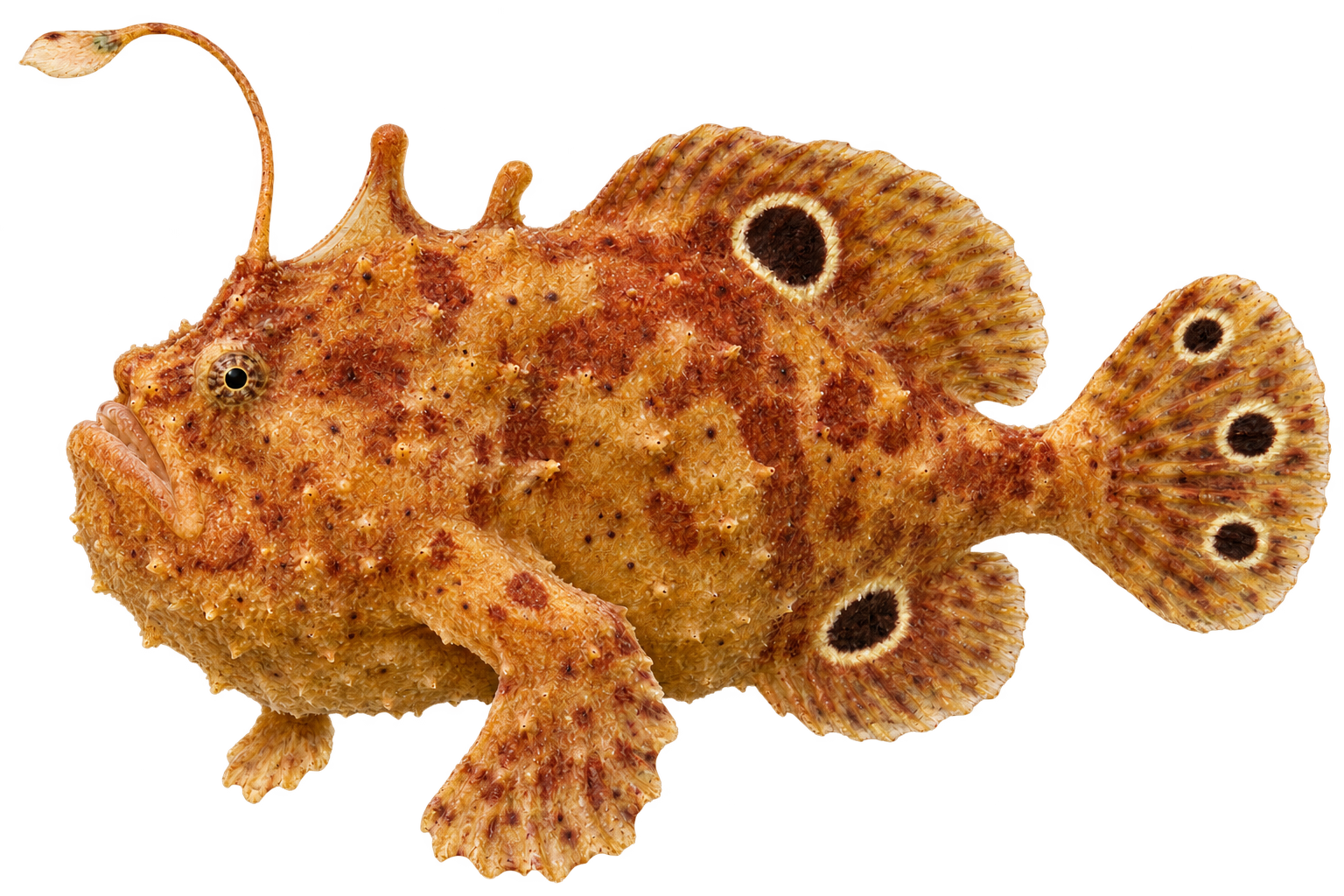
A longlure frogfish can resemble a sponge until its eye or oversized mouth gives it away. Its rounded body has rough skin, a large upward-directed mouth and limb-like pectoral fins. Color is highly variable, so yellow, red or brown alone cannot identify the species. Look for the combination of a long lure, prominent dark eye-like spots and fin arrangement. The fishing pole is a modified dorsal spine; Smithsonian describes it as roughly twice the length of the second dorsal spine. Compare photographs with the Smithsonian identification account, rather than relying on color.
Florida habitat and size
This is a reef-associated bottom fish within the western Atlantic fauna, including Florida. It shelters around reef structure and sponges. Smithsonian lists a maximum of 14.3 cm, while the Florida Museum describes lengths around 11 cm; these summaries should not become a rigid identification cutoff. A regional range does not establish a sighting at a specific Stuart Scuba dive site.
The National Park Service fish list for Biscayne includes this species among fishes reported in the park. This supports regional occurrence, not present-day abundance or a guaranteed sighting.
Feeding and reproduction
The fish waits for prey to come within reach and works its lure to draw attention. Small fishes form much of its diet, with crustaceans also taken. Its paired fins let it reposition slowly along the bottom. During reproduction, eggs leave the female in a buoyant, ribbon-like mass often called an egg raft. The Florida Museum profile describes this unusual reproductive package and the animal’s sponge-like camouflage.
Observe responsibly
Frogfishes are regulated marine-life species in Florida. Harvest is prohibited within the defined Blue Heron Bridge Special Marine Life Area; collecting in Biscayne National Park requires the park’s collecting permit. Check current FWC rules and the exact site before any collection. FWC marine-life rules
Keep buoyancy clear of the bottom and give a concealed fish room. Never reposition it, poke it to reveal the lure, or supply food for a photograph. A hiding animal is already displaying its normal behavior. Avoid an “open harvest” label: any collection requires checking current rules for the animal, method and exact site. This page is an identification guide, not a collection permit.
Quick quiz
- Is the fishing pole an antenna? No. It is a modified dorsal-fin spine.
- Can color alone prove the species? No. Color varies greatly.
- Do its eggs remain fixed to a rock? They are released in a buoyant egg mass.
Blue Heron Bridge observation
Matthew Sullivan’s 2023 Blue Heron Bridge (BHB) portfolio reports longlure frogfish at this Riviera Beach dive site. This is a site-specific observation report, not a guarantee of a sighting. Observe without disturbing the animal or its habitat. Matthew Sullivan’s Blue Heron Bridge portfolio
Plan responsible observation with our Blue Heron Bridge shore-dive guide.
Make your next dive happen
Dive With Us
Explore local charters and plan a dive suited to your experience.
View dive calendarTrain With Us
Build your fish identification, buoyancy and diving skills.
Explore trainingTravel With Us
Discover upcoming dive adventures and trip details.
Explore dive travelShop With Us
Browse equipment for your diving and ask our team for help choosing.
Explore dive gearReview current dates, availability, prices, inclusions and requirements on each listing before booking or buying.
Call us now
Ask about fish identification training
Reef Fish Identification
Ask about dates, prerequisites or your next step. An inquiry does not reserve a place. Please provide your own contact details; do not include medical, payment or a child's personal information.
We use these details to respond to your inquiry. This form does not sign you up for marketing.
Explore more with Stuart Scuba
Open Water course options · Advanced Adventure training · Technical training · Professional training · All courses · Local dives · Dive trips · Facebook · Instagram · YouTube
Your surface-interval essentials
Questions for Stuart Scuba? info@stuartscuba.com
Check the Stuart Scuba Weather Center · Play scuba trivia
Weather and wildlife vary. Confirm current conditions, trip requirements and departure details with the operator.
Plan Your Next Dive with Stuart Scuba
Dive With Us
Explore upcoming local charters and choose a dive that fits your experience.
Before you book
Check the individual listing for departure time, requirements and availability.
Travel With Us
Find upcoming dive adventures and start planning your next trip.
Plan your trip
Review dates, inclusions and trip details on the travel calendar.
Stay Connected with Stuart Scuba
 Follow pageShare
YouTube
SubscribeWatch & shareFollow on InstagramView & share post
Follow company news, training updates, and dive stories.
Follow on LinkedInGoogle Reviews
See Stuart Scuba’s current Google rating and review count below. Open the listing in Google Maps to browse customer reviews.



