

Fish identification archive / Long-spined Sea Urchin
Long-spined Sea Urchin
Diadema antillarum
I saw this
Spotted this marine animal? Share the guide with your dive buddies. Review your caption before posting.
For Instagram, copy the caption and link into your own post or message. Nothing is posted automatically and this does not record a verified sighting.
Fun facts for your next surface interval
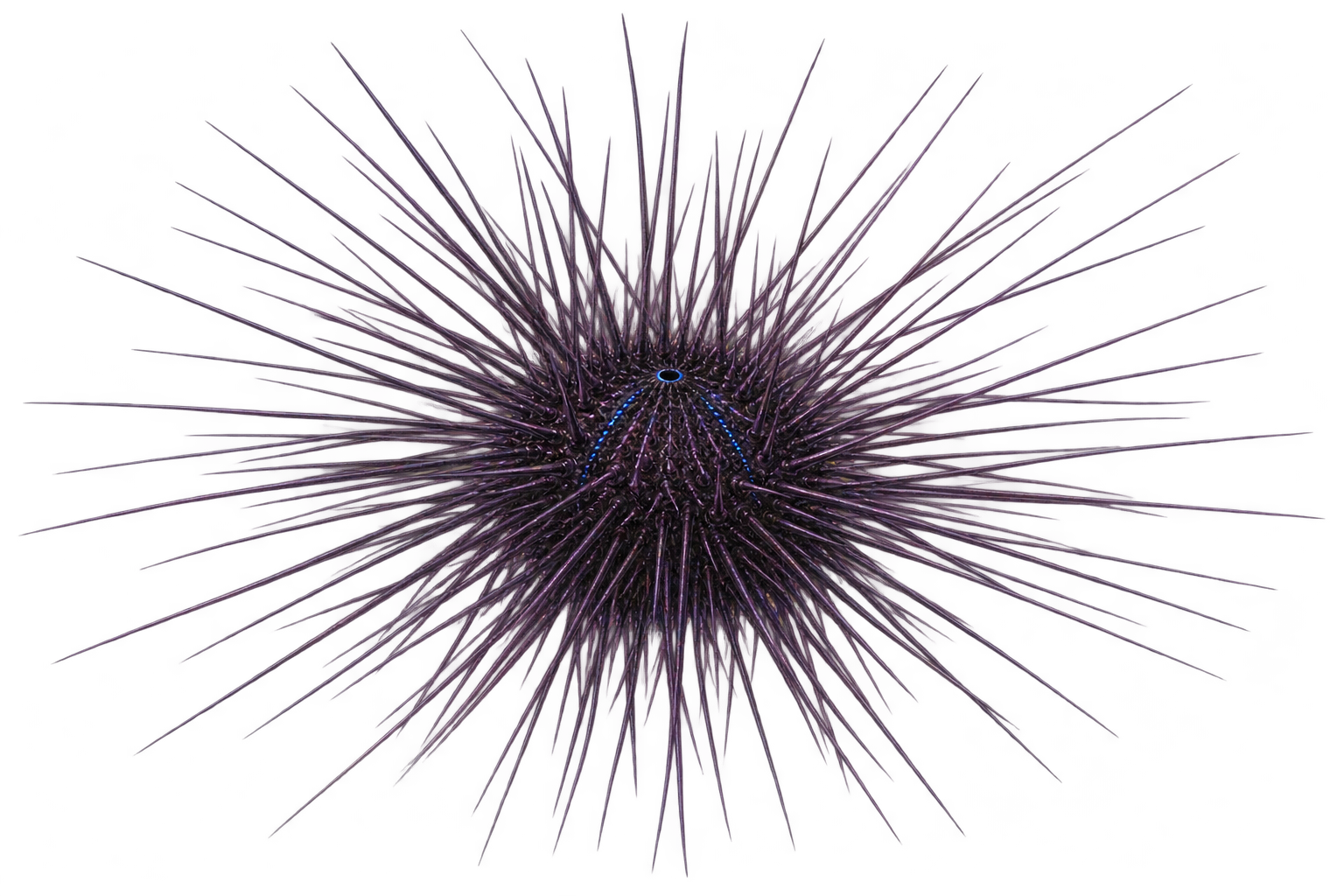
- Most of the dramatic silhouette is spines, not body.
- Its grazing makes a small animal important in the competition between reef algae and corals.
- Baby long-spined urchins can wear striped spines even when familiar adults look almost entirely black.
Florida and local context
Florida reefs, including the Florida Keys: Florida research and FWC accounts confirm regional occurrence; no named Palm Beach site is promised.
Documented regional presence is not a guarantee of an encounter or a measure of how common this animal is at your dive site.
How to recognize this animal
Extremely long, slender spines radiate from a relatively small rounded body. Adults are often dark, although pale individuals occur; young animals may have distinctly banded spines. A bright ring around the raised anal opening can help orientation, but never approach close enough to brush the spines.
Size and life stages
The rigid central skeleton, called the test, can approach 10 centimeters in diameter. Spines extend far beyond it and make the entire animal much wider. Report test diameter and overall span separately, because a large spiny silhouette is not a 50-centimeter body.
Habitat and where to look
Reef crevices and rocky surfaces provide shelter, with adjacent grazing areas supporting feeding. The animal may also occur in seagrass-associated habitat. Its needles can project beyond a dark hole, so careful buoyancy and awareness of where hands and knees are going are important.
Range and local context
This western Atlantic urchin occurs on Florida reefs and throughout the Caribbean region. Florida Keys research documents both restoration interest and continuing challenges. Historical descriptions of abundance should not be mistaken for present-day conditions after major regional die-offs and uneven recovery.
What is on the menu?
It grazes algae from hard surfaces, helping limit competition between algae and corals. That ecological role has made the species a focus of reef-restoration research. Grazing is a process involving many organisms, so one urchin cannot be described as single-handedly restoring an entire reef.
Daily habits and behavior
Tube feet and movable spines help the animal move and interact with the bottom. Many individuals remain sheltered during daylight. The spines are fragile and can break in skin, making contact hazardous to a diver and harmful to the urchin as well. The central test is a rigid skeleton covered by living tissue, and the spines move at their attachments rather than forming one fixed cage. Tube feet reach between them to contact the substrate. This arrangement allows an animal that looks like an immobile pincushion to move and graze. After death, the spines can detach, leaving a very different-looking bare test.
Mating and the next generation
Eggs and sperm are released into the water, and larvae develop before settling. When adults are sparse, successful fertilization can become more difficult. This connection between population density and reproduction helps explain why apparently suitable habitat alone may not ensure quick recovery.
Look-alikes and identification traps
Shorter-spined Florida urchins differ greatly in outline. Juvenile banding and unusual adult color can confuse an identification based only on black spines.
Observe without disturbing
Use overall proportions and regional references, while maintaining enough distance that no detail requires handling the animal. Protected from Florida recreational harvest: leave this urchin in place. Do not move it to a supposedly better reef, clip spines or collect an individual for an aquarium. Keep fins, hoses and camera equipment clear of the spines and allow room for safe passage. Dive with Stuart Scuba to explore Florida marine life with an emphasis on careful observation. Ask about current conditions and an appropriate dive plan; wildlife sightings remain unpredictable.
Harvest, protection and eating safety
PROTECTED: recreational harvest prohibited in Florida
Can it be hunted or harvested?
No. Florida expressly prohibits harvesting long-spined sea urchin (Diadema antillarum). Do not take one for an aquarium, food, a souvenir or a staged photograph on shore. The five-per-species limit for some other marine-life organisms does not override this prohibition. Observe it in place without lifting, breaking spines, detaching tube feet or removing habitat. The prohibition also covers possession and landing, not just capture.
Florida seasons and areas
No open recreational season: the Florida prohibition is year-round. The regulated marine-life framework covers adjacent federal waters as specified by the rules, and parks or sanctuary zones can add protections. Blue Heron Bridge is also closed to regulated marine-life collection. Do not infer a live-animal exemption from rules about empty shells.
Can it be speared?
No. Harvest is prohibited regardless of method, including hands, nets and spears.
Is it safe to eat?
Do not collect this animal for food. It is protected from recreational harvest in Florida. An edible relative, a restaurant dish, or customary use elsewhere does not make a wild Florida animal legal or safe to eat.
Before you act: This recreational overview is not permission to collect or spear at your dive site. Confirm the species, date, management area, state or federal waters, gear, licenses and current local closures. Identification artwork cannot establish an identification or guarantee seafood safety.
Official rules and health guidance
- FWC: Recreational Marine Life
- Florida Administrative Code: Marine Life, Chapter 68B-42
- NOAA: Florida Keys Sanctuary Marine Zones
- FDA: Selecting and Serving Seafood Safely
- Florida Department of Health: Seafood Poisoning
- FAC 68B-42.003: prohibition of harvest, possession and landing (LII reproduction)
Reviewed 2026-11-10. Rules and advisories can change; check the linked authorities before harvesting or eating.
Sources and review
Reviewed 2026-11-10.
Make your next dive happen
Dive With Us
Explore local charters and plan a dive suited to your experience.
View dive calendarTrain With Us
Build your fish identification, buoyancy and diving skills.
Explore trainingTravel With Us
Discover upcoming dive adventures and trip details.
Explore dive travelShop With Us
Browse equipment for your diving and ask our team for help choosing.
Explore dive gearReview current dates, availability, prices, inclusions and requirements on each listing before booking or buying.
Call us now
Ask about marine life identification
Marine Life Identification
Ask about dates, prerequisites or your next step. An inquiry does not reserve a place. Please provide your own contact details; do not include medical, payment or a child's personal information.
We use these details to respond to your inquiry. This form does not sign you up for marketing.
Explore more with Stuart Scuba
Open Water course options · Advanced Adventure training · Technical training · Professional training · All courses · Local dives · Dive trips · Facebook · Instagram · YouTube
Your surface-interval essentials
Questions for Stuart Scuba? info@stuartscuba.com
Check the Stuart Scuba Weather Center · Play scuba trivia
Weather and wildlife vary. Confirm current conditions, trip requirements and departure details with the operator.
Plan Your Next Dive with Stuart Scuba
Dive With Us
Explore upcoming local charters and choose a dive that fits your experience.
Before you book
Check the individual listing for departure time, requirements and availability.
Travel With Us
Find upcoming dive adventures and start planning your next trip.
Plan your trip
Review dates, inclusions and trip details on the travel calendar.
Stay Connected with Stuart Scuba
 Follow pageShare
YouTube
SubscribeWatch & shareFollow on InstagramView & share post
Follow company news, training updates, and dive stories.
Follow on LinkedInGoogle Reviews
See Stuart Scuba’s current Google rating and review count below. Open the listing in Google Maps to browse customer reviews.



