

Fish identification archive / Loggerhead Sea Turtle
Loggerhead Sea Turtle
Caretta caretta
Fun facts for your next surface interval
- No shell game: a loggerhead cannot pull its head and flippers completely inside its shell.
- Vacation mileage: a Melbourne Beach tagged loggerhead reached Cuba about 400 miles away eleven days later.
- The sand sets the scene: the temperature of nesting sand helps determine whether hatchlings are male or female.
Florida and local context
Florida coastal waters and nesting beaches: Florida nesting and coastal waters
Documented regional presence is not a guarantee of an encounter or a measure of how common this animal is at your dive site.
How to recognize this animal
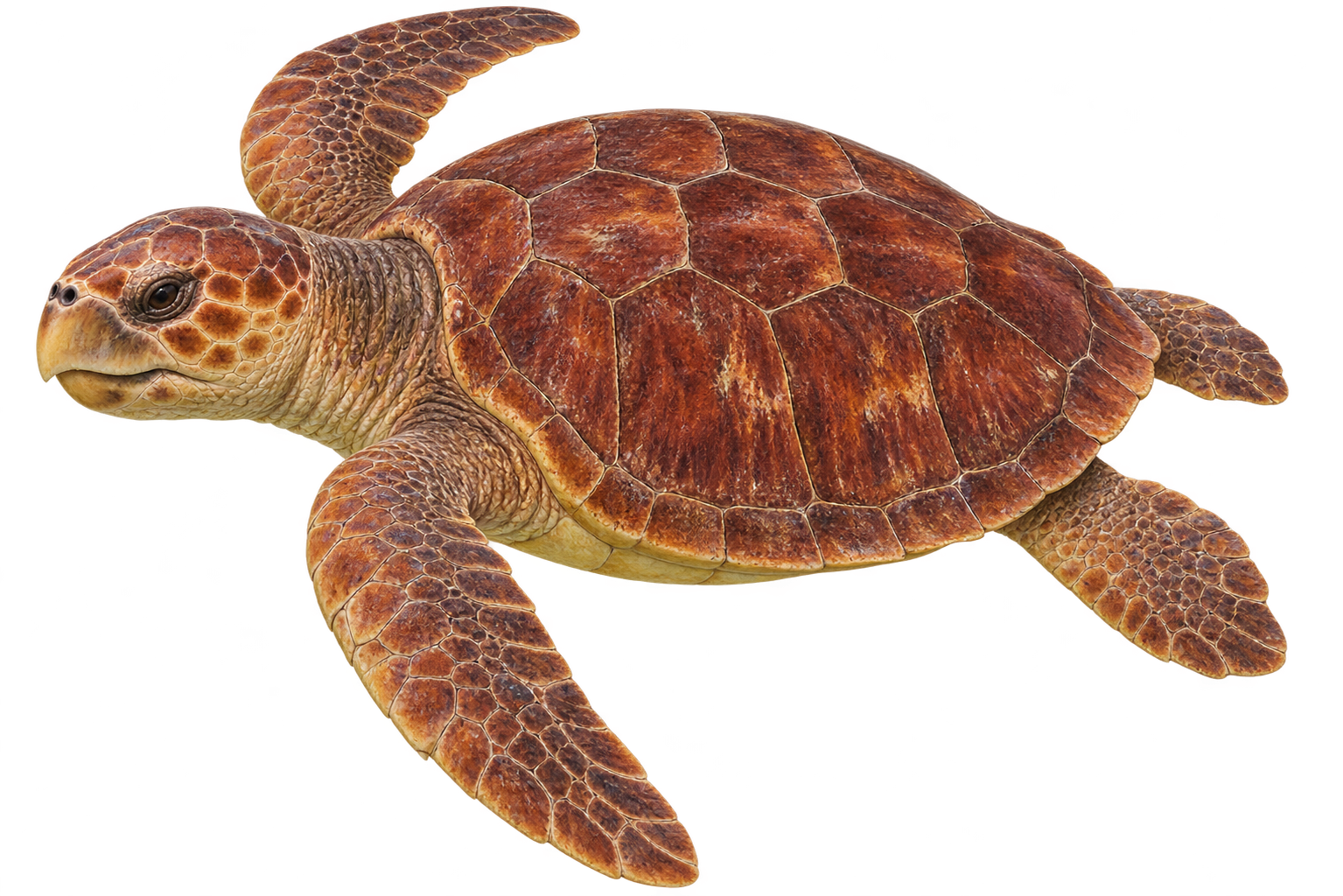
A disproportionately large, blocky head is the first clue. The adult's upper shell is reddish brown and somewhat heart-shaped, broad toward the shoulders and narrowing behind. Underneath it is usually pale yellow. Five lateral scutes run along each side of the carapace. Check head proportions and shell structure together rather than identifying a turtle from brown coloration alone.
Size and life stages
FWC describes an average adult with a shell about one yard long, approximately 91 centimeters, and a weight near 275 pounds. NOAA gives a broader adult length range of 2.5–3.5 feet. Shell length is the useful field comparison, not flipper span. A small loggerhead is a juvenile, not a separate dwarf species; adults vary considerably.
Habitat and where to look
Different life stages use different parts of the sea. Hatchlings and young juveniles spend years in open-ocean habitats before moving into coastal feeding grounds. Older animals forage over bottom habitats that support hard-shelled prey. Sandy Florida beaches provide nesting habitat, but a turtle swimming beside a reef is not necessarily there to breed or nest.
Range and local context
Loggerheads occur in temperate and subtropical seas worldwide. Florida's Atlantic and Gulf beaches support a major nesting aggregation, and coastal waters support feeding juveniles and adults. This profile verifies Florida occurrence, not a particular Palm Beach dive-site census. Nesting activity on a nearby beach does not establish how many loggerheads will be encountered underwater on any given day.
What is on the menu?
Powerful jaw muscles make a loggerhead well equipped to crush mollusks and crustaceans. Coastal juveniles and adults eat bottom-dwelling animals including conchs, whelks, crabs and horseshoe crabs. Young oceanic turtles have a broader drifting-food menu. Floating plastic can be mistaken for food, so debris removal on shore helps address a genuine feeding hazard rather than merely improving scenery.
Daily habits and behavior
A loggerhead must surface to breathe even though it spends most of its life at sea. Adults may migrate hundreds or thousands of miles between feeding and breeding areas. FWC records a turtle tagged at Melbourne Beach reaching Cuba roughly 400 miles away in eleven days. A resting or slowly swimming individual can therefore be an accomplished long-distance traveler.
Mating and the next generation
Females generally mature at about 35 years and return to the region where they hatched to nest. They lay several clutches in a breeding season, commonly around 100 eggs each, rather than one enormous nest. Incubation lasts roughly two months. Sand temperature influences hatchling sex, and artificial beachfront light can draw emerging young away from the sea.
Look-alikes and identification traps
A green turtle has a smaller-looking head and four lateral shell scutes per side rather than the loggerhead's usual five. Hawksbills have a more sharply projecting beak and overlapping shell plates. Kemp's ridleys have a rounder, often nearly circular carapace. Perspective, algae and poor visibility can hide these clues; a clear side and upper-shell photograph is more useful than color alone.
Observe without disturbing
Give a loggerhead room to reach the surface and do not follow it into a resting space. NOAA advises against touching, feeding or disturbing turtles, nests and hatchlings. Watch for surfacing turtles from boats and slow down. On nesting beaches, keep lights off and remove chairs and obstacles; a close photograph is not worth interrupting a nesting female.
Harvest, protection and eating safety
Protected: no recreational take
Florida and applicable federal protection apply year-round: no ordinary recreational harvest season, open-area exception or spearing allowance. Nesting, breeding or viewing seasons do not authorize take. This is not a lawful recreational food target.
This color is a qualified summary, not permission to collect or a guarantee that a particular catch is safe to eat. Read the current rules and health guidance below.
Threatened Northwest Atlantic DPS; protected, no recreational take
Can it be hunted or harvested?
Loggerhead Sea Turtle is not a recreational harvest target. NOAA lists the Northwest Atlantic loggerhead distinct population segment as threatened. Florida’s Marine Turtle Protection Act also protects turtles, eggs and nests. Recreational taking, possession and disturbance are prohibited; scientific or conservation permits are separate authorizations, not ordinary fishing privileges.
Florida seasons and areas
There is no Florida recreational harvest season, open area, bag limit or edible-size exception for this protected animal. Protection applies year-round in Florida and under applicable federal law. Nesting months describe reproduction, not a legal harvest window. Park, refuge and beach restrictions can add further protections.
Can it be speared?
No. Spearing, shooting, injuring or killing this protected sea turtle is not an authorized recreational activity. An otherwise open spearfishing area does not create an exception for the animal.
Is it safe to eat?
Not a lawful recreational food target. This guide provides no assurance that its meat, eggs or other tissues are safe to eat; protected status and the absence of a named consumption advisory are not a food-safety assessment.
Before you act: This recreational overview is not permission to collect or spear at your dive site. Confirm the species, date, management area, state or federal waters, gear, licenses and current local closures. Identification artwork cannot establish an identification or guarantee seafood safety.
Official rules and health guidance
- NOAA Fisheries: Loggerhead Sea Turtle biology and current ESA status
- FWC: Loggerhead Sea Turtle Florida profile
- FWC: Marine Turtle Protection Act and protected sea turtles
Reviewed 2026-11-10. Rules and advisories can change; check the linked authorities before harvesting or eating.
Sources and review
Reviewed 2026-11-10.
Make your next dive happen
Dive With Us
Explore local charters and plan a dive suited to your experience.
View dive calendarTrain With Us
Build your fish identification, buoyancy and diving skills.
Explore trainingTravel With Us
Discover upcoming dive adventures and trip details.
Explore dive travelShop With Us
Browse equipment for your diving and ask our team for help choosing.
Explore dive gearReview current dates, availability, prices, inclusions and requirements on each listing before booking or buying.
Call us now
Ask about marine life identification
Marine Life Identification
Ask about dates, prerequisites or your next step. An inquiry does not reserve a place. Please provide your own contact details; do not include medical, payment or a child's personal information.
We use these details to respond to your inquiry. This form does not sign you up for marketing.
Explore more with Stuart Scuba
Open Water course options · Advanced Adventure training · Technical training · Professional training · All courses · Local dives · Dive trips · Facebook · Instagram · YouTube
Your surface-interval essentials
Questions for Stuart Scuba? info@stuartscuba.com
Check the Stuart Scuba Weather Center · Play scuba trivia
Weather and wildlife vary. Confirm current conditions, trip requirements and departure details with the operator.
Plan Your Next Dive with Stuart Scuba
Dive With Us
Explore upcoming local charters and choose a dive that fits your experience.
Before you book
Check the individual listing for departure time, requirements and availability.
Travel With Us
Find upcoming dive adventures and start planning your next trip.
Plan your trip
Review dates, inclusions and trip details on the travel calendar.
Stay Connected with Stuart Scuba
 Follow pageShare
YouTube
SubscribeWatch & shareFollow on InstagramView & share post
Follow company news, training updates, and dive stories.
Follow on LinkedInGoogle Reviews
See Stuart Scuba’s current Google rating and review count below. Open the listing in Google Maps to browse customer reviews.



