

Fish identification archive / Little Tunny
Little Tunny
Euthynnus alletteratus · Scombridae
I saw this
Spotted this fish? Share the guide with your dive buddies. Review your caption before posting.
For Instagram, copy the caption and link into your own post or message. Nothing is posted automatically and this does not record a verified sighting.
What to look for
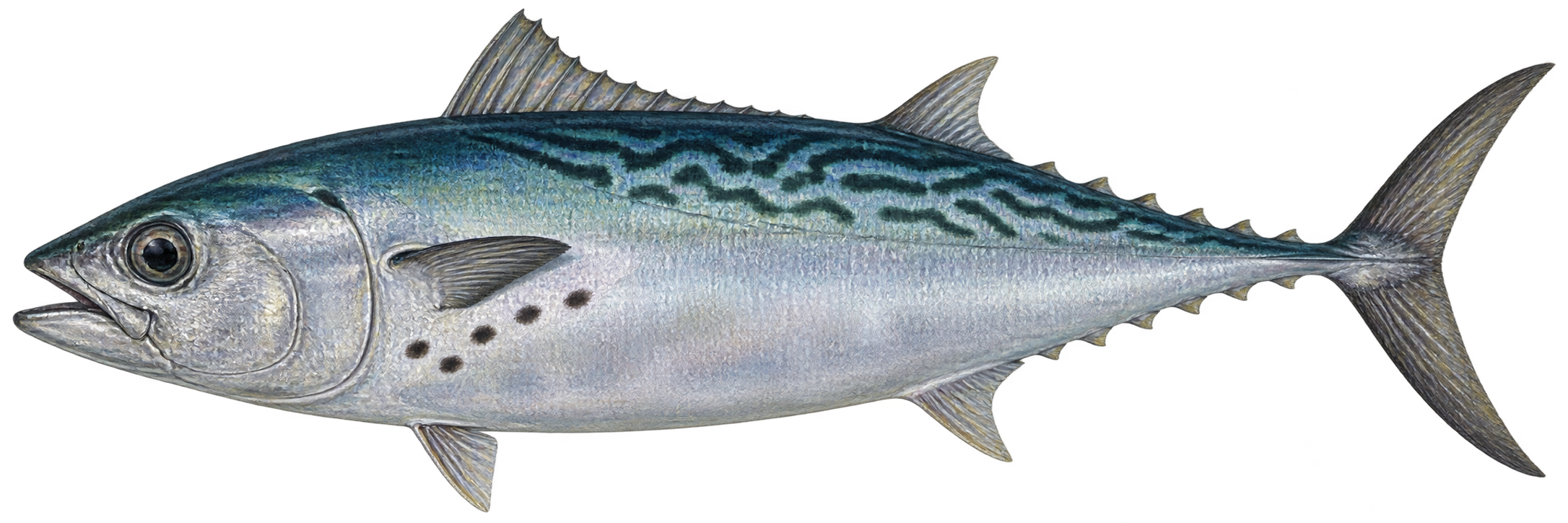
Little tunny combine a compact tuna-shaped body with two useful markings: broken, wavy lines on the upper rear body and a cluster of dark spots below the pectoral region. Their bellies lack skipjack’s lengthwise dark bands. The pectoral fins are short, and the narrow tail base leads into a strong crescent-shaped tail. FWC little tunny profile
The names bonito and false albacore are widely used, but a nickname is not a scientific identification. Atlantic bonito and albacore are different fishes. For a sighting record, photograph both the rear-back pattern and the area below the pectoral fin. Either feature may disappear behind another fish in a tight school.
Range and daily life
Little tunny occur in Florida’s coastal and offshore waters. The Florida Museum describes a western Atlantic distribution extending from Massachusetts to Brazil, including the Gulf and Caribbean. Schools use continental-shelf waters and may mix with other members of the mackerel family. This distribution supports regional inclusion without establishing a regular visitor at any named dive site. Florida Museum distribution and biology
Small fishes and invertebrates are important prey. Reproduction involves batches of buoyant eggs released into the water. The museum reports Atlantic spawning from April through November; that is a broad regional interval, not a forecast for every Florida coast.
FWC gives a size reaching 48 inches, without specifying total or fork length in the short profile. Treat it as a general size reference, not a measurement suitable for a precise comparison or a legal limit.
Three memorable details
- The scribbled back and spotted underside form a two-part identification clue.
- Despite the nickname false albacore, this is a real member of the mackerel family, just not an albacore.
- Little tunny lack a swim bladder: their internal equipment differs from many familiar reef fishes. Museum anatomy and names
Observation and fishing caution
Let a school pass without feeding, touching or driving it toward another diver. When surface action attracts boats and birds, stay with the dive plan rather than joining the commotion.
FWC distinguishes tunas managed federally as highly migratory species from its other tuna rules. Do not apply yellowfin or blackfin limits to little tunny by analogy. Check the species entry, jurisdiction, gear and local protected-area restrictions before fishing. The term unregulated does not mean unlimited harvest; Florida has default recreational limits. FWC tuna rules
Make your next dive happen
Dive With Us
Explore local charters and plan a dive suited to your experience.
View dive calendarTrain With Us
Build your fish identification, buoyancy and diving skills.
Explore trainingTravel With Us
Discover upcoming dive adventures and trip details.
Explore dive travelShop With Us
Browse equipment for your diving and ask our team for help choosing.
Explore dive gearReview current dates, availability, prices, inclusions and requirements on each listing before booking or buying.
Call us now
Ask about fish identification training
Reef Fish Identification
Ask about dates, prerequisites or your next step. An inquiry does not reserve a place. Please provide your own contact details; do not include medical, payment or a child's personal information.
We use these details to respond to your inquiry. This form does not sign you up for marketing.
Explore more with Stuart Scuba
Open Water course options · Advanced Adventure training · Technical training · Professional training · All courses · Local dives · Dive trips · Facebook · Instagram · YouTube
Your surface-interval essentials
Questions for Stuart Scuba? info@stuartscuba.com
Check the Stuart Scuba Weather Center · Play scuba trivia
Weather and wildlife vary. Confirm current conditions, trip requirements and departure details with the operator.
Plan Your Next Dive with Stuart Scuba
Dive With Us
Explore upcoming local charters and choose a dive that fits your experience.
Before you book
Check the individual listing for departure time, requirements and availability.
Travel With Us
Find upcoming dive adventures and start planning your next trip.
Plan your trip
Review dates, inclusions and trip details on the travel calendar.
Stay Connected with Stuart Scuba
 Follow pageShare
YouTube
SubscribeWatch & shareFollow on InstagramView & share post
Follow company news, training updates, and dive stories.
Follow on LinkedInGoogle Reviews
See Stuart Scuba’s current Google rating and review count below. Open the listing in Google Maps to browse customer reviews.



