

Fish identification archive / Lined Seahorse
Lined Seahorse
Hippocampus erectus
I saw this
Spotted this fish? Share the guide with your dive buddies. Review your caption before posting.
For Instagram, copy the caption and link into your own post or message. Nothing is posted automatically and this does not record a verified sighting.
Fun facts for your next surface interval
- No dental appointment needed: that little mouth is toothless.
- Dad has the nursery covered: developing young are carried in his pouch.
- Armor, not sequins: bony plates replace ordinary fish scales.
Palm Beach connection
Lake Worth Lagoon / Blue Heron Bridge: Verified species row in Florida Museum local checklist.
Documented regional presence is not a guarantee of an encounter or a measure of how common this fish is at your dive site.
How to recognize this fish
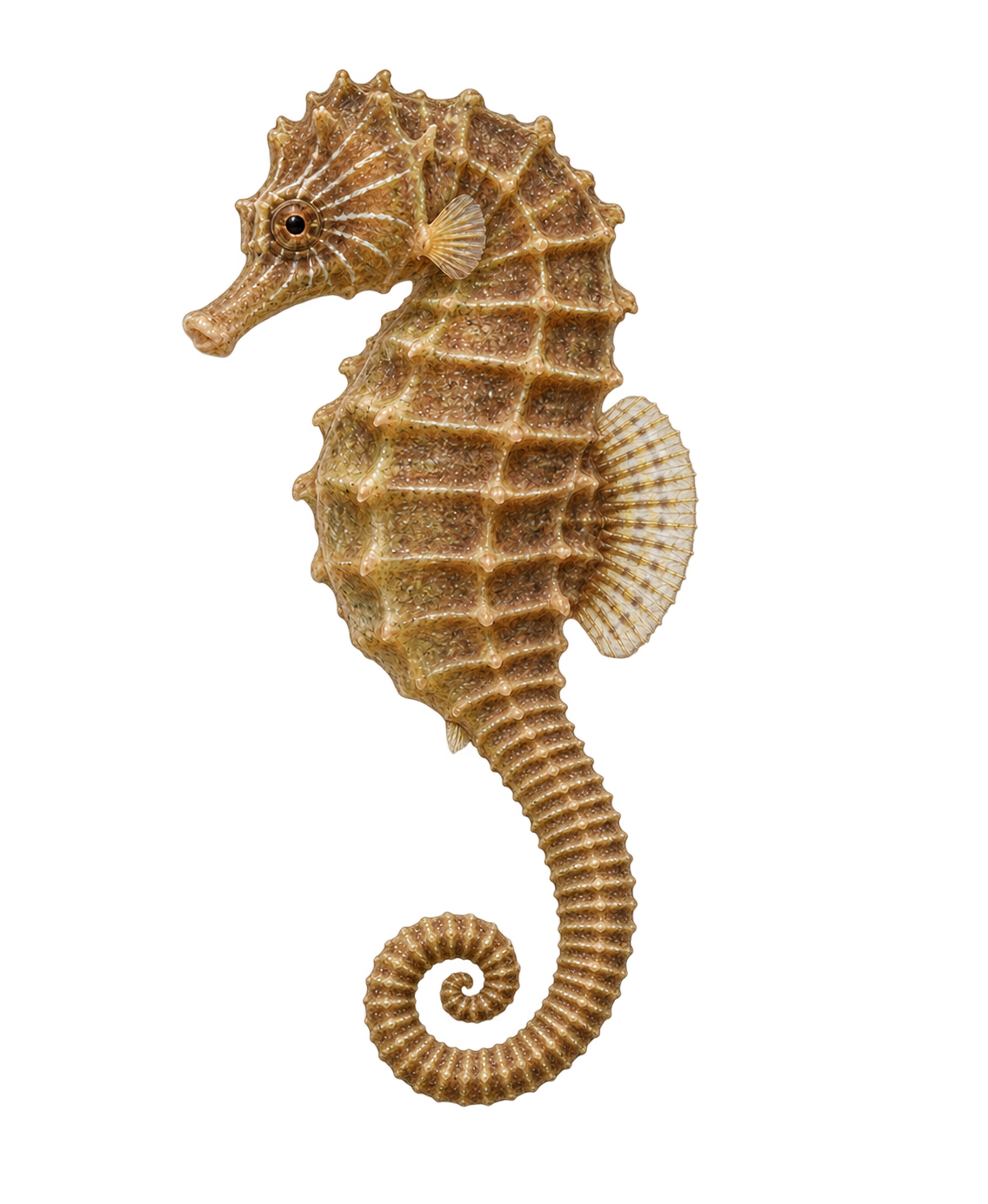
Lined Seahorse is generally deep-chested and more robust than Longsnout Seahorse. Look for a relatively short tubular snout, a low ridged or wedge-like coronet and pale lines radiating around the eye and across the cheek. Skin covers a series of bony rings rather than ordinary fish scales. Some individuals have skin flaps, and the range of colors makes a color-only identification unreliable.
Size and life stages
Smithsonian and Florida Museum both report a maximum around 19 cm. A curled seahorse occupies less vertical space than a straightened reference measurement, so an underwater estimate should stay approximate. Young animals share the basic horse-like profile but can be difficult to distinguish from other seahorses. Do not stretch a tail or bring a measuring device into contact with the animal.
Habitat and where to look
The species uses seagrass, macroalgae and reef-associated habitat, sometimes attaching to drifting vegetation or man-made structure. A holdfast is not merely a perch for a photograph: it lets the fish remain in position. Look slowly around suitable structure while controlling buoyancy, and avoid treating a patch that appears empty at first glance as permission to kneel or place equipment on it.
Range and local context
Lined Seahorse occurs in the western Atlantic, including Florida and the Caribbean. The museum's Lake Worth Lagoon inventory verifies the species, supplying the local evidence for this page. Broader southern range boundaries have taxonomic complications, so this guide does not need to settle every distant population in order to document its Palm Beach-region occurrence.
What is on the menu?
Small crustaceans and other tiny prey are sucked into the toothless mouth. A slow swimmer does not need to chase prey over long distances when suction feeding works at close range. Watch the snout and nearby water for short feeding movements. Food should never be offered to create an encounter or to keep a seahorse in place for a camera.
Daily habits and behavior
A grasping tail anchors the animal while small fins make controlled movements. It has a dorsal fin, paired pectoral fins and a tiny anal fin, but lacks pelvic and tail fins. That unusual anatomy is worth noticing without trying to make the animal swim. The familiar upright pose is genuine; it should not be exaggerated into an invented body plan in identification art.
Mating and the next generation
Males carry the developing eggs in a brood pouch after receiving them from a female. The pouch supports the embryos until the young can be released. Courtship may involve color changes and coordinated movements, but a swollen profile alone is not a sufficient photograph-based diagnosis of reproductive condition. This guide avoids fixed pregnancy durations that would imply identical timing under all conditions.
Look-alikes and identification traps
Compare Longsnout Seahorse using snout length relative to the head, chest depth, coronet and pale head markings together. A striped or spotted body is not enough on its own, and body posture can distort proportions in an angled image. A side-on photograph is useful, but species certainty should never require physically rotating or detaching the fish.
Observe without disturbing
Keep hands, lights and camera equipment from touching the seahorse or its holdfast. Avoid repeated attempts that make it turn away, and leave space rather than surrounding it with several divers. Keep sediment down with controlled fin movements. If it remains partly concealed, appreciate the camouflage and log a tentative sighting instead of clearing the vegetation to improve the view.
Harvest, protection and eating safety
Restricted marine life: live collection only; no spearing
Can it be hunted or harvested?
Lined Seahorse is regulated as tropical ornamental marine life, rather than an ordinary food-fishing target. Where collection is lawful, a recreational saltwater fishing license is required unless exempt; fish must be landed and kept alive with suitable aeration or circulation. No species-specific size limit is listed for lined seahorse. The daily limit is five of this species within 20 marine-life organisms total. A two-day possession limit also applies.
Florida seasons and areas
No recreational closed months are listed in the FWC marine-life rules reviewed. This does not make every location open: collection is prohibited within the designated Blue Heron Bridge dive-site boundary. Florida marine-life rules also apply in adjacent federal waters, on both coasts. Check park, refuge and Florida Keys sanctuary restrictions before collecting.
Can it be speared?
Prohibited. FWC expressly includes this ornamental-fish family in its no-spearing list.
Is it safe to eat?
Not recommended as food. This seahorse is managed under live ornamental-collection rules, and no species-specific Florida consumption-safety guidance was verified. A collection allowance does not establish edibility; observe and photograph seahorses at protected dive sites.
Before you act: This recreational overview is not permission to collect or spear at your dive site. Confirm the species, date, management area, state or federal waters, gear, licenses and current local closures. A fish illustration cannot establish an identification or guarantee seafood safety.
Official rules and health guidance
- FWC: Recreational Marine Life
- Florida Administrative Code: Marine Life, Chapter 68B-42
- FWC: Saltwater Recreational Licenses and Permits
- NOAA: Florida Keys National Marine Sanctuary Zones
- FWC: Spearing
- Florida Department of Health: Eating Healthy Seafood and Local Advisories
- Florida Department of Health: Seafood Poisoning
Reviewed 2026-11-10. Rules and advisories can change; check the linked authorities before harvesting or eating.
Sources and review
Reviewed 2026-11-10.
Make your next dive happen
Dive With Us
Explore local charters and plan a dive suited to your experience.
View dive calendarTrain With Us
Build your fish identification, buoyancy and diving skills.
Explore trainingTravel With Us
Discover upcoming dive adventures and trip details.
Explore dive travelShop With Us
Browse equipment for your diving and ask our team for help choosing.
Explore dive gearReview current dates, availability, prices, inclusions and requirements on each listing before booking or buying.
Call us now
Ask about fish identification training
Reef Fish Identification
Ask about dates, prerequisites or your next step. An inquiry does not reserve a place. Please provide your own contact details; do not include medical, payment or a child's personal information.
We use these details to respond to your inquiry. This form does not sign you up for marketing.
Explore more with Stuart Scuba
Open Water course options · Advanced Adventure training · Technical training · Professional training · All courses · Local dives · Dive trips · Facebook · Instagram · YouTube
Your surface-interval essentials
Questions for Stuart Scuba? info@stuartscuba.com
Check the Stuart Scuba Weather Center · Play scuba trivia
Weather and wildlife vary. Confirm current conditions, trip requirements and departure details with the operator.
Plan Your Next Dive with Stuart Scuba
Dive With Us
Explore upcoming local charters and choose a dive that fits your experience.
Before you book
Check the individual listing for departure time, requirements and availability.
Travel With Us
Find upcoming dive adventures and start planning your next trip.
Plan your trip
Review dates, inclusions and trip details on the travel calendar.
Stay Connected with Stuart Scuba
 Follow pageShare
YouTube
SubscribeWatch & shareFollow on InstagramView & share post
Follow company news, training updates, and dive stories.
Follow on LinkedInGoogle Reviews
See Stuart Scuba’s current Google rating and review count below. Open the listing in Google Maps to browse customer reviews.



