

Fish identification archive / Lettered Olive
Lettered Olive
Oliva sayana · Olividae
I saw this
Spotted this marine life? Share the guide with your dive buddies. Review your caption before posting.
For Instagram, copy the caption and link into your own post or message. Nothing is posted automatically and this does not record a verified sighting.
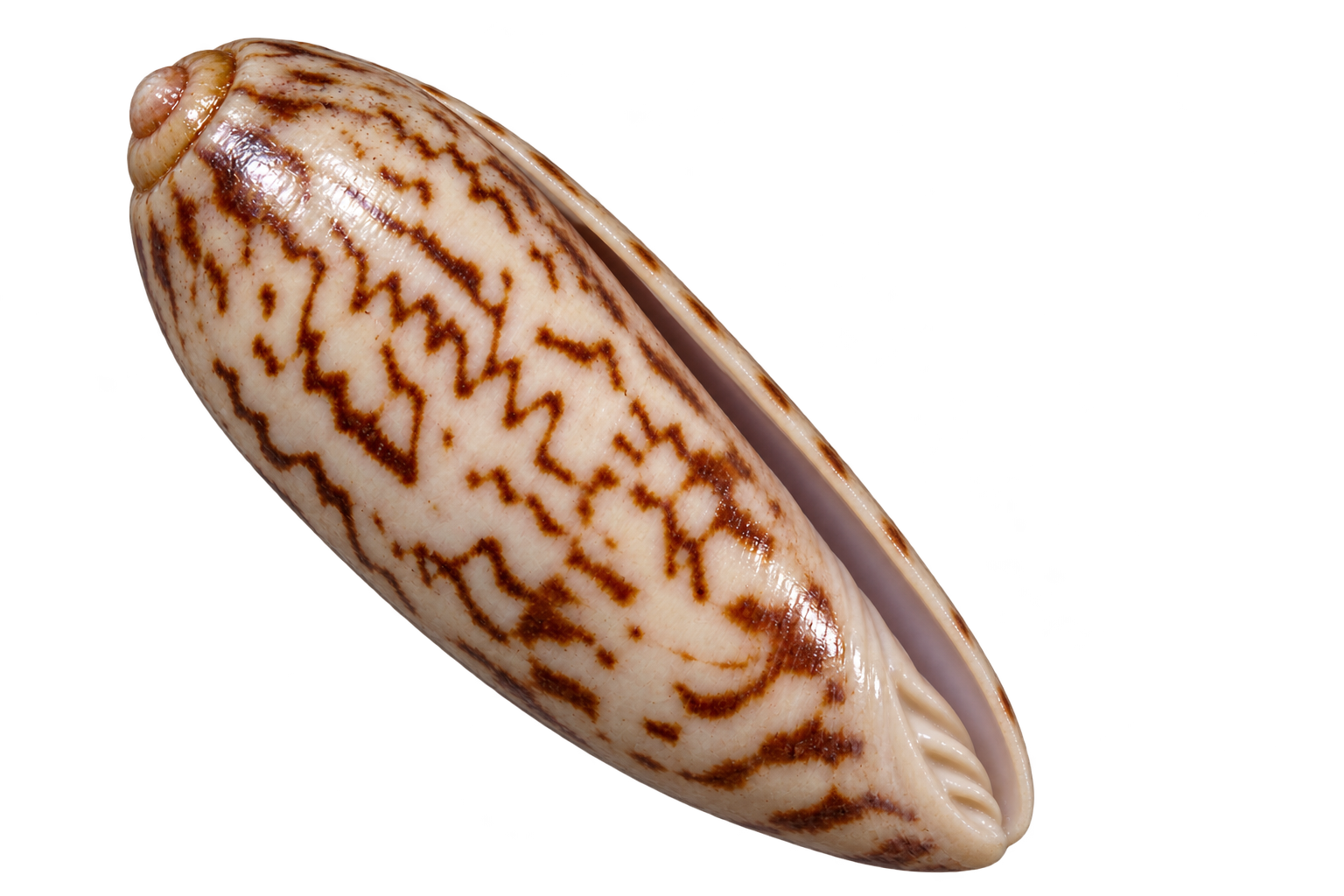
The lettered olive, Oliva sayana, has a smooth, cylindrical shell with a very short spire and a long, narrow opening. Brown markings can resemble irregular handwriting across the pale surface. The glossy finish is a natural feature of the shell, not evidence that someone polished it. Compare the overall proportions and opening as well as the pattern.
An Atlantic Florida animal
Biscayne National Park’s published mollusk inventory documents the lettered olive within the park. That provides a specific Atlantic South Florida context, while broader accounts describe shallow sandy habitat along the southeastern coast. It does not establish current abundance at every beach, inlet or dive site from Vero Beach to Key Largo.
The important habitat is sand, not an animal fixed to coral. A living olive can move partly beneath the surface, leaving only a siphon visible. An empty beach shell is useful for learning shell characters, but its location is not automatically the location of a living population. Record the circumstances of each observation.
Food and movement
Lettered olives are predators of small animals, including clams and crustaceans. The Tybee Island Marine Science Center specifically identifies coquinas and other small clams as prey. A snail moving beneath the sand is therefore not simply hiding: that bottom habitat is also part of its feeding environment.
Do not dig after an animal that disappears. Waiting quietly may reveal movement or a trail without exposing the snail or disturbing nearby burrowing life. Feeding observations should be recorded as they happen rather than created by offering prey.
Reproduction
Species accounts describe eggs laid in capsules and a larval stage before the adult form develops. This guide does not assign a local spawning season or exact incubation period because those details were not verified for the Atlantic Florida corridor. Egg material should remain where it was deposited rather than being collected for closer inspection.
Compare other olives
A short spire, nearly cylindrical outline and narrow opening are useful together. Other olive-like snails can share polished surfaces or brown patterning, so a close photograph of only one patch of color is not enough. The complete shell profile and opening are more helpful, provided they can be photographed without handling a living animal.
Leave living snails and occupied shells in their habitat. A shell used by a hermit crab is not an empty souvenir. Check current Florida live-shell rules and the particular park or waterway’s restrictions before any collecting. A species appearing in a park inventory is a record of occurrence, not permission to remove it.
References
Collection and shellfish safety
Identification is not permission to collect. FWC distinguishes empty shells from shells containing living animals; a recreational saltwater fishing license is generally required for live-shell harvest. Species rules and park or sanctuary restrictions must also be checked. Leave animals undisturbed while identifying them. FWC live-shell collection guidance and FWC hard-clam and oyster rules. Official guidance reviewed November 12, 2026; no location-specific harvest or sanitation clearance is given.
Make your next dive happen
Dive With Us
Explore local charters and plan a dive suited to your experience.
View dive calendarTrain With Us
Build your fish identification, buoyancy and diving skills.
Explore trainingTravel With Us
Discover upcoming dive adventures and trip details.
Explore dive travelShop With Us
Browse equipment for your diving and ask our team for help choosing.
Explore dive gearReview current dates, availability, prices, inclusions and requirements on each listing before booking or buying.
Call us now
Ask about fish identification training
Reef Fish Identification
Ask about dates, prerequisites or your next step. An inquiry does not reserve a place. Please provide your own contact details; do not include medical, payment or a child's personal information.
We use these details to respond to your inquiry. This form does not sign you up for marketing.
Explore more with Stuart Scuba
Open Water course options · Advanced Adventure training · Technical training · Professional training · All courses · Local dives · Dive trips · Facebook · Instagram · YouTube
Your surface-interval essentials
Questions for Stuart Scuba? info@stuartscuba.com
Check the Stuart Scuba Weather Center · Play scuba trivia
Weather and wildlife vary. Confirm current conditions, trip requirements and departure details with the operator.
Plan Your Next Dive with Stuart Scuba
Dive With Us
Explore upcoming local charters and choose a dive that fits your experience.
Before you book
Check the individual listing for departure time, requirements and availability.
Travel With Us
Find upcoming dive adventures and start planning your next trip.
Plan your trip
Review dates, inclusions and trip details on the travel calendar.
Stay Connected with Stuart Scuba
 Follow pageShare
YouTube
SubscribeWatch & shareFollow on InstagramView & share post
Follow company news, training updates, and dive stories.
Follow on LinkedInGoogle Reviews
See Stuart Scuba’s current Google rating and review count below. Open the listing in Google Maps to browse customer reviews.



