

Fish identification archive / Lesser Electric Ray
Lesser Electric Ray
Narcine bancroftii · Narcinidae
I saw this
Spotted this fish? Share the guide with your dive buddies. Review your caption before posting.
For Instagram, copy the caption and link into your own post or message. Nothing is posted automatically and this does not record a verified sighting.
Identification
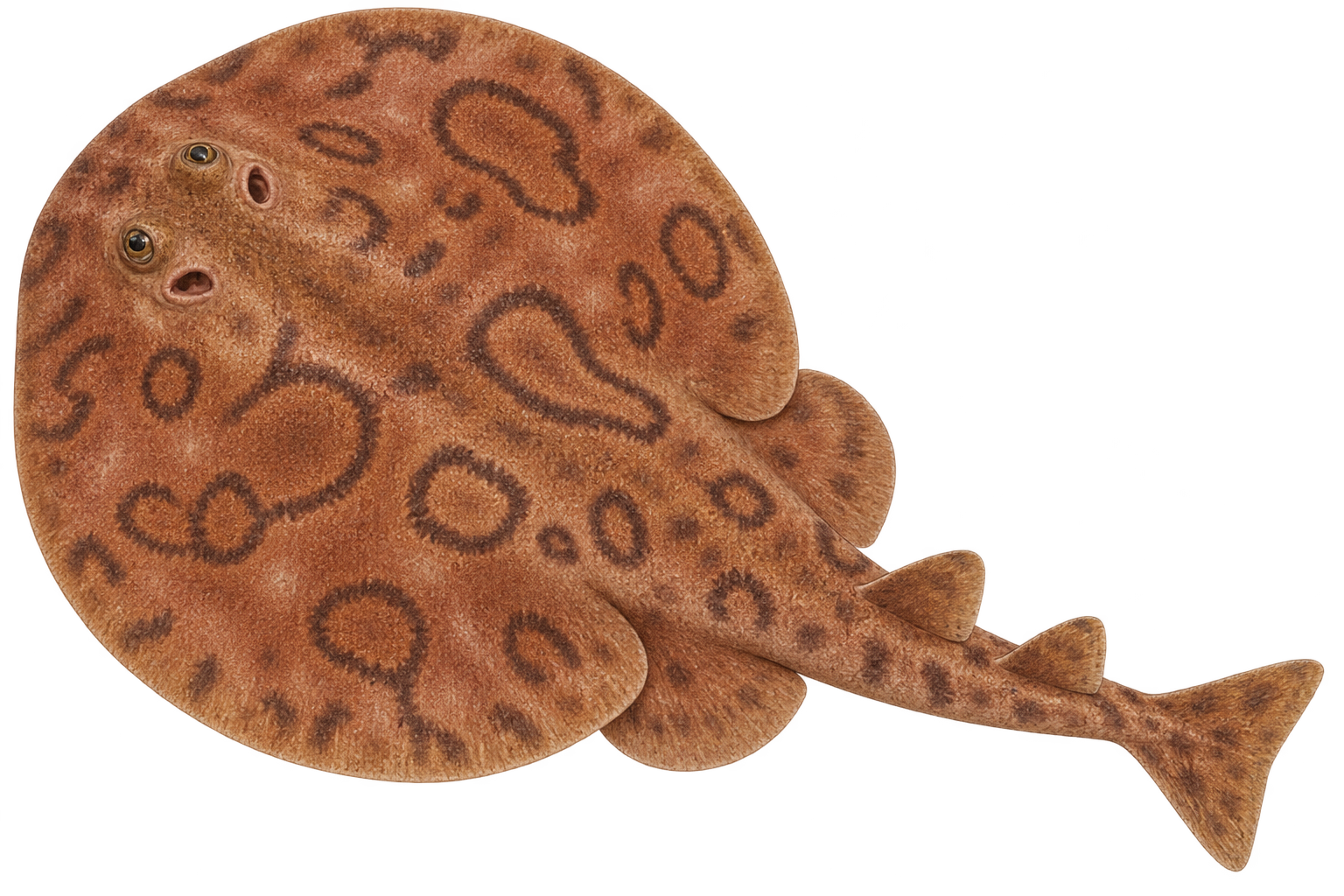
A rounded disc, a short stout tail and two dorsal fins distinguish the lesser electric ray from the familiar long-tailed stingray outline. Its back can be brown, reddish or patterned with darker rings and blotches. The skin is soft rather than covered in conspicuous thorns. The Florida Museum’s lesser electric ray profile describes these external features.
Its electric organs are a reason to observe without contact, not a feature to test. Never touch, lift or prod a ray to see whether it produces a discharge. A rounded body alone is not enough for identification: look for the tail and paired dorsal fins in a photograph taken without disturbing the animal.
Florida Keys and habitat
The Fishes of Texas research database gives a range extending from North Carolina to the Florida Keys and Cuba. That supports inclusion in a southeastern Florida and Keys guide. It does not establish a sighting at a specific local beach, reef or dive site.
Shallow coastal sand, mud and seagrass settings are associated with this ray. A resting animal may be partly buried. Keep fins and equipment clear of the bottom, and do not brush sediment away to uncover its outline.
Older accounts sometimes combined different electric-ray species under a broader name and range. NOAA’s species status review is a useful reference for that taxonomic background. This profile does not repeat the older South American or Pacific range claims, and conflicting numerical size statements have been omitted.
Feeding and reproduction
Bottom-dwelling worms are an important part of its diet, alongside other small animals. Young develop inside the female and are born alive. The museum reports that newborn rays can already produce electrical discharges. The absence of a stingray-style tail weapon therefore should not be interpreted as an invitation to handle the fish.
Responsible observation and rules
Give the animal space to remain buried or move away. Avoid feeding, chasing or repositioning it for photography. Document the habitat and naturally visible features rather than provoking a response.
No species-specific harvest allowance has been established for this profile. FWC’s general regulations explain that species without individual limits remain subject to restrictions. Check species identity, jurisdiction, gear and protected-area rules before any proposed collection. This is not a food-safety recommendation.
Quick quiz
- How many dorsal fins are visible on the tail? Two.
- Can young rays produce electricity? Yes.
- Should a diver test the discharge? No.
Current observation and collection guidance
This identification guide does not establish permission to collect or harvest this species. Check current FWC rules for Florida waters and possession or landing in Florida, and applicable federal rules for fishing in federal waters. Those jurisdictions are not interchangeable. Biscayne National Park and Florida Keys sanctuary zones can impose additional restrictions or closures. Verify the exact species, location and activity before any proposed take; no food-safety recommendation is made here. FWC recreational saltwater fishing regulations FWC recreational fishing maps FWC guidance for species without individual bag limits Florida shark rule 68B-44.004 Florida Administrative Register notice 30356458 Biscayne National Park fishing regulations Florida Keys National Marine Sanctuary regulations NOAA Endangered Species Act not-warranted findings FWC lesser electric ray species account Florida marine-life rule 68B-42.001 Florida rule text (Cornell LII) Florida rule text (Cornell LII)
Blue Heron Bridge report
REEF’s Blue Heron Bridge / Phil Foster Park survey report includes Lesser electric ray among species reported at this site. The cumulative volunteer survey record is not a guarantee of a sighting or evidence of current abundance. Blue Heron Bridge (BHB) is a Riviera Beach dive site at Phil Foster Park. Site-specific observation source.
Make your next dive happen
Dive With Us
Explore local charters and plan a dive suited to your experience.
View dive calendarTrain With Us
Build your fish identification, buoyancy and diving skills.
Explore trainingTravel With Us
Discover upcoming dive adventures and trip details.
Explore dive travelShop With Us
Browse equipment for your diving and ask our team for help choosing.
Explore dive gearReview current dates, availability, prices, inclusions and requirements on each listing before booking or buying.
Call us now
Ask about fish identification training
Reef Fish Identification
Ask about dates, prerequisites or your next step. An inquiry does not reserve a place. Please provide your own contact details; do not include medical, payment or a child's personal information.
We use these details to respond to your inquiry. This form does not sign you up for marketing.
Explore more with Stuart Scuba
Open Water course options · Advanced Adventure training · Technical training · Professional training · All courses · Local dives · Dive trips · Facebook · Instagram · YouTube
Your surface-interval essentials
Questions for Stuart Scuba? info@stuartscuba.com
Check the Stuart Scuba Weather Center · Play scuba trivia
Weather and wildlife vary. Confirm current conditions, trip requirements and departure details with the operator.
Plan Your Next Dive with Stuart Scuba
Dive With Us
Explore upcoming local charters and choose a dive that fits your experience.
Before you book
Check the individual listing for departure time, requirements and availability.
Travel With Us
Find upcoming dive adventures and start planning your next trip.
Plan your trip
Review dates, inclusions and trip details on the travel calendar.
Stay Connected with Stuart Scuba
 Follow pageShare
YouTube
SubscribeWatch & shareFollow on InstagramView & share post
Follow company news, training updates, and dive stories.
Follow on LinkedInGoogle Reviews
See Stuart Scuba’s current Google rating and review count below. Open the listing in Google Maps to browse customer reviews.



