

Fish identification archive / Lesser Devil Ray
Lesser Devil Ray
Mobula hypostoma
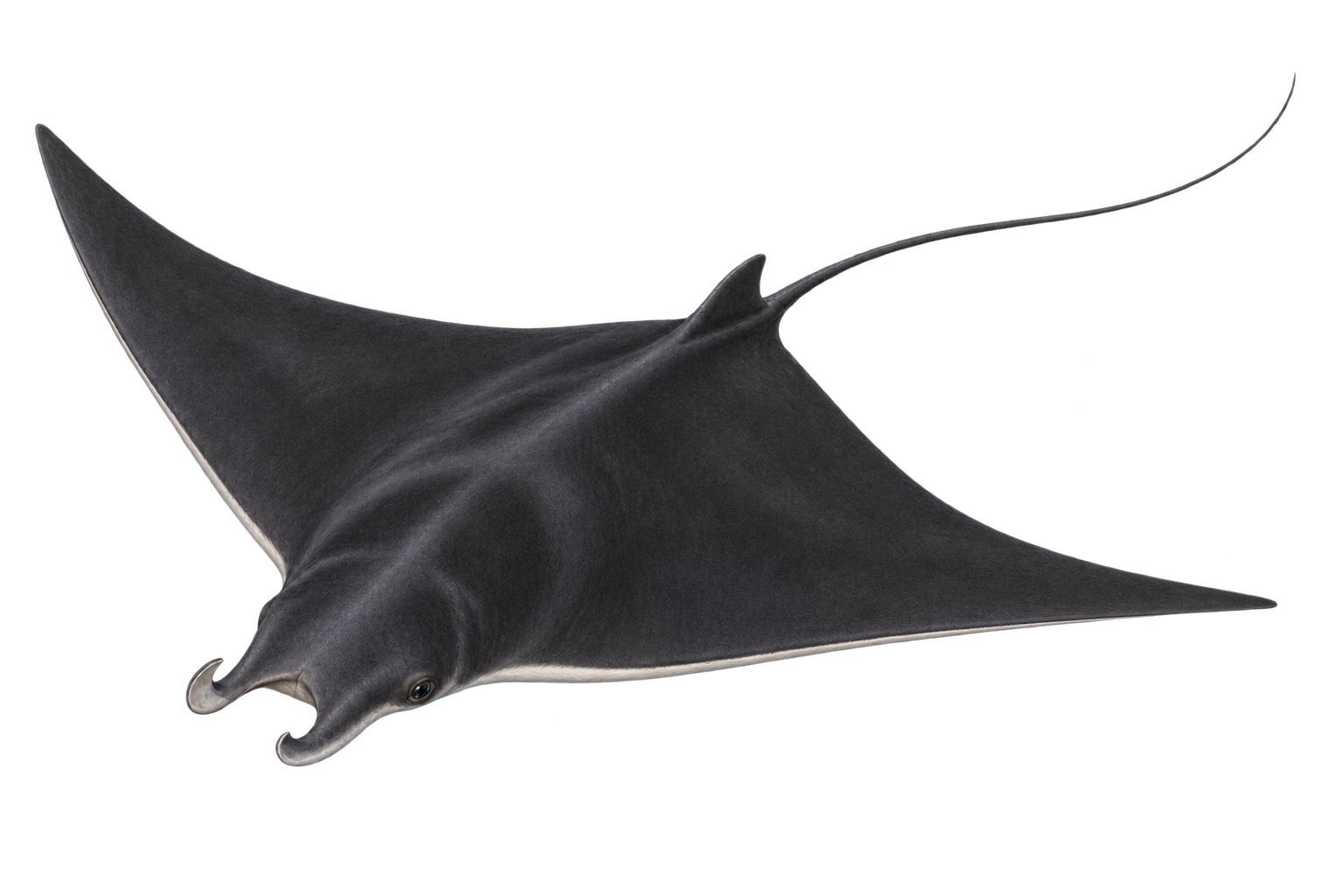
Fun facts for your next surface interval
- Horns with a practical job: its ‘devil horns’ are rolled cephalic fins that help with feeding.
- A ray without the stingray spine: unlike many stingrays, this species has no tail spine.
- One small arrival: a female usually gives birth to one pup, and much of its reproductive life remains poorly known.
Florida and local context
Florida Atlantic coastal waters; seasonal regional occurrence; no guaranteed sighting: FWC documents Florida Atlantic-coast occurrence, particularly summer observations. That seasonal tendency is not a predictable Palm Beach encounter calendar.
Documented regional presence is not a guarantee of an encounter or a measure of how common this animal is at your dive site.
How to recognize this animal
A lesser devil ray has a dark upper surface, a pale underside and long pointed wings. Two short cephalic fins project beside the head and can roll into hornlike shapes. The mouth lies below the front of the head rather than opening directly at its leading edge. Its slender tail lacks the stingray-type spine that many people expect on every ray.
Size and life stages
FWC reports a maximum disc width around 4 feet (1.2 meters). This is wingtip-to-wingtip width, not total length including the tail. The species is much smaller than a large manta, but a juvenile manta can overlap in apparent size. A width estimate therefore supports identification only when paired with head, mouth and cephalic-fin details.
Habitat and where to look
Lesser devil rays swim in coastal and open water rather than spending their time buried in sand. Bays and nearshore areas can be used when food conditions are suitable. Their pointed pectoral wings drive an efficient flying motion through the water. Look up into the water column as well as down at the reef when watching for passing rays.
Range and local context
FWC documents the species along Florida’s Atlantic coast, particularly in summer observations. This is a regional and seasonal tendency, not a guarantee of a Palm Beach encounter. Its broader Atlantic range extends well beyond Florida. A distant dark ray should not be named solely from the month; body shape and the short cephalic fins still need to be seen.
What is on the menu?
Planktonic crustaceans and small fishes are important foods. The cephalic fins help direct water and prey toward the mouth while the ray swims. Despite its name and horns, it is a filter-feeding animal rather than a hunter of large prey. Do not introduce food to make a ray open its mouth or approach a camera.
Daily habits and behavior
Individuals may travel alone or in groups, and devil rays can leap clear of the water. A breach is exciting but does not by itself distinguish this species from other rays. Underwater, note the wing shape, dark back and head appendages while allowing it to pass freely. Surface activity also calls for care around boats and propellers.
Mating and the next generation
Lesser devil rays give birth to live young, usually one pup. Detailed reproductive timing and gestation remain poorly known, so this guide does not assign a confident Florida breeding calendar. Male claspers can be visible near the pelvic fins, but they are not a reason to swim under or restrain the animal. A small ray is not automatically a newborn.
Look-alikes and identification traps
Mantas have a mouth at the front of the head, while the lesser devil’s mouth is below it. Cownose rays have a notched, lobed snout rather than these distinct short horns, and spotted eagle rays have pale dorsal spotting and a different head. Size alone can mislead. An ordinary photograph may not show the mouth well enough for certainty.
Observe without disturbing
Keep your distance from the wing tips and leave a clear route ahead. Photograph the head and full disc only if they are naturally visible, without diving underneath to inspect the mouth. Do not chase a breaching animal from a boat. Record the sighting as uncertain when head details are missing, and remember that this protected ray must not be collected.
Harvest, protection and eating safety
Protected: no state-water harvest
Florida state waters: no harvest or possession year-round. A separate federal rule effective June 22, 2026 prohibits mobulid retention by covered Atlantic HMS-permitted vessels, including applicable Gulf and Caribbean operations. No food-harvest exception applies.
This color is a qualified summary, not permission to collect or a guarantee that a particular catch is safe to eat. Read the current rules and health guidance below.
Protected in Florida state waters: no recreational harvest
Can it be hunted or harvested?
Do not harvest or possess this Mobula ray in Florida state waters. No ordinary recreational size, bag allowance or permit overrides that protection. In Atlantic HMS fisheries, a separate federal rule effective June 22, 2026 prohibits retention of all mobulid rays, including this species, by covered HMS-permitted vessels.
Florida seasons and areas
Florida state-water protection applies year-round. The 2026 federal mobulid rule covers Atlantic HMS fisheries, including the Gulf and Caribbean; it should not be described as a generic rule for every federal-water fishery. Follow the rule’s handling and release requirements and any additional sanctuary or site restrictions.
Can it be speared?
No harvest in Florida state waters, including by spear. The species’ protected status controls even if a general spearfishing list uses a different manta or devil-ray common name.
Is it safe to eat?
Do not collect this protected ray for food. No species-specific food-safety clearance is offered here. A legal or biological name similarity to skate or another ray does not establish a safe consumption category; consult current Florida DOH guidance for any lawfully caught seafood.
Before you act: This recreational overview is not permission to collect or spear at your dive site. Confirm the species, date, management area, state or federal waters, gear, licenses and current local closures. Identification artwork cannot establish an identification or guarantee seafood safety.
Official rules and health guidance
- FWC devil ray: protected Florida species
- FWC current recreational shark rules
- NOAA final mobulid retention rule, effective June 22, 2026
- FWC prohibited species, gear and spearing locations
- Florida DOH current fish-consumption advisory portal
- FDA advice about eating fish
Reviewed 2026-11-10. Rules and advisories can change; check the linked authorities before harvesting or eating.
Sources and review
Reviewed 2026-11-10.
Make your next dive happen
Dive With Us
Explore local charters and plan a dive suited to your experience.
View dive calendarTrain With Us
Build your fish identification, buoyancy and diving skills.
Explore trainingTravel With Us
Discover upcoming dive adventures and trip details.
Explore dive travelShop With Us
Browse equipment for your diving and ask our team for help choosing.
Explore dive gearReview current dates, availability, prices, inclusions and requirements on each listing before booking or buying.
Call us now
Ask about marine life identification
Marine Life Identification
Ask about dates, prerequisites or your next step. An inquiry does not reserve a place. Please provide your own contact details; do not include medical, payment or a child's personal information.
We use these details to respond to your inquiry. This form does not sign you up for marketing.
Explore more with Stuart Scuba
Open Water course options · Advanced Adventure training · Technical training · Professional training · All courses · Local dives · Dive trips · Facebook · Instagram · YouTube
Your surface-interval essentials
Questions for Stuart Scuba? info@stuartscuba.com
Check the Stuart Scuba Weather Center · Play scuba trivia
Weather and wildlife vary. Confirm current conditions, trip requirements and departure details with the operator.
Plan Your Next Dive with Stuart Scuba
Dive With Us
Explore upcoming local charters and choose a dive that fits your experience.
Before you book
Check the individual listing for departure time, requirements and availability.
Travel With Us
Find upcoming dive adventures and start planning your next trip.
Plan your trip
Review dates, inclusions and trip details on the travel calendar.
Stay Connected with Stuart Scuba
 Follow pageShare
YouTube
SubscribeWatch & shareFollow on InstagramView & share post
Follow company news, training updates, and dive stories.
Follow on LinkedInGoogle Reviews
See Stuart Scuba’s current Google rating and review count below. Open the listing in Google Maps to browse customer reviews.



