

Fish identification archive / Lemon Shark
Lemon Shark
Negaprion brevirostris
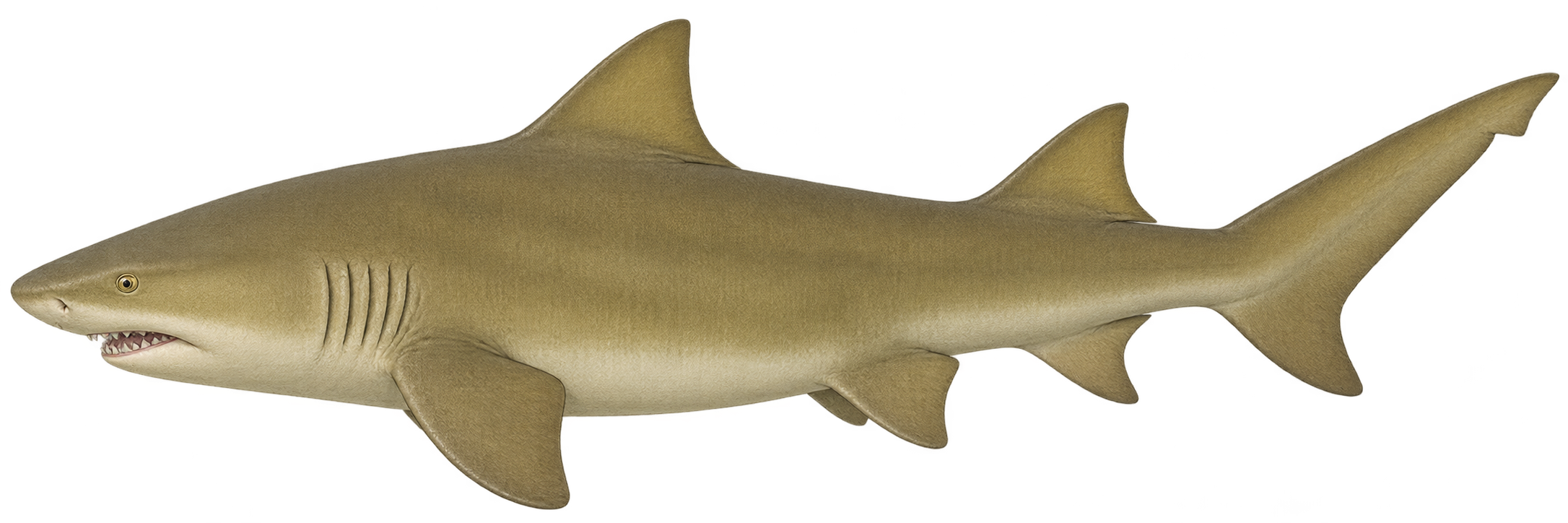
Fun facts for your next surface interval
- Spot the nearly matching pair: its second dorsal fin is almost as large as the first, a handy clue even when its yellowish color disappears underwater.
- A nursery with staying power: a sheltered mangrove nursery can remain part of a young lemon shark’s world for several years.
- Social sharks: lemon sharks form social groups; they are not necessarily solitary hunters.
Florida and local context
Florida regional occurrence; no site-level or abundance claim: FWC documents Florida Atlantic and Gulf occurrence and shallow coastal nursery use. No individual Palm Beach site or encounter frequency is asserted.
Documented regional presence is not a guarantee of an encounter or a measure of how common this animal is at your dive site.
How to recognize this animal
A lemon shark combines a broad, blunt snout with two dorsal fins that are unusually close in size. The first dorsal sits behind the pectoral fins. Its back is yellowish brown to olive gray above a pale belly, without bold fin-tip markings. There is no ridge connecting the dorsal fins; color alone is an unreliable underwater clue.
Size and life stages
Adults commonly measure about 8–10 feet (2.4–3 meters) long, with FWC reporting a maximum around 10.5 feet (3.2 meters). Newborns are only about 20–24 inches (50–60 centimeters). A small lemon shark is therefore a nursery-age animal, not a separate miniature species. Total length includes the extended upper tail lobe.
Habitat and where to look
This is a coastal shark of bays, estuaries, mangrove margins, grass flats and nearby reef or shelf habitat. Shallow sheltered areas are particularly important to young sharks. Adults can move between coastal habitats, so a reef encounter and a mangrove nursery observation describe different parts of the same life history rather than conflicting habitat preferences.
Range and local context
FWC documents lemon sharks in Florida’s Atlantic and Gulf waters. This profile treats Florida occurrence as established but does not assign a guaranteed Palm Beach dive site or a daily sighting season. The broader warm-water Atlantic distribution includes the Caribbean. Seasonal movement and individual site attachment make a statewide range map a poor predictor of tomorrow’s encounter.
What is on the menu?
Bony fishes are major prey, alongside crustaceans, rays and other small sharks. The blunt head and strong jaws suit a coastal predator searching close to the bottom. A shark moving slowly over sand may be investigating food rather than simply passing through. Feeding behavior should be watched without bait, discarded catch or attempts to direct its route.
Daily habits and behavior
Lemon sharks can form groups, with size and sex influencing associations. Young animals may remain closely connected to a nursery area for years. That social behavior does not make a group domesticated or safe to crowd. Watch how individuals space themselves and move around bottom features rather than judging temperament from the absence of rapid swimming.
Mating and the next generation
Lemon sharks give birth to live young, nourished through a placental connection during development. Reported litters contain roughly 4–17 pups after about 10–12 months of gestation. Shallow nurseries shelter the young. Sex is not reliably read from yellow coloration: males have paired claspers beside the pelvic fins, which should be observed only when naturally visible.
Look-alikes and identification traps
A bull shark has a much smaller second dorsal fin. A sand tiger also has two large dorsals, but they sit farther back and accompany a pointed snout and conspicuous needlelike teeth. A nurse shark has nasal barbels and a very different tail. Use head shape and fin placement together before calling a plain brown shark a lemon.
Observe without disturbing
Give both the shark and its exit route generous space. Photograph the two dorsal fins in one side view if possible, without following a young shark into shallow mangroves. Stay off nursery grass and avoid blocking channels. Record approximate length and habitat with the sighting; those details are more useful than an unsupported claim that the animal was an adult.
Harvest, protection and eating safety
Protected: no state-water harvest
Florida state waters: protected year-round, with no ordinary recreational harvest season. Release accidental catches without delay with gills submerged. Federal species and HMS-vessel rules must also be checked. Shark mercury advice does not create a harvest exception.
This color is a qualified summary, not permission to collect or a guarantee that a particular catch is safe to eat. Read the current rules and health guidance below.
Protected in Florida state waters: no recreational harvest
Can it be hunted or harvested?
Do not harvest, possess or land this species from Florida state waters. No size, bag allowance or harvest permit creates an exception for ordinary recreational fishing. Release an accidental catch without delay, keeping the shark in the water with its gills submerged and following FWC handling requirements.
Florida seasons and areas
Florida state-water protection applies year-round. This is not a claim that every federal shark rule is identical: federal species restrictions and HMS vessel-permit conditions must also be followed for the trip. Marine parks, sanctuaries and local closures may be stricter.
Can it be speared?
No. Florida prohibits spearing sharks, including this protected species. Never use a spear, powerhead or bangstick to collect it.
Is it safe to eat?
Not a food-harvest recommendation: retention is prohibited in Florida state waters. FDA lists shark among the highest-mercury Choices to Avoid for people who are pregnant, might become pregnant or are breastfeeding, and children ages 1–11. Other consumers should consult current Florida DOH species and catch-area advisories; no individual shark is certified safe by this profile. The June 2021 guide currently linked by Florida DOH says not to eat coastal-water sharks 43 inches or longer, for any listed population. Below 43 inches, it advises women of childbearing age and young children not to eat them, and other consumers to limit them to one meal per month. This is an older currently linked guide, not a new 2026 table; recheck the current advisory before eating. The guide defines a meal as six ounces of cooked fish; consult current advice for age-appropriate portions and count other fish eaten as well.
Before you act: This recreational overview is not permission to collect or spear at your dive site. Confirm the species, date, management area, state or federal waters, gear, licenses and current local closures. Identification artwork cannot establish an identification or guarantee seafood safety.
Official rules and health guidance
- FWC current recreational shark rules
- NOAA current HMS recreational guide landing page and permit guidance
- FWC prohibited species, gear and spearing locations
- FDA advice about eating fish
- Florida DOH current fish-consumption advisory portal
- Florida DOH June 2021 guide, currently linked from its advisory portal
Reviewed 2026-11-10. Rules and advisories can change; check the linked authorities before harvesting or eating.
Sources and review
Reviewed 2026-11-10.
- FWC species account: Florida occurrence and biology
- NOAA shark identification guide: diagnostic anatomy, size, habitat and range
- Florida Museum species account: anatomy and life history
- UF/IFAS Florida Sea Grant: claspers and shark/ray reproductive anatomy
- Eschmeyer’s Catalog of Fishes: current taxonomy and synonymy
Make your next dive happen
Dive With Us
Explore local charters and plan a dive suited to your experience.
View dive calendarTrain With Us
Build your fish identification, buoyancy and diving skills.
Explore trainingTravel With Us
Discover upcoming dive adventures and trip details.
Explore dive travelShop With Us
Browse equipment for your diving and ask our team for help choosing.
Explore dive gearReview current dates, availability, prices, inclusions and requirements on each listing before booking or buying.
Call us now
Ask about marine life identification
Marine Life Identification
Ask about dates, prerequisites or your next step. An inquiry does not reserve a place. Please provide your own contact details; do not include medical, payment or a child's personal information.
We use these details to respond to your inquiry. This form does not sign you up for marketing.
Explore more with Stuart Scuba
Open Water course options · Advanced Adventure training · Technical training · Professional training · All courses · Local dives · Dive trips · Facebook · Instagram · YouTube
Your surface-interval essentials
Questions for Stuart Scuba? info@stuartscuba.com
Check the Stuart Scuba Weather Center · Play scuba trivia
Weather and wildlife vary. Confirm current conditions, trip requirements and departure details with the operator.
Plan Your Next Dive with Stuart Scuba
Dive With Us
Explore upcoming local charters and choose a dive that fits your experience.
Before you book
Check the individual listing for departure time, requirements and availability.
Travel With Us
Find upcoming dive adventures and start planning your next trip.
Plan your trip
Review dates, inclusions and trip details on the travel calendar.
Stay Connected with Stuart Scuba
 Follow pageShare
YouTube
SubscribeWatch & shareFollow on InstagramView & share post
Follow company news, training updates, and dive stories.
Follow on LinkedInGoogle Reviews
See Stuart Scuba’s current Google rating and review count below. Open the listing in Google Maps to browse customer reviews.



