

Fish identification archive / Leatherback Sea Turtle
Leatherback Sea Turtle
Dermochelys coriacea
Fun facts for your next surface interval
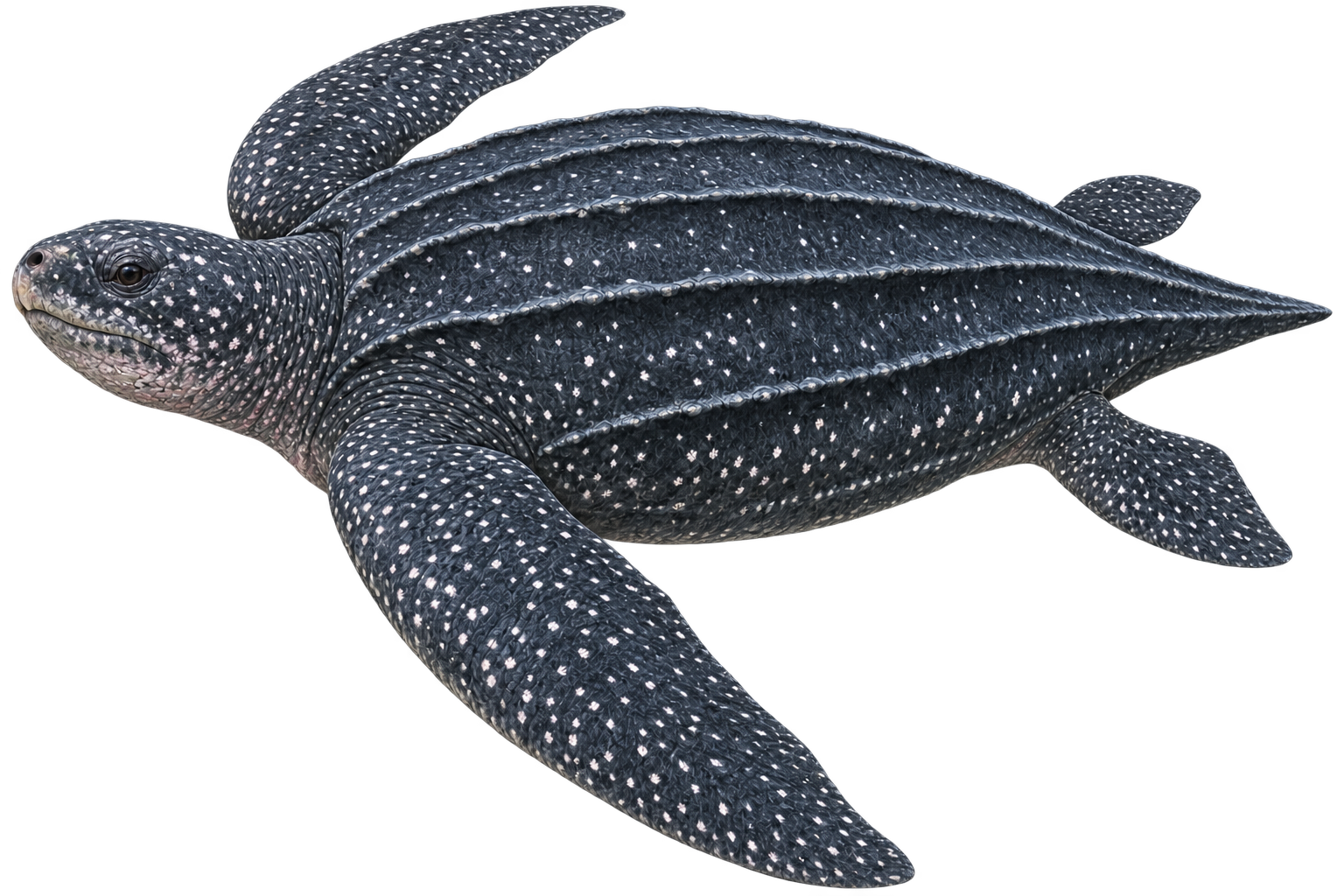
- No hard-shell suitcase: seven longitudinal ridges replace the familiar large external shell plates of other sea turtles.
- Jelly-grip engineering: backward-pointing structures in the mouth and throat help retain slippery jellyfish.
- Frequent-swimmer miles: some leatherbacks travel more than 10,000 miles between feeding and nesting areas in a year.
Florida and local context
Florida Atlantic nesting coast: Florida Atlantic nesting; pelagic, uncommon recreational dive encounter
Documented regional presence is not a guarantee of an encounter or a measure of how common this animal is at your dive site.
How to recognize this animal
Seven lengthwise ridges run along the dark, leathery upper shell. Unlike the other Florida sea turtles, a leatherback lacks large external shell scutes and body scales. Pale spots contrast with the mostly black skin, and the exceptionally long front flippers help create its distinctive outline. The shell narrows behind rather than forming the broad rounded disc of a ridley.
Size and life stages
The National Park Service gives adult carapace lengths of approximately 121–244 centimeters, or four to eight feet. NOAA's typical adult summary is narrower at five to six feet and 750–1,000 pounds. These sources describe different portions of adult variation. Use carapace length rather than flipper span, and do not assume an unusually large silhouette can be measured accurately from a passing boat.
Habitat and where to look
This is primarily an open-ocean turtle rather than a resident reef grazer. It travels between tropical or subtropical nesting beaches and far-ranging feeding areas, sometimes in cool waters. Florida's Atlantic beaches are an important United States nesting region. A coastal nesting record confirms seasonal use of that coastline but does not imply regular encounters on shallow recreational dive sites.
Range and local context
Leatherbacks occur across the Atlantic, Pacific and Indian oceans, with feeding records far beyond tropical latitudes. NOAA confirms nesting in Florida, Puerto Rico and the U.S. Virgin Islands, and identifies Florida's Atlantic coast as a major continental nesting area. This is a verified Florida species with a predominantly pelagic lifestyle, not a promised sighting at Palm Beach's nearshore reefs.
What is on the menu?
Jellyfish, salps and other soft-bodied ocean animals are the main foods. Sharp jaw edges and tooth-like cusps grasp slippery prey, while backward-pointing structures in the mouth and throat help retain it. Those structures are not ordinary mammalian teeth. Floating plastic and balloons can resemble food, making marine debris particularly relevant to a turtle that searches for gelatinous prey.
Daily habits and behavior
Leatherbacks are powerful swimmers capable of dives approaching 4,000 feet, about 1,200 meters, and extended submergence. Some migrate more than 10,000 miles in a year. Their large bodies, insulation and heat-exchange adaptations let them use cooler feeding waters than many other sea turtles. Such records describe exceptional animal capabilities, not safe depths or distances for people to follow.
Mating and the next generation
Nesting females come ashore at night and dig deep egg chambers. NOAA describes several clutches per season, usually separated by about eight to twelve days, with roughly 100 eggs in a clutch. Incubation takes about two months. Females commonly return after two to four years. Estimates of age at maturity remain uncertain, so a precise birthday should not be inferred.
Look-alikes and identification traps
The absence of large scutes and presence of seven ridges separate a leatherback from loggerheads, greens, hawksbills and Kemp's ridleys. Size alone is insufficient because a juvenile leatherback can be smaller than an adult hard-shelled species. A distant dark animal at the surface can be difficult to resolve; record the ridge pattern and flipper proportions only if naturally visible.
Observe without disturbing
A leatherback at the surface needs space and protection from boat traffic. Slow down and avoid intercepting its route; never feed, touch or pursue it. On a nesting beach, remain well back and keep lights off. NOAA recommends contacting trained responders for injured or entangled turtles. Its size makes untrained handling especially hazardous to both the turtle and people.
Harvest, protection and eating safety
Protected: no recreational take
Florida and applicable federal protection apply year-round: no ordinary recreational harvest season, open-area exception or spearing allowance. Nesting, breeding or viewing seasons do not authorize take. This is not a lawful recreational food target.
This color is a qualified summary, not permission to collect or a guarantee that a particular catch is safe to eat. Read the current rules and health guidance below.
Endangered; protected, no recreational take
Can it be hunted or harvested?
Leatherback Sea Turtle is not a recreational harvest target. NOAA lists this species as endangered under the federal Endangered Species Act. Florida’s Marine Turtle Protection Act also protects turtles, eggs and nests. Recreational taking, possession and disturbance are prohibited; scientific or conservation permits are separate authorizations, not ordinary fishing privileges.
Florida seasons and areas
There is no Florida recreational harvest season, open area, bag limit or edible-size exception for this protected animal. Protection applies year-round in Florida and under applicable federal law. Nesting months describe reproduction, not a legal harvest window. Park, refuge and beach restrictions can add further protections.
Can it be speared?
No. Spearing, shooting, injuring or killing this protected sea turtle is not an authorized recreational activity. An otherwise open spearfishing area does not create an exception for the animal.
Is it safe to eat?
Not a lawful recreational food target. This guide provides no assurance that its meat, eggs or other tissues are safe to eat; protected status and the absence of a named consumption advisory are not a food-safety assessment.
Before you act: This recreational overview is not permission to collect or spear at your dive site. Confirm the species, date, management area, state or federal waters, gear, licenses and current local closures. Identification artwork cannot establish an identification or guarantee seafood safety.
Official rules and health guidance
- NOAA Fisheries: Leatherback Sea Turtle biology and current ESA status
- FWC: Marine Turtle Protection Act and protected sea turtles
Reviewed 2026-11-10. Rules and advisories can change; check the linked authorities before harvesting or eating.
Sources and review
Reviewed 2026-11-10.
- NOAA Fisheries: Leatherback Sea Turtle biology and current ESA status
- FWC: Marine Turtle Protection Act and protected sea turtles
- National Park Service: leatherback carapace dimensions
- NOAA Fisheries: sea turtle comparison anatomy
- NOAA Fisheries: sea turtle comparison anatomy
- NOAA Fisheries: sea turtle comparison anatomy
Make your next dive happen
Dive With Us
Explore local charters and plan a dive suited to your experience.
View dive calendarTrain With Us
Build your fish identification, buoyancy and diving skills.
Explore trainingTravel With Us
Discover upcoming dive adventures and trip details.
Explore dive travelShop With Us
Browse equipment for your diving and ask our team for help choosing.
Explore dive gearReview current dates, availability, prices, inclusions and requirements on each listing before booking or buying.
Call us now
Ask about marine life identification
Marine Life Identification
Ask about dates, prerequisites or your next step. An inquiry does not reserve a place. Please provide your own contact details; do not include medical, payment or a child's personal information.
We use these details to respond to your inquiry. This form does not sign you up for marketing.
Explore more with Stuart Scuba
Open Water course options · Advanced Adventure training · Technical training · Professional training · All courses · Local dives · Dive trips · Facebook · Instagram · YouTube
Your surface-interval essentials
Questions for Stuart Scuba? info@stuartscuba.com
Check the Stuart Scuba Weather Center · Play scuba trivia
Weather and wildlife vary. Confirm current conditions, trip requirements and departure details with the operator.
Plan Your Next Dive with Stuart Scuba
Dive With Us
Explore upcoming local charters and choose a dive that fits your experience.
Before you book
Check the individual listing for departure time, requirements and availability.
Travel With Us
Find upcoming dive adventures and start planning your next trip.
Plan your trip
Review dates, inclusions and trip details on the travel calendar.
Stay Connected with Stuart Scuba
 Follow pageShare
YouTube
SubscribeWatch & shareFollow on InstagramView & share post
Follow company news, training updates, and dive stories.
Follow on LinkedInGoogle Reviews
See Stuart Scuba’s current Google rating and review count below. Open the listing in Google Maps to browse customer reviews.



