

Fish identification archive / Lantern Bass
Lantern Bass
Serranus baldwini
Fun facts for your next surface interval
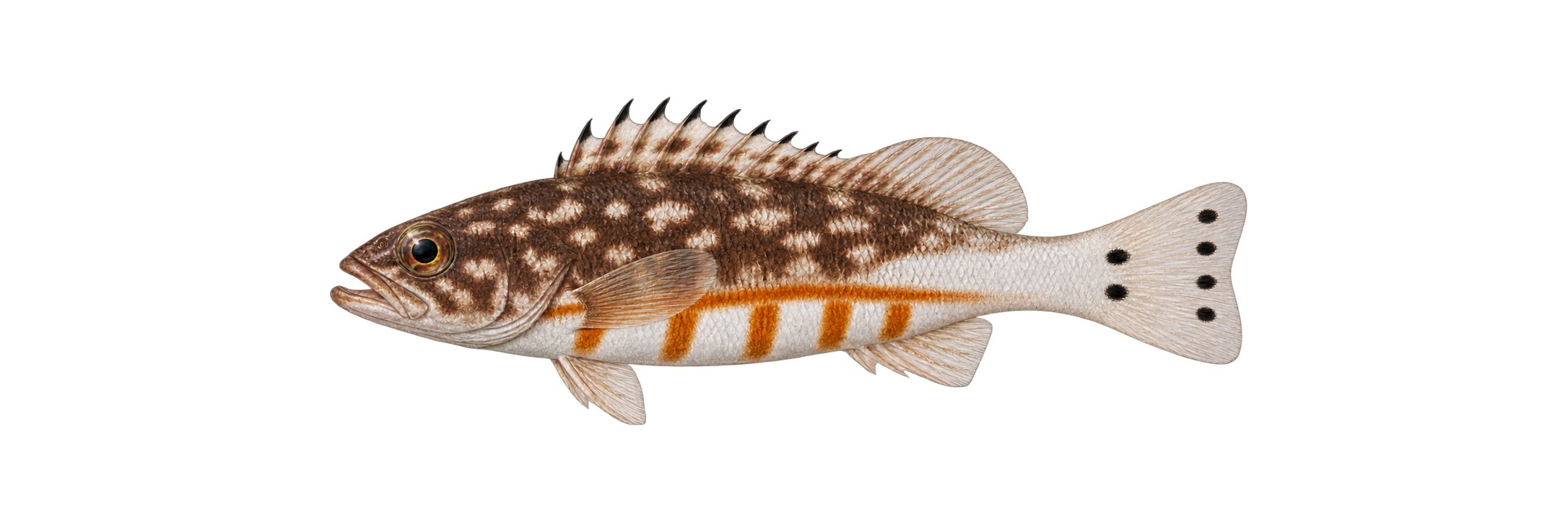
- A row of tail spots can be a better identification clue than the fish’s overall brown color. [source]
- Its reproductive system includes smaller simultaneous hermaphrodites and larger males. [source]
- Scientists have studied how the male’s patrolling and courtship differ from the behavior of the smaller fish around it. [source]
Florida and local context
REEF's cumulative diver-survey report lists Serranus baldwini at Blue Heron Bridge (WPB), Phil Foster Park. This is a species-level citizen-science report, not an independently reidentified specimen or a prediction of present-day abundance.
A documented past record does not establish present abundance or guarantee an encounter.
Sources: REEF: Blue Heron Bridge cumulative diver-survey species report
How to recognize this animal
A small bass with a mottled dark upper front body and a pale belly and rear body. Orange-brown bars mark the lower side, and an orange stripe runs along the flank. Look closely at the tail: Smithsonian describes one row of two black spots near its base and another row of four behind them.
Sources: Smithsonian Tropical Research Institute: lantern bass
Size and life stages
Size summaries differ: the Smithsonian regional account gives 7.4 cm (2.9 inches), while FishBase lists a 12 cm maximum. The smaller value is useful context for a tiny fish among rubble, but neither source establishes a guaranteed encounter size. Do not estimate reproductive role from length alone.
Sources: Smithsonian Tropical Research Institute: lantern bass; FishBase: lantern bass size and biology
Habitat and where to look
Sand mixed with rubble and seagrass is the consistent habitat description. The primary behavioral study describes fish in turtle grass and rubble substrates. Look for a small predator close to the bottom without turning stones or flattening vegetation. A sharp eye for the tail pattern can be more useful than searching large reef crevices.
Sources: Smithsonian Tropical Research Institute: lantern bass; Fischer and Petersen (1986): social behavior of lantern bass
Range and local context
This is a western Atlantic species. Smithsonian’s regional account reaches from North Carolina toward Brazil, while FishBase’s summary begins farther south at Florida and the Bahamas. The Blue Heron Bridge REEF report supplies the local species record. These broad and local sources describe occurrence, not current abundance.
Sources: Smithsonian Tropical Research Institute: lantern bass; FishBase: lantern bass size and biology
What is on the menu?
The species is a gleaning carnivore: it takes small animal prey from its surroundings. Smithsonian lists crustaceans and fishes. Wait for a visible feeding action rather than assuming that every quick dart is a strike, and do not bait the fish to make a normally subtle behavior easier to film.
Sources: Smithsonian Tropical Research Institute: lantern bass; Fischer and Petersen (1986): social behavior of lantern bass
Daily habits and behavior
A published Caribbean study found large males patrolling territories containing several smaller simultaneous hermaphrodites. Males were more active and aggressive in the observed groups. This explains why two nearby fish may behave differently, but a short encounter or a still photograph is not enough to assign either fish a reproductive role.
Sources: Fischer and Petersen (1986): social behavior of lantern bass
Mating and the next generation
The primary study documents an unusual social arrangement: smaller fish could have both male and female reproductive function, while large individuals were male. The smaller fish mainly spawned in the female role with resident males. This is not a claim that any isolated individual self-fertilizes. Smithsonian lists pelagic eggs and larvae.
Sources: Smithsonian Tropical Research Institute: lantern bass; Fischer and Petersen (1986): social behavior of lantern bass
Look-alikes and identification traps
Other small Serranus basses can share dark bars and orange or pale areas. Compare the lantern bass’s lower-body pattern and spotted tail as a combination. A cropped photo that excludes the tail loses an important clue. Body shape alone is not enough to distinguish it from similar small seabasses.
Sources: Smithsonian Tropical Research Institute: lantern bass
Observe without disturbing
Hover quietly without placing a camera or hand on rubble. Let fish emerge on their own, and avoid pursuing a territorial individual through neighboring cover. Photograph the tail with the body if the opportunity arises naturally. Leave small prey and shelter undisturbed so the observed behavior stays meaningful.
Sources: Fischer and Petersen (1986): social behavior of lantern bass
Harvest, protection and eating safety
Live-only ornamental collection; no collection at Blue Heron Bridge
Yellow means legal or safety conditions require attention. It is not an edible badge or permission to take an animal.
This color is a qualified summary, not permission to collect or a guarantee that a particular animal is safe to eat.
Can it be hunted or harvested?
Lantern Bass falls under Florida’s hamlet/seabass category, family Serranidae; Serranus baldwini is not an excluded Centropristis seabass or one of the listed sand perches. A recreational saltwater fishing license is required unless exempt. Where collection is lawful, the animal must be landed alive and maintained alive in a suitably sized circulating, aerated or oxygenated system. The recreational limit is five of this species within 20 marine-life organisms per person per day; the two-day possession limit is ten of this species within 40 total. Recreational sale is prohibited. No species-specific size limit is stated in the reviewed marine-life table.
Florida seasons and areas
The designated Blue Heron Bridge Special Marine Life Area, including Phil Foster Park and its mapped surrounding waters, is closed to collection of listed tropical ornamental marine life. Narrow motorized-vessel transit and landing exceptions concern animals lawfully taken elsewhere, not collection here. The Florida marine-life requirements also apply in adjacent federal waters. No species-specific annual closed months are stated in the reviewed marine-life table. Biscayne National Park, state parks, wildlife refuges and Florida Keys sanctuary zones can impose additional closures; check the actual location before collecting.
Can it be speared?
No recreational spearing under these live-only marine-life requirements. Collection uses authorized nonlethal hand/net/slurp-gun methods, subject to species and site restrictions. Quinaldine is prohibited.
Is it safe to eat?
This is live-only ornamental collection, not food harvest. Do not kill a collected animal for a meal. No recipe or safe-to-eat claim is provided.
Palm Beach is Atlantic Florida. Do not transfer Atlantic guidance to the Gulf, Monroe County, or federal waters without checking the applicable rules.
Before you act: Confirm the species, date, exact management area, state or federal waters, gear, licenses and current local closures. A local occurrence record never grants permission to take an animal.
Official rules and health guidance
- FWC recreational marine-life requirements and species list
- Florida Rule 68B-42.001: listed marine-life species
- Florida Rule 68B-42.0036: mapped marine-life collection closures
- Palm Beach County: Phil Foster Park fishing and collection notice
- FWC spearing restrictions
- NOAA: Florida Keys sanctuary zones
- Florida Rule 68B-42.005: final-adopted recreational bag rule register
Reviewed 2026-11-11. Rules and advisories can change; check the linked authorities before acting.
Identification and source cautions
- Maximum length differs between Smithsonian (7.4 cm) and FishBase (12 cm).
- Behavioral findings are from studied Caribbean populations, not a local schedule or sex assignment for photographed fish.
Sources and review
Biology and taxonomy reviewed 2026-11-11. Photographs on cited sites are reference material and are not reproduced here.
Make your next dive happen
Dive With Us
Explore local charters and plan a dive suited to your experience.
View dive calendarTrain With Us
Build your fish identification, buoyancy and diving skills.
Explore trainingTravel With Us
Discover upcoming dive adventures and trip details.
Explore dive travelShop With Us
Browse equipment for your diving and ask our team for help choosing.
Explore dive gearReview current dates, availability, prices, inclusions and requirements on each listing before booking or buying.
Call us now
Ask about marine life identification
Marine Life Identification
Ask about dates, prerequisites or your next step. An inquiry does not reserve a place. Please provide your own contact details; do not include medical, payment or a child's personal information.
We use these details to respond to your inquiry. This form does not sign you up for marketing.
Explore more with Stuart Scuba
Open Water course options · Advanced Adventure training · Technical training · Professional training · All courses · Local dives · Dive trips · Facebook · Instagram · YouTube
Your surface-interval essentials
Questions for Stuart Scuba? info@stuartscuba.com
Check the Stuart Scuba Weather Center · Play scuba trivia
Weather and wildlife vary. Confirm current conditions, trip requirements and departure details with the operator.
Plan Your Next Dive with Stuart Scuba
Dive With Us
Explore upcoming local charters and choose a dive that fits your experience.
Before you book
Check the individual listing for departure time, requirements and availability.
Travel With Us
Find upcoming dive adventures and start planning your next trip.
Plan your trip
Review dates, inclusions and trip details on the travel calendar.
Stay Connected with Stuart Scuba
 Follow pageShare
YouTube
SubscribeWatch & shareFollow on InstagramView & share post
Follow company news, training updates, and dive stories.
Follow on LinkedInGoogle Reviews
See Stuart Scuba’s current Google rating and review count below. Open the listing in Google Maps to browse customer reviews.



