

Fish identification archive / Ladyfish
Ladyfish
Elops saurus · Elopidae
I saw this
Spotted this fish? Share the guide with your dive buddies. Review your caption before posting.
For Instagram, copy the caption and link into your own post or message. Nothing is posted automatically and this does not record a verified sighting.
Identification and lookalikes
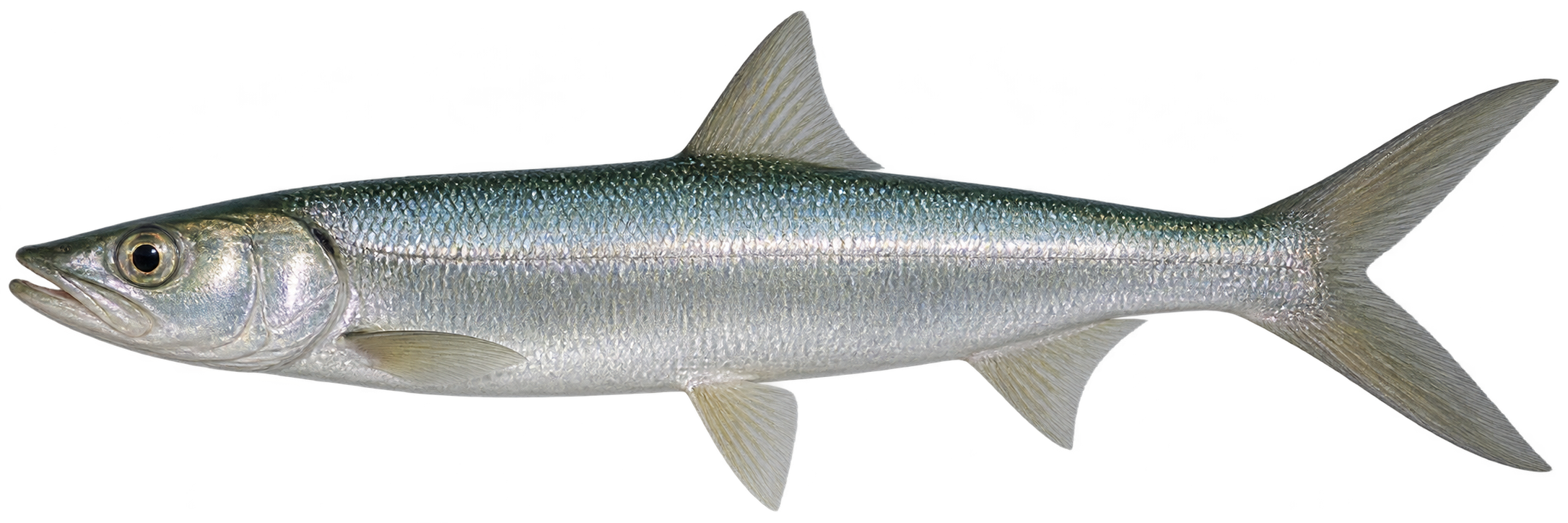
A long silver body, pointed head, front-facing mouth and deeply forked tail make the familiar ladyfish silhouette. The back has a blue-green tint and the scales are small. Compare a juvenile tarpon carefully: ladyfish lack the tarpon’s long trailing dorsal ray. Bonefish have a smaller mouth beneath an overhanging snout. These visible clues identify the familiar ladyfish form; the Smithsonian describes E. saurus and E. smithi as externally indistinguishable. A photograph alone cannot reliably separate them. FWC species identification Florida Museum species account Smithsonian species research
Florida habitat and range
Ladyfish use bays, lagoons and estuaries and may enter freshwater. The Florida Museum describes channels, bars and moderately flowing open-water areas among their habitats. They tolerate changes in salinity, but cold events can affect them. This general account does not establish a recent sighting at Blue Heron Bridge or another named local dive site. FWC species identification Florida Museum species account
Feeding and reproduction
Adults are predators of small fishes and crustaceans. They can form large schools, and their jumping behavior is familiar to anglers. Spawning occurs offshore; FWC identifies a fall peak. The early life history includes a transparent, ribbon-shaped larval stage that changes dramatically before becoming a recognizable juvenile. FWC species identification Florida Museum species account
Size and growth
The short FWC account and broader museum account present sizes differently. This guide therefore avoids turning either into a precise maximum-size claim. A legal measurement, a common adult length and a record-sized individual answer different questions. Species identity should be resolved before attaching a confident size range to an observation.
Three facts to remember
- The missing dorsal streamer helps distinguish it from a small tarpon.
- Its early ribbon-like appearance gives little hint of the silver adult to come.
- A fish nicknamed “ten-pounder” should still be weighed or measured properly; nicknames are not rulers. FWC species identification Florida Museum species account
Observation and Florida harvest caution
Let a passing school keep its route. A side-view photograph showing the head, dorsal fin and tail is more useful than a bright silver blur. Do not catch or handle a fish just to obtain those details.
FWC includes ladyfish among its “unregulated” examples. That word does not mean unlimited harvest: default recreational limits, licensing and other applicable rules still exist. This page does not supply a numeric allowance or claim that take is permitted at a particular site. Verify FWC’s current rules before acting. Legal harvest also does not establish that fish from a particular location are safe to eat. FWC current harvest rules
Blue Heron Bridge report
REEF’s Blue Heron Bridge / Phil Foster Park survey report includes Ladyfish among species reported at this site. The cumulative volunteer survey record is not a guarantee of a sighting or evidence of current abundance. Blue Heron Bridge (BHB) is a Riviera Beach dive site at Phil Foster Park. Blue Heron Bridge species observation source.
Make your next dive happen
Dive With Us
Explore local charters and plan a dive suited to your experience.
View dive calendarTrain With Us
Build your fish identification, buoyancy and diving skills.
Explore trainingTravel With Us
Discover upcoming dive adventures and trip details.
Explore dive travelShop With Us
Browse equipment for your diving and ask our team for help choosing.
Explore dive gearReview current dates, availability, prices, inclusions and requirements on each listing before booking or buying.
Call us now
Ask about fish identification training
Reef Fish Identification
Ask about dates, prerequisites or your next step. An inquiry does not reserve a place. Please provide your own contact details; do not include medical, payment or a child's personal information.
We use these details to respond to your inquiry. This form does not sign you up for marketing.
Explore more with Stuart Scuba
Open Water course options · Advanced Adventure training · Technical training · Professional training · All courses · Local dives · Dive trips · Facebook · Instagram · YouTube
Your surface-interval essentials
Questions for Stuart Scuba? info@stuartscuba.com
Check the Stuart Scuba Weather Center · Play scuba trivia
Weather and wildlife vary. Confirm current conditions, trip requirements and departure details with the operator.
Plan Your Next Dive with Stuart Scuba
Dive With Us
Explore upcoming local charters and choose a dive that fits your experience.
Before you book
Check the individual listing for departure time, requirements and availability.
Travel With Us
Find upcoming dive adventures and start planning your next trip.
Plan your trip
Review dates, inclusions and trip details on the travel calendar.
Stay Connected with Stuart Scuba
 Follow pageShare
YouTube
SubscribeWatch & shareFollow on InstagramView & share post
Follow company news, training updates, and dive stories.
Follow on LinkedInGoogle Reviews
See Stuart Scuba’s current Google rating and review count below. Open the listing in Google Maps to browse customer reviews.



