

Fish identification archive / Jolthead Porgy
Jolthead Porgy
Calamus bajonado
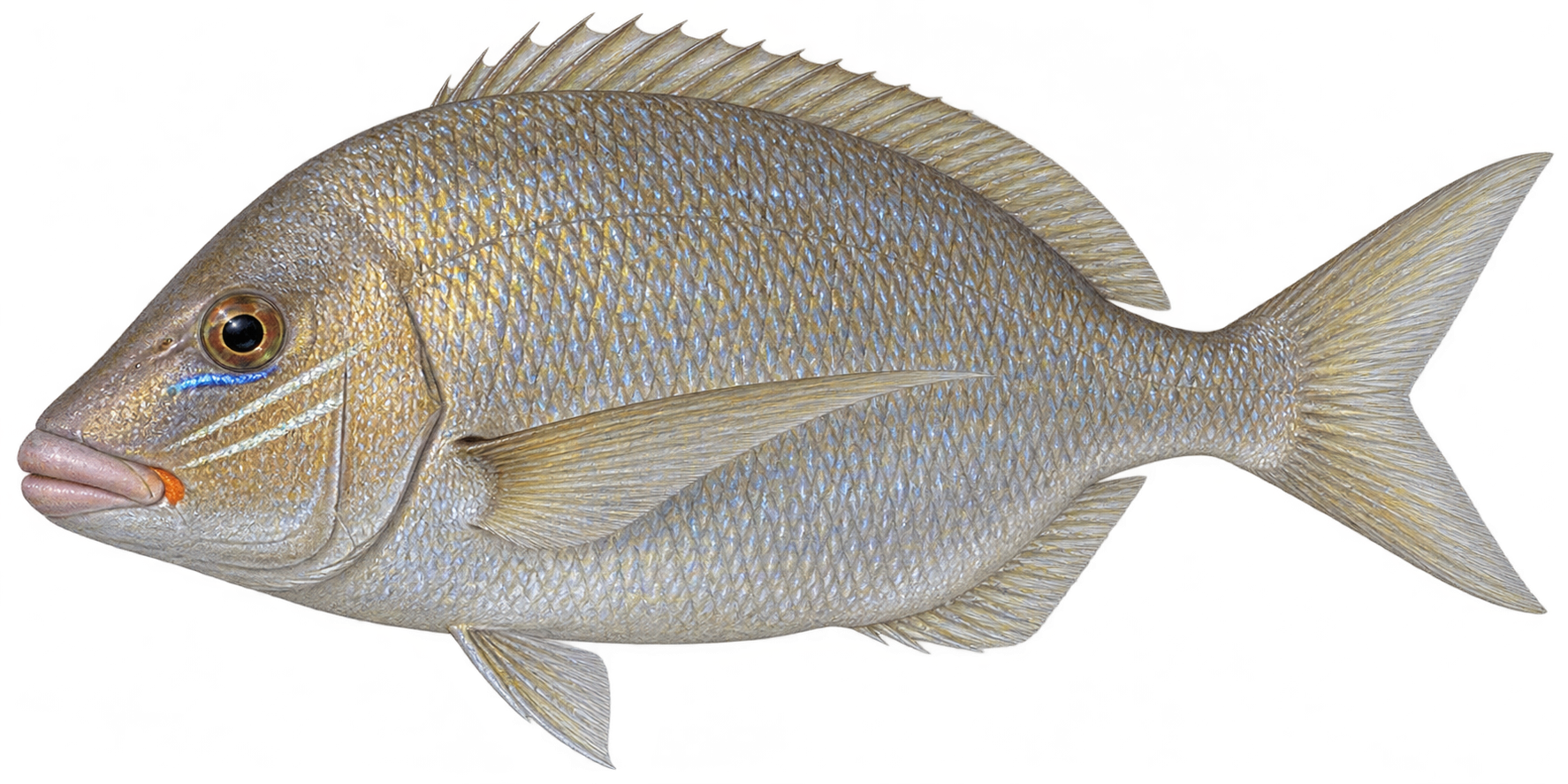
Fun facts for your next surface interval
- A splash of lipstick: The orange corner of the mouth is a small but valuable identification clue.
- Built-in crunch: Its jaw combines grasping front teeth with crushing teeth farther back.
- A solo act: Large adults are often solitary rather than members of a tight reef school.
Florida and local context
Broader Florida; no verified Lake Worth Lagoon checklist claim: The cited Florida life-history study sampled this exact species from Florida fisheries.
Documented regional presence is not a guarantee of an encounter or a measure of how common this animal is at your dive site.
How to recognize this animal
Look for a deep silver body, brassy cheek and a relatively long, moderately sloping forehead. A blue line follows the lower eye margin, with pale facial streaks below it. The mouth has thick lips and an orange corner. The pectoral fin is long enough to extend beyond the beginning of the anal fin when spread.
Size and life stages
Smithsonian reports 68 centimeters, while the South Atlantic Council gives a larger published maximum of 76 centimeters fork length. These are source-specific maxima with different reported measurement conventions, not interchangeable typical sizes. Juveniles can have dark bars on both body and tail. A small barred fish may therefore look quite unlike the heavy, almost plain adult.
Habitat and where to look
The species occupies coral and hard bottoms as well as vegetated sandy areas. Smithsonian's compiled depth range is 3–200 meters, and the Council reports records deeper than 200 meters. Only part of that range is accessible to recreational divers. At ordinary dive depths, inspect both hard structure and neighboring sand rather than assuming every porgy remains inside a reef.
Range and local context
This western Atlantic porgy ranges from the northern United States to Brazil, including Bermuda and the Gulf. The cited Florida life-history study directly documents specimens from Florida fisheries. The Lake Worth Lagoon checklist does not mark this species as verified; this profile therefore claims broader Florida presence, not a confirmed local checklist sighting or local abundance.
What is on the menu?
Crabs and mollusks are major prey, with echinoderms also included in the Smithsonian diet categories. The jaws combine front canines with crushing molar-like teeth along the sides. That combination helps handle hard-bodied bottom animals. Neither strong teeth nor the name porgy proves that a fish is eating coral or that every feeding strike targets a shellfish.
Daily habits and behavior
The Council describes large adults as usually solitary. A single robust porgy patrolling structure is therefore consistent with its biology, though solitary behavior is not diagnostic by itself. Keep the facial pattern in view as it turns: the orange mouth corner can disappear behind an angled jaw, and reflected light can obscure the narrow blue eye line.
Mating and the next generation
A study of Florida fish collected during 2008–2016 found mature hydrated eggs from December through March and evidence of a March spawning peak. Those sampled populations do not establish the date of spawning on any particular Palm Beach dive. Smithsonian records pelagic eggs and larvae, so early life includes a water-column stage rather than a guarded reef nest.
Look-alikes and identification traps
Littlehead porgy have a steeper, more humped head and stronger blue-and-yellow cheek markings. Grass porgy carry a dark shoulder blotch and shorter pectoral fin; sheepshead porgy have a dark bar below the eye and a small pectoral-base spot. For jolthead, combine head slope, orange mouth corner and long pectoral instead of relying on silver scales.
Observe without disturbing
Remain above the bottom while following a feeding route visually, leaving space between the fish and the structure it is using. Do not dig up prey or throw food to create a feeding image. Take a clear lateral photograph with the mouth corner visible. For a harvested fish, a field-guide image alone is not adequate to settle an uncertain porgy identification.
Harvest, protection and eating safety
Harvest conditional; ciguatera risk
Florida state-water harvest is conditional; no species-specific annual state closed months are listed. Check federal and site rules before taking fish. This species is specifically associated with ciguatera, which cooking or freezing does not remove. Appearance does not establish food safety; see the full area and health guidance. South Atlantic federal retention is currently open at ten/species within the twenty-fish aggregate; Biscayne also has its named-species aggregate.
This color is a qualified summary, not permission to collect or a guarantee that a particular catch is safe to eat. Read the current rules and health guidance below.
Jolthead porgy: Florida general limits; stricter South Atlantic federal and Biscayne limits
Can it be hunted or harvested?
In Florida Atlantic and Gulf state waters, this species falls under the general recreational rules unless an area-specific rule below is stricter. The default daily bag is two fish or 100 pounds per person, whichever is greater, not unlimited harvest. No species-specific statewide size limit is listed for this category. The cited default is a daily bag, not an additional off-water possession allowance. A saltwater fishing license is required unless exempt, including for Florida landings from federal waters; a shoreline-only license does not cover taking fish while swimming or diving. Legal general gear includes hook and line, spears, gigs, haul seines and cast nets subject to location restrictions. Recreational rules do not authorize commercial sale. In South Atlantic federal waters, the current recreational limit is ten jolthead porgy per person within the 20-fish snapper-grouper aggregate; no minimum size is listed. Fish must retain head and fins intact through landing. Snapper-grouper gear requirements include a ready descending device with at least 16 ounces of weight and 60 feet of line, a dehooking tool, non-stainless hooks with natural bait, and non-offset circle hooks north of 28 degrees N when using natural bait. These South Atlantic federal provisions are not automatically Gulf rules.
Florida seasons and areas
The South Atlantic Council lists the jolthead recreational fishery OPEN as reviewed November 10, 2026; that current status is not a guarantee for a future trip. Its federal limit is ten within the 20-fish aggregate, distinct from Florida state general limits and not imported to Gulf waters. No separate annual Florida state closed-month schedule is listed for this general category. The designated Western Dry Rocks area closes to all fishing April 1–July 31. In Biscayne National Park, the designated bonefish pre-spawning area closes to fishing and fish possession March 1–May 31; continuous transit with fish and gear properly stowed is allowed. Sanctuary, park and refuge zones may impose additional no-take or gear restrictions. These are area rules, not a claim that every Florida site is closed. Biscayne National Park includes jolthead porgy in its ten-fish-per-person named-species aggregate, with no transit above the aggregate even for fish caught elsewhere.
Can it be speared?
Spearing is allowed for this species only where the location and other rules permit it. No powerheads, bangsticks or rebreathers. No spearfishing in freshwater; within 100 yards of public swimming beaches, commercial/public fishing piers or bridges open to public fishing; or within 100 feet of an above-water jetty except the last 500 yards of a jetty longer than 1,500 yards from shore. It is prohibited from Long Key north to the Miami-Dade line in Monroe County, in state-park waters and in Volusia inland waters for this species. Check additional federal protected-area rules. South Atlantic federal jolthead rules allow spearing without rebreathers where the management area is open; vertical hook-and-line gear is also allowed. Federal snapper-grouper protected areas and special management zones may further restrict taking or gear.
Is it safe to eat?
FWC specifically warns that jolthead porgy can cause ciguatera poisoning. Cooking or freezing does not make a ciguatoxin-contaminated fish safe. This identification page cannot establish that a particular catch is safe to eat. Consult current Florida DOH advice for the exact species and capture water, especially for pregnancy, breastfeeding and children. Do not borrow an advisory for a similarly named fish. Prompt chilling and proper cooking reduce some hazards, but cooking does not remove mercury or all marine toxins; absence of a named advisory is not a safety clearance. Advice labeled scup, red porgy or sheepshead must not be assumed to cover this Calamus species.
Before you act: This recreational overview is not permission to collect or spear at your dive site. Confirm the species, date, management area, state or federal waters, gear, licenses and current local closures. Identification artwork cannot establish an identification or guarantee seafood safety.
Official rules and health guidance
- FWC default recreational bag and gear rules
- FWC saltwater licensing and Florida landing requirements
- South Atlantic Council: jolthead porgy current recreational rules
- FWC Biscayne National Park rules
- NOAA Florida Keys sanctuary zones
- FWC Western Dry Rocks seasonal closure
- FWC spearing prohibitions and locations
- Florida DOH fish-consumption advisories
- Florida DOH seafood poisoning guidance
- FDA Bad Bug Book: ciguatera and scombrotoxin
- FWC jolthead porgy species and ciguatera information
Reviewed 2026-11-10. Rules and advisories can change; check the linked authorities before harvesting or eating.
Sources and review
Reviewed 2026-11-10.
- Burton et al. (2017): jolthead porgy from Florida, NOAA repository
- Smithsonian Shorefishes of the Greater Caribbean: Jolthead Porgy
- Smithsonian species data and distribution coordinates
- FWC, Florida Museum or Council species account: Jolthead Porgy
- Florida Museum: verified versus potential Lake Worth Lagoon fishes
Make your next dive happen
Dive With Us
Explore local charters and plan a dive suited to your experience.
View dive calendarTrain With Us
Build your fish identification, buoyancy and diving skills.
Explore trainingTravel With Us
Discover upcoming dive adventures and trip details.
Explore dive travelShop With Us
Browse equipment for your diving and ask our team for help choosing.
Explore dive gearReview current dates, availability, prices, inclusions and requirements on each listing before booking or buying.
Call us now
Ask about marine life identification
Marine Life Identification
Ask about dates, prerequisites or your next step. An inquiry does not reserve a place. Please provide your own contact details; do not include medical, payment or a child's personal information.
We use these details to respond to your inquiry. This form does not sign you up for marketing.
Explore more with Stuart Scuba
Open Water course options · Advanced Adventure training · Technical training · Professional training · All courses · Local dives · Dive trips · Facebook · Instagram · YouTube
Your surface-interval essentials
Questions for Stuart Scuba? info@stuartscuba.com
Check the Stuart Scuba Weather Center · Play scuba trivia
Weather and wildlife vary. Confirm current conditions, trip requirements and departure details with the operator.
Plan Your Next Dive with Stuart Scuba
Dive With Us
Explore upcoming local charters and choose a dive that fits your experience.
Before you book
Check the individual listing for departure time, requirements and availability.
Travel With Us
Find upcoming dive adventures and start planning your next trip.
Plan your trip
Review dates, inclusions and trip details on the travel calendar.
Stay Connected with Stuart Scuba
 Follow pageShare
YouTube
SubscribeWatch & shareFollow on InstagramView & share post
Follow company news, training updates, and dive stories.
Follow on LinkedInGoogle Reviews
See Stuart Scuba’s current Google rating and review count below. Open the listing in Google Maps to browse customer reviews.



