

Fish identification archive / Inshore Lizardfish
Inshore Lizardfish
Synodus foetens · Synodontidae
I saw this
Spotted this fish? Share the guide with your dive buddies. Review your caption before posting.
For Instagram, copy the caption and link into your own post or message. Nothing is posted automatically and this does not record a verified sighting.
Recognizing the fish
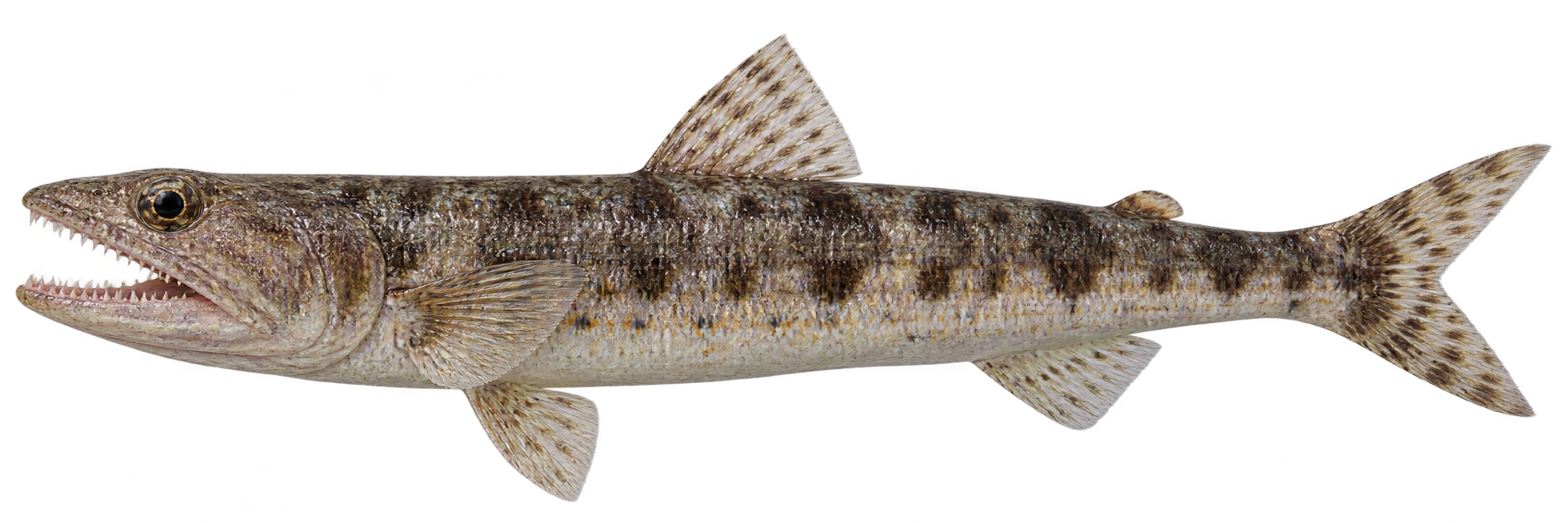
An inshore lizardfish can look like a piece of mottled debris until its eyes and long mouth come into focus. Its body is slender and nearly cylindrical, with a broad, somewhat flattened head, a pointed snout and jaws extending behind the eye. Small sharp teeth line the mouth. A normal dorsal fin rises near the middle of the back, while a much smaller, fleshy adipose fin sits farther toward the tail. Brownish mottling and bars help break up its outline against the bottom. Smithsonian identification guide.
The general shape identifies a lizardfish more readily than it identifies the species. Sand divers and other Synodus can look similar. A 2013 revision separated Synodus bondi from fishes previously grouped with S. foetens. Snout proportions, nostril-flap shape and fin-ray counts matter, so a distant photograph should not become a certain identification simply because the fish is lying on sand. Smithsonian-authored taxonomic revision.
Southeast Florida context
Biscayne National Park includes inshore lizardfish among fishes reported within the park, providing documented occurrence inside the Vero Beach–Key Largo corridor. That historical checklist does not establish present abundance or a dependable encounter at a named dive site. Biscayne fish checklist.
Its wider habitat includes shallow coastal and estuarine bottoms with sand, mud or mixed sediment. The seafloor beside vegetation or other structure can be as relevant as the reef itself. Habitat is useful context, but it cannot replace diagnostic anatomy.
Feeding and early life
This is a fish-eating predator, not a harmless-looking piece of driftwood. Its mouth and backward-pointing teeth help it seize prey. Remaining still can make it inconspicuous, although lizardfish also hunt actively. The Smithsonian account records free-floating eggs and larvae, so the early life stages occupy a different setting from a bottom-resting adult. Smithsonian species data.
Watching responsibly
Pause above the bottom rather than approaching head-on. A side photograph that includes the snout, dorsal fins and tail is more useful than a close-up of teeth alone. Do not uncover a buried fish, move it onto a cleaner background or feed it for a photograph. Keep fins and gauges out of the sediment.
This profile offers no harvest authorization or eating recommendation. Check current FWC recreational rules and the rules for the exact waterbody before any fishing or collection. A fish lacking a familiar sport-fish regulation is not automatically unrestricted.
Current Florida collection cautions
Reviewed November 12, 2026. No species-specific harvest allowance is asserted here. Check the applicable FWC fishing rules, gear requirements and exact protected-area boundaries before fishing or collection. Do not assume that absence from a familiar sport-fish list means unrestricted harvest. Official FWC recreational fishing rules
Blue Heron Bridge report
REEF’s Blue Heron Bridge / Phil Foster Park survey report includes Inshore lizardfish among species reported at this site. The cumulative volunteer survey record is not a guarantee of a sighting or evidence of current abundance. Blue Heron Bridge (BHB) is a Riviera Beach dive site at Phil Foster Park. Site-specific observation source.
Make your next dive happen
Dive With Us
Explore local charters and plan a dive suited to your experience.
View dive calendarTrain With Us
Build your fish identification, buoyancy and diving skills.
Explore trainingTravel With Us
Discover upcoming dive adventures and trip details.
Explore dive travelShop With Us
Browse equipment for your diving and ask our team for help choosing.
Explore dive gearReview current dates, availability, prices, inclusions and requirements on each listing before booking or buying.
Call us now
Ask about fish identification training
Reef Fish Identification
Ask about dates, prerequisites or your next step. An inquiry does not reserve a place. Please provide your own contact details; do not include medical, payment or a child's personal information.
We use these details to respond to your inquiry. This form does not sign you up for marketing.
Explore more with Stuart Scuba
Open Water course options · Advanced Adventure training · Technical training · Professional training · All courses · Local dives · Dive trips · Facebook · Instagram · YouTube
Your surface-interval essentials
Questions for Stuart Scuba? info@stuartscuba.com
Check the Stuart Scuba Weather Center · Play scuba trivia
Weather and wildlife vary. Confirm current conditions, trip requirements and departure details with the operator.
Plan Your Next Dive with Stuart Scuba
Dive With Us
Explore upcoming local charters and choose a dive that fits your experience.
Before you book
Check the individual listing for departure time, requirements and availability.
Travel With Us
Find upcoming dive adventures and start planning your next trip.
Plan your trip
Review dates, inclusions and trip details on the travel calendar.
Stay Connected with Stuart Scuba
 Follow pageShare
YouTube
SubscribeWatch & shareFollow on InstagramView & share post
Follow company news, training updates, and dive stories.
Follow on LinkedInGoogle Reviews
See Stuart Scuba’s current Google rating and review count below. Open the listing in Google Maps to browse customer reviews.



