

Fish identification archive / Horse Conch
Horse Conch
Triplofusus giganteus
I saw this
Spotted this marine animal? Share the guide with your dive buddies. Review your caption before posting.
For Instagram, copy the caption and link into your own post or message. Nothing is posted automatically and this does not record a verified sighting.
Fun facts for your next surface interval
- Florida’s state shell belongs to a snail that can eat other substantial snails.
- The name says conch, but its family tree puts it with spindle and tulip snails.
- Its bright orange body can be more conspicuous than the enormous shell it carries.
Florida and local context
Florida coastal waters, including southwest Florida: Museum accounts and documented feeding photographs establish Florida occurrence; no Palm Beach-specific claim.
Documented regional presence is not a guarantee of an encounter or a measure of how common this animal is at your dive site.
How to recognize this animal
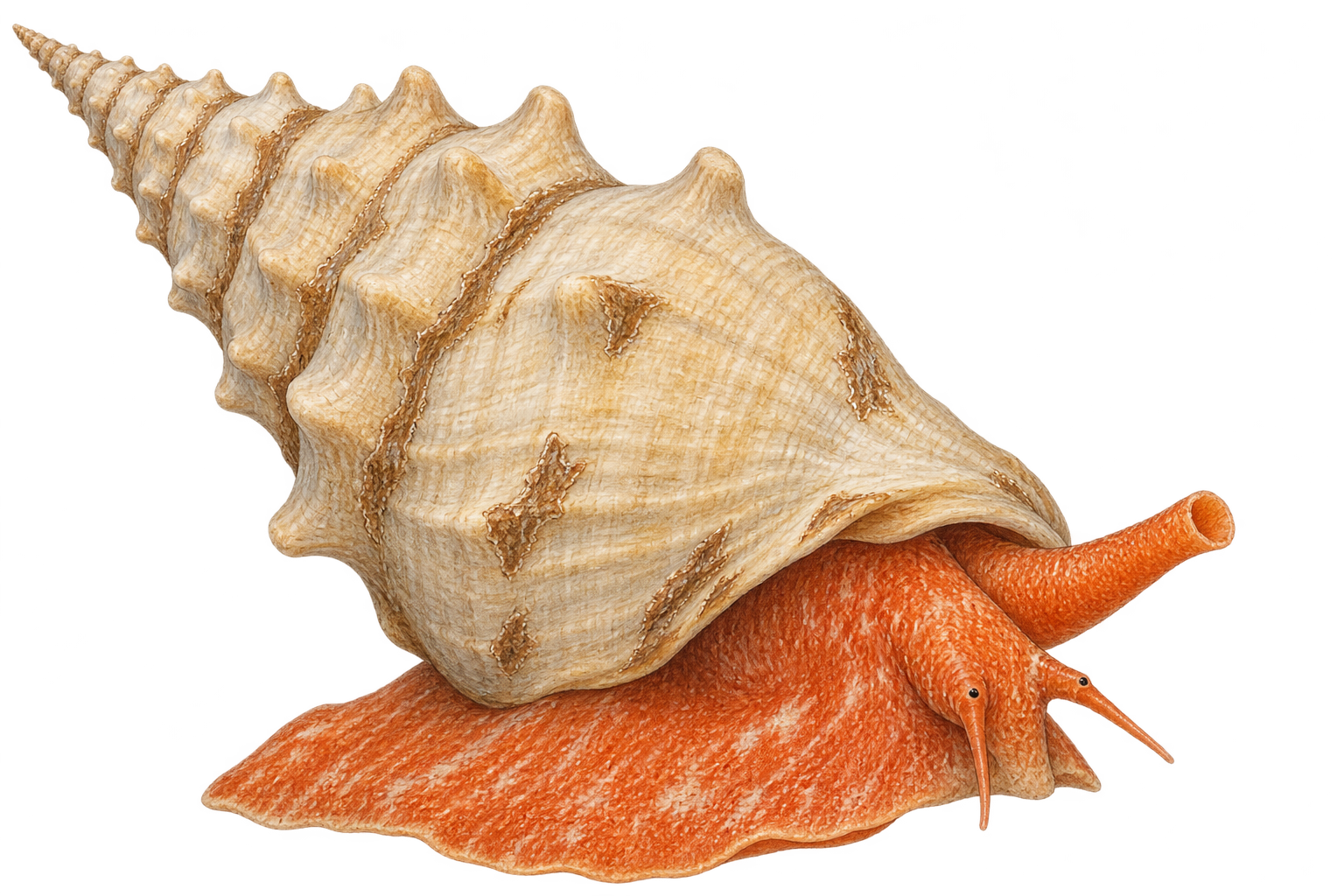
A long, spindle-shaped shell with a high spire and extended siphonal canal houses this impressive predatory snail. Living animals often expose a vivid orange foot and body. Older shells may be coated with growth, so the living color and overall shape are more useful than a pristine-shell illustration.
Size and life stages
Exceptional shells approach 60 centimeters, placing horse conch among the largest living marine snails. Most animals seen on dives or grass flats are substantially smaller. Shell length is the relevant measurement, not the distance covered by an extended siphon or crawling foot.
Habitat and where to look
Horse conchs live on Florida’s shallow coastal bottoms, including sandy and seagrass-associated habitat. An apparently quiet flat can support a large predator and its prey. Look carefully without digging, uprooting vegetation or dragging a fin over the places where small snails shelter.
Range and local context
The species is strongly associated with Florida and neighboring western Atlantic and Gulf waters. Florida museum accounts and photographs of natural feeding document its presence. This profile does not imply that giant adults are common or that any particular Palm Beach site guarantees one.
What is on the menu?
Other mollusks are important prey, including sizable snails. A documented Florida feeding photograph shows a horse conch consuming a fighting conch. Its imposing size is functional: this is an active predator, not simply a decorative shell rolling around on the bottom. Its prey choices place the horse conch higher in the local food web than algae-grazing true conchs. A fighting conch and a horse conch can therefore share a grass flat while having very different feeding roles. The shell’s long canal accommodates the siphon, part of the snail’s connection with the surrounding water while its foot moves over the bottom.
Daily habits and behavior
The bright orange body can extend well beyond the shell while the animal crawls or feeds. A tough outer coating may hide much of the shell’s original color.
Mating and the next generation
Females attach clusters of egg capsules to firm surfaces, with developing shells visible inside photographed capsules. A Florida study using shell-growth records proposed that females first reproduce at about six or seven years, relatively late within the reconstructed lifespan. Losing large breeding females can therefore remove animals that took years to reach maturity, rather than individuals rapidly replaced by the next season’s young.
Look-alikes and identification traps
Tulip snails share a spindle-shaped outline but remain smaller and differ in shell proportions and pattern. Queen conch has a broad flared lip and is a true conch. Despite its common name, horse conch belongs to the tulip-and-spindle-snail family, not Strombidae.
Observe without disturbing
Watch the foot’s contact with the bottom and the direction of travel rather than expecting rapid movement. Do not lift, turn or pry a feeding animal away from its prey. Large adults are valuable parts of a coastal ecosystem, not photo props. Florida’s state-shell designation celebrates the species but is separate from the legal harvest and local collection restrictions summarized below. Dive with Stuart Scuba to explore Florida marine life with an emphasis on careful observation. Ask about current conditions and an appropriate dive plan; wildlife sightings remain unpredictable.
Harvest, protection and eating safety
Live-shell collection restrictions apply; not the queen-conch rule
Can it be hunted or harvested?
Horse conch is not queen conch and is not listed in the reviewed restricted marine-life species schedule. Where lawful, general recreational limits apply: 100 pounds or two individuals of the species per person per day, whichever is greater. A saltwater license is required for a shell containing a live animal, including collection from shore, unless a statutory exemption applies. A genuinely empty shell is different, but a hermit crab or other occupant makes it living wildlife. Hand collection must not damage protected coral or live rock. Leaving the animal in place is the preferred dive practice.
Florida seasons and areas
No species-specific statewide recreational closed season or minimum size was identified in the reviewed rules. Lee County prohibits collecting these live shells; Manatee County allows no more than two live shells of any one species per person per day. Empty shells and protected sites have separate rules. The Blue Heron Bridge area prohibits designated ornamental marine life collection; do not use this profile as permission to collect at the bridge. Park, refuge and Florida Keys sanctuary zones can prohibit collection even where general state rules allow it. Check the exact site and current boundaries before any take. The Lee rule also restricts possession in county waters seaward of mean high water; Manatee’s two-animal restriction applies to possession in those waters as well as daily harvest. Empty shells must not be obtained by killing, mutilating or removing the living mollusk.
Can it be speared?
No species-specific statewide spearing ban was identified in the reviewed rules. Spearing is still prohibited in restricted areas, including within 100 yards of public swimming beaches, public fishing piers and bridge sections where public fishing is allowed. Hand collection or an appropriate lawful net is the practical choice for this animal; do not damage coral or live rock.
Is it safe to eat?
No unconditional safe-to-eat designation is made for this species. Legal shell collection is not food-safety approval, and this archive does not recommend it as a food target. Florida DOH warns that marine gastropods such as conchs and whelks can carry red-tide toxins acquired through their food. Do not harvest or eat them from red-tide-affected or closed areas. Cooking, heating and freezing do not remove these toxins; taste and smell are not reliable tests.
Before you act: This recreational overview is not permission to collect or spear at your dive site. Confirm the species, date, management area, state or federal waters, gear, licenses and current local closures. Identification artwork cannot establish an identification or guarantee seafood safety.
Official rules and health guidance
- FWC: Recreational Sea Shell Collecting
- Florida Administrative Code: Marine Life, Chapter 68B-42
- FAC 68B-42.001: restricted-species definitions (LII reproduction; current effective date checked against official FAC index)
- FWC: Recreational Marine Life
- FWC: Saltwater Recreational Licenses and Permits
- NOAA: Florida Keys Sanctuary Marine Zones
- FWC: Spearing and Restricted Areas
- FWC: Unregulated Species and Default Limits
- Florida Department of Health: Seafood Poisoning
- FDA: Selecting and Serving Seafood Safely
- Florida Administrative Code: Southwest Florida Shells, Chapter 68B-26
- FAC 68B-26.002: live shellfish definition (LII reproduction)
- FAC 68B-26.004: Lee and Manatee restrictions (LII reproduction)
Reviewed 2026-11-10. Rules and advisories can change; check the linked authorities before harvesting or eating.
Sources and review
Reviewed 2026-11-10.
- jaxshells.org: Horse Conch
- floridamuseum.ufl.edu: Horse Conch
- shellmuseum.org: Horse Conch
- Jaxshells: Horse Conch egg capsule with embryonic shells
- PLOS ONE: Age and growth of the Florida Horse Conch
- Bailey-Matthews National Shell Museum: Horse Conch
- World Register of Marine Species: Horse Conch
- Taxonomic reference: Horse Conch
- Taxonomic reference: Horse Conch
Make your next dive happen
Dive With Us
Explore local charters and plan a dive suited to your experience.
View dive calendarTrain With Us
Build your fish identification, buoyancy and diving skills.
Explore trainingTravel With Us
Discover upcoming dive adventures and trip details.
Explore dive travelShop With Us
Browse equipment for your diving and ask our team for help choosing.
Explore dive gearReview current dates, availability, prices, inclusions and requirements on each listing before booking or buying.
Call us now
Ask about marine life identification
Marine Life Identification
Ask about dates, prerequisites or your next step. An inquiry does not reserve a place. Please provide your own contact details; do not include medical, payment or a child's personal information.
We use these details to respond to your inquiry. This form does not sign you up for marketing.
Explore more with Stuart Scuba
Open Water course options · Advanced Adventure training · Technical training · Professional training · All courses · Local dives · Dive trips · Facebook · Instagram · YouTube
Your surface-interval essentials
Questions for Stuart Scuba? info@stuartscuba.com
Check the Stuart Scuba Weather Center · Play scuba trivia
Weather and wildlife vary. Confirm current conditions, trip requirements and departure details with the operator.
Plan Your Next Dive with Stuart Scuba
Dive With Us
Explore upcoming local charters and choose a dive that fits your experience.
Before you book
Check the individual listing for departure time, requirements and availability.
Travel With Us
Find upcoming dive adventures and start planning your next trip.
Plan your trip
Review dates, inclusions and trip details on the travel calendar.
Stay Connected with Stuart Scuba
 Follow pageShare
YouTube
SubscribeWatch & shareFollow on InstagramView & share post
Follow company news, training updates, and dive stories.
Follow on LinkedInGoogle Reviews
See Stuart Scuba’s current Google rating and review count below. Open the listing in Google Maps to browse customer reviews.



