

Fish identification archive / Hogfish
Hogfish
Lachnolaimus maximus
I saw this
Spotted this marine animal? Share the guide with your dive buddies. Review your caption before posting.
For Instagram, copy the caption and link into your own post or message. Nothing is posted automatically and this does not record a verified sighting.
Fun facts for your next surface interval
- Hog snapper is a nickname; biologically, this fish is a wrasse.
- Its piglike snout helps it root through the bottom for food.
- Some females later become males, so reproductive roles can change during a hogfish's life.
Florida and local context
Lake Worth Lagoon / Blue Heron Bridge, Palm Beach County: Florida Museum checklist explicitly marks this species verified. This documents occurrence, not local abundance.
Documented regional presence is not a guarantee of an encounter or a measure of how common this animal is at your dive site.
How to recognize this animal
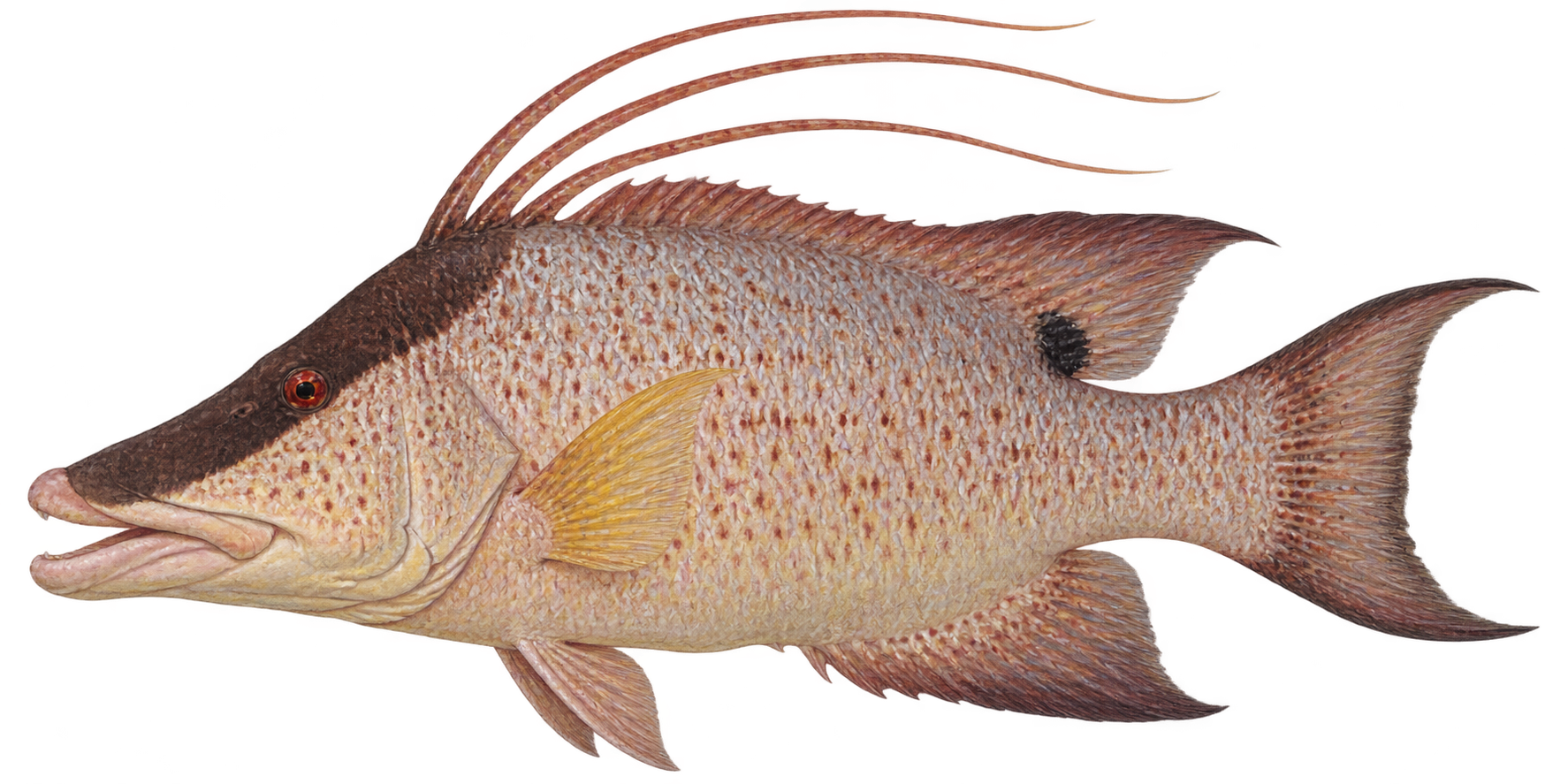
The hogfish's long piglike snout, deep oval body and three trailing front dorsal spines make an excellent identification combination. Large males often have a dark mask running from the snout up the forehead, while smaller fish can be much paler or reddish. Look also for the red iris and dark mark near the rear base of the dorsal fin.
Size and life stages
Hogfish can reach approximately 3 feet, or 91 centimeters, in total length. A maximum is not a typical encounter size, and juveniles are far smaller. Their deep bodies can make them look especially large when they turn broadside. A dive-log size estimate should remain approximate; the legally required measurement is a separate question addressed in the harvest guidance.
Habitat and where to look
They use reefs, hard sand, rock and patch-reef edges, with young fish also associated with seagrass. Much of the interesting activity happens near the bottom, where the elongated snout can investigate food. Look across open spaces between structure instead of only into holes. Keep enough distance to watch a fish complete a feeding sequence without redirecting its path.
Range and local context
The species lives in the western Atlantic, including Florida, the Gulf region and the Caribbean. Florida Museum verifies hogfish in Lake Worth Lagoon, providing a documented Palm Beach County record. Occurrence does not establish a regular encounter at a bridge, reef or wreck. Site conditions, habitat and the day's dive plan still determine what can reasonably be observed.
What is on the menu?
Mollusks are important prey, alongside crustaceans and other bottom-living animals. The protrusible mouth and strong jaws help collect and process food from sand and rubble. A puff of sediment can mark a feeding attempt rather than a fish being clumsy. Watch where the snout enters the bottom, but never dig alongside the fish to uncover additional prey.
Daily habits and behavior
Hogfish can change color, and their appearance also differs with age and reproductive phase. A large dark-faced male and a pale smaller individual should not be treated as separate species. The distinctive body shape and long dorsal spines remain useful anchors. Color alone becomes even less reliable at depth, where ambient light changes the appearance of red and brown.
Mating and the next generation
Hogfish are protogynous: some begin reproductive life as females and later become males. Social structure influences that transition, and groups may contain a dominant male with several females. Spawning releases eggs into open water, followed by a drifting larval stage. These reproductive facts do not predict the sex of every fish from size alone or establish a local spawning date.
Look-alikes and identification traps
Spotfin and Spanish hogfish are smaller wrasses with different color layouts and without the same dramatic trio of trailing dorsal spines. Despite the nickname hog snapper, Lachnolaimus maximus belongs to the wrasse family, not the snapper family. Use the snout, body depth and fin structure together when the dark facial mask is absent or hard to see.
Observe without disturbing
Let the fish search naturally and avoid turning a feeding encounter into a chase. Photograph the complete outline, including all three long dorsal spines, from a position that does not block its route. For anyone considering harvest, the separate regional rules are essential: the familiar common name and a good identification do not establish that the season is open.
Harvest, protection and eating safety
Regulated food fish: Atlantic/Keys seasonal closure; Gulf limits differ
Can it be hunted or harvested?
Hogfish (Lachnolaimus maximus) has food-fish rules, unlike ornamental Bodianus hogfish. Gulf state and federal waters north of Cape Sable: minimum 14 inches fork length and five per person daily. Atlantic and all state/federal waters south of Cape Sable, including the Keys: minimum 16 inches fork length and one per person daily. In Biscayne National Park, that one fish also counts toward the park’s ten-fish aggregate. Applicable saltwater licensing and reef-fish gear requirements apply.
Florida seasons and areas
Atlantic/Florida Keys annual harvest season: May 1–October 31; closed November 1–April 30. This region is closed on the November 10, 2026 review date. Gulf north of Cape Sable has no regular seasonal closure. The federal west-coast stock boundary is 25°09′ N latitude. Emergency and quota notices may change availability. Local closures still apply, including Biscayne National Park’s mapped bonefish pre-spawning area, closed to fishing and fish possession March 1–May 31 with a properly stowed continuous-transit exception. Check Florida Keys sanctuary zones before fishing. Western Dry Rocks’ designated one-square-mile area is closed to all fishing April 1–July 31 annually.
Can it be speared?
Allowed only where spearfishing is lawful and the fish meets all size, bag and seasonal rules. Florida exclusions include within 100 yards of public swimming beaches, fishing piers and bridges open to fishing, the specified jetty buffer, state-park waters, and Monroe County from Long Key north to the Miami-Dade line. Florida prohibits powerheads and rebreathers under its spearing rules. Check sanctuary and other site restrictions before entering the water. South Atlantic federal spearfishing gear may not be used with rebreathers.
Is it safe to eat?
Edible when legally retained, but not automatically safe. Check Florida DOH fish advisories for the catch location and consumer group, especially for children and anyone pregnant or breastfeeding. Reef-fish ciguatoxin is not removed by cooking or freezing and cannot be detected by taste or smell. Do not eat reef-fish heads, liver, intestines or roe, or reef fish from an area under a ciguatera advisory. Chill promptly and cook to 145°F; cooking does not remove mercury. Florida DOH specifically lists hogfish in its coastal mercury-consumption advice.
Before you act: This recreational overview is not permission to collect or spear at your dive site. Confirm the species, date, management area, state or federal waters, gear, licenses and current local closures. Identification artwork cannot establish an identification or guarantee seafood safety.
Official rules and health guidance
- FWC hogfish limits, Cape Sable boundary and seasons
- 50 CFR 622.37: Gulf federal minimum sizes
- 50 CFR 622.38: Gulf federal bag and aggregate limits
- FWC Biscayne National Park limits and closed areas
- FWC recreational saltwater licenses and exemptions
- South Atlantic Council Florida hogfish federal rules
- NOAA Gulf seasonal and current fishery closures
- NOAA South Atlantic seasonal closures
- NOAA Florida Keys sanctuary zones
- FWC species and location restrictions on spearing
- Florida DOH advisory booklet currently linked from its seafood page
- Florida DOH seafood-consumption guidance
- Florida DOH location-specific fish-advisory search
- Florida DOH ciguatera and other seafood poisoning
- FDA safe seafood handling and cooking
- FDA/EPA questions about mercury and fish preparation
- FWC Western Dry Rocks seasonal closure
Reviewed 2026-11-10. Rules and advisories can change; check the linked authorities before harvesting or eating.
Sources and review
Reviewed 2026-11-10.
Make your next dive happen
Dive With Us
Explore local charters and plan a dive suited to your experience.
View dive calendarTrain With Us
Build your fish identification, buoyancy and diving skills.
Explore trainingTravel With Us
Discover upcoming dive adventures and trip details.
Explore dive travelShop With Us
Browse equipment for your diving and ask our team for help choosing.
Explore dive gearReview current dates, availability, prices, inclusions and requirements on each listing before booking or buying.
Call us now
Ask about marine life identification
Marine Life Identification
Ask about dates, prerequisites or your next step. An inquiry does not reserve a place. Please provide your own contact details; do not include medical, payment or a child's personal information.
We use these details to respond to your inquiry. This form does not sign you up for marketing.
Explore more with Stuart Scuba
Open Water course options · Advanced Adventure training · Technical training · Professional training · All courses · Local dives · Dive trips · Facebook · Instagram · YouTube
Your surface-interval essentials
Questions for Stuart Scuba? info@stuartscuba.com
Check the Stuart Scuba Weather Center · Play scuba trivia
Weather and wildlife vary. Confirm current conditions, trip requirements and departure details with the operator.
Plan Your Next Dive with Stuart Scuba
Dive With Us
Explore upcoming local charters and choose a dive that fits your experience.
Before you book
Check the individual listing for departure time, requirements and availability.
Travel With Us
Find upcoming dive adventures and start planning your next trip.
Plan your trip
Review dates, inclusions and trip details on the travel calendar.
Stay Connected with Stuart Scuba
 Follow pageShare
YouTube
SubscribeWatch & shareFollow on InstagramView & share post
Follow company news, training updates, and dive stories.
Follow on LinkedInGoogle Reviews
See Stuart Scuba’s current Google rating and review count below. Open the listing in Google Maps to browse customer reviews.



