

Fish identification archive / Green Sea Turtle
Green Sea Turtle
Chelonia mydas
Fun facts for your next surface interval
- Wrong paint swatch: the name green turtle refers to greenish body fat, not a necessarily green shell.
- A menu that grows up: young oceanic green turtles eat both animal and plant material before their largely herbivorous coastal life.
- Long-term homecoming: a female may return to the region where she hatched several decades earlier to lay eggs.
Florida and local context
Florida coastal waters and nesting beaches: Florida nesting and coastal feeding habitat
Documented regional presence is not a guarantee of an encounter or a measure of how common this animal is at your dive site.
How to recognize this animal
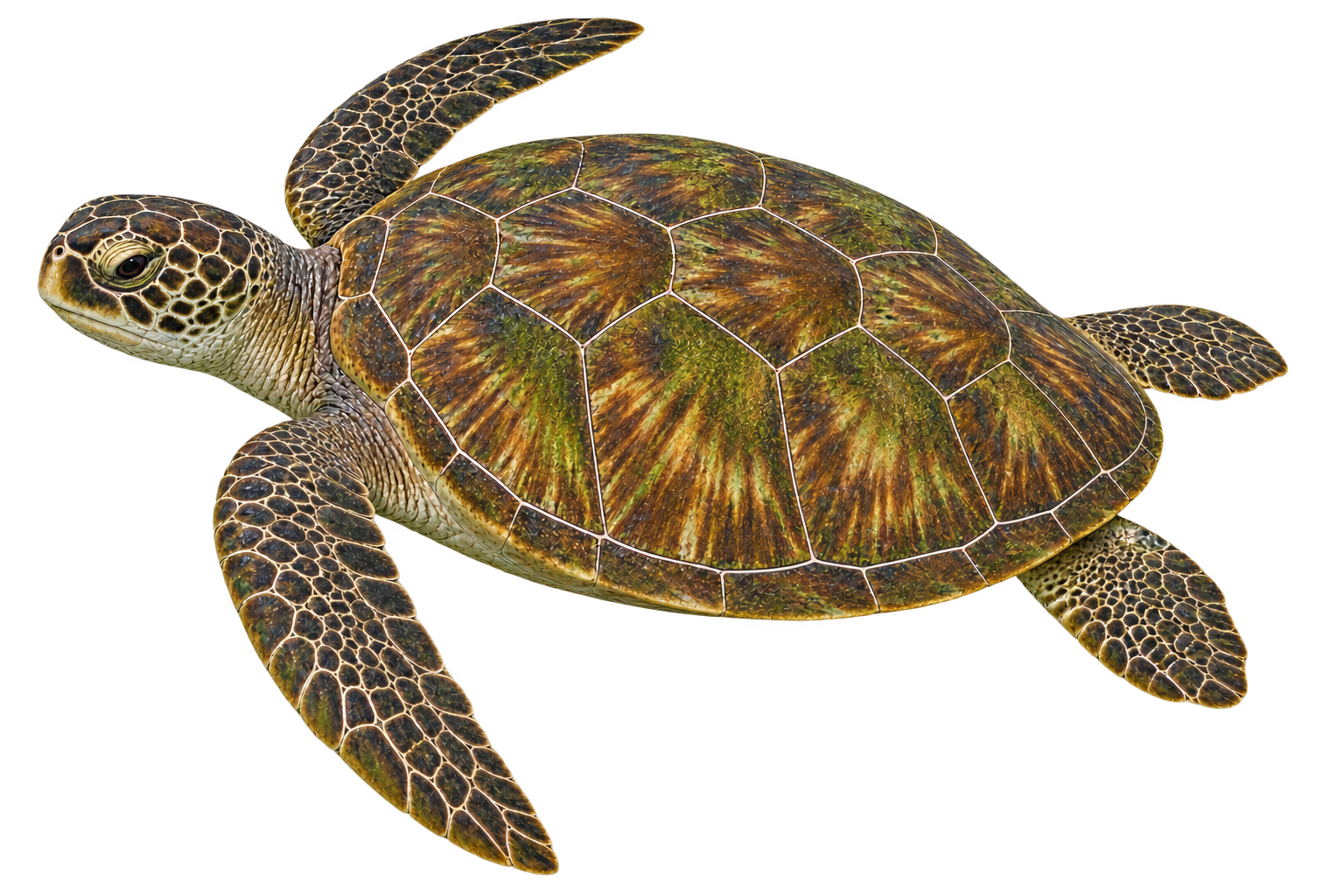
The small head, smooth-looking oval shell and one pair of large scales between the eyes distinguish a green turtle. There are four lateral scutes on each side of the carapace. Adults may look olive, gray or brown rather than bright green. Youngsters often have attractive radiating or sunburst shell markings that can cause confusion with a hawksbill.
Size and life stages
Adult carapace length is commonly about 90–122 centimeters, or three to four feet, in the National Park Service species account. NOAA describes typical adults weighing roughly 300–350 pounds. These are adult reference sizes rather than minimum identification thresholds. Juveniles using coastal feeding grounds may be much smaller, and a photograph without scale cannot establish an animal's age.
Habitat and where to look
Young green turtles begin in oceanic drift communities, including floating Sargassum, before moving into shallow coastal feeding habitat. Florida seagrass meadows and flats provide forage; reef ledges and other structures can offer resting areas. Protecting both food beds and quieter resting habitat matters. A turtle observed on a reef need not have been feeding on coral.
Range and local context
Green turtles occur widely in the Atlantic, Pacific and Indian oceans and the Mediterranean. Florida has both coastal feeding habitat and an important nesting population. The verified regional claim here is Florida, not guaranteed occurrence at Blue Heron Bridge. NOAA currently lists the North Atlantic distinct population segment as threatened; global conservation assessments and older state-profile wording are not interchangeable with that federal designation.
What is on the menu?
Older green turtles feed predominantly on seagrasses and algae, unlike the mainly animal-eating diets of other sea turtles. This is not an absolute rule for every age or population: oceanic juveniles eat plant and animal material, and greens may take invertebrates or other animal food. Their serrated beak edges suit cropping vegetation, but bait is not appropriate wildlife food.
Daily habits and behavior
Green turtles can travel hundreds to thousands of miles between coastal feeding areas and nesting beaches. Breeding migrations generally recur after intervals of several years rather than annually for every female. All must surface to breathe. A turtle that leaves a feeding patch or rises through the water needs an unobstructed route, not a circle of approaching divers.
Mating and the next generation
NOAA estimates female maturity at roughly 25–35 years. Nesting females return to the general region of their natal beach and may lay successive clutches about two weeks apart. A typical nest contains around 110 eggs, which incubate for about two months. Florida nesting is concentrated in the warmer months; those dates describe reproduction, never a collection season.
Look-alikes and identification traps
Juvenile hawksbills can share a patterned brown shell, but their beak is more hooked, their scutes usually overlap and they have two pairs of scales between the eyes. Loggerheads have much bulkier heads and usually five lateral scutes per side. Use several visible features together, since algae, camera angle and juvenile coloration can make a single clue unreliable.
Observe without disturbing
Observe grazing without swimming between the turtle and the surface or resting area. Do not touch, chase, feed or offer bait. Avoid standing on seagrass or anchoring into it while watching. On shore, leave nests and hatchlings alone and keep beachfront lights from shining onto sand. Entangled or injured turtles need trained responders rather than improvised handling by observers.
Harvest, protection and eating safety
Protected: no recreational take
Florida and applicable federal protection apply year-round: no ordinary recreational harvest season, open-area exception or spearing allowance. Nesting, breeding or viewing seasons do not authorize take. This is not a lawful recreational food target.
This color is a qualified summary, not permission to collect or a guarantee that a particular catch is safe to eat. Read the current rules and health guidance below.
Threatened North Atlantic DPS; protected, no recreational take
Can it be hunted or harvested?
Green Sea Turtle is not a recreational harvest target. NOAA currently lists the North Atlantic green turtle distinct population segment as threatened; other populations have different listings. Florida’s Marine Turtle Protection Act also protects turtles, eggs and nests. Recreational taking, possession and disturbance are prohibited; scientific or conservation permits are separate authorizations, not ordinary fishing privileges.
Florida seasons and areas
There is no Florida recreational harvest season, open area, bag limit or edible-size exception for this protected animal. Protection applies year-round in Florida and under applicable federal law. Nesting months describe reproduction, not a legal harvest window. Park, refuge and beach restrictions can add further protections.
Can it be speared?
No. Spearing, shooting, injuring or killing this protected sea turtle is not an authorized recreational activity. An otherwise open spearfishing area does not create an exception for the animal.
Is it safe to eat?
Not a lawful recreational food target. This guide provides no assurance that its meat, eggs or other tissues are safe to eat; protected status and the absence of a named consumption advisory are not a food-safety assessment.
Before you act: This recreational overview is not permission to collect or spear at your dive site. Confirm the species, date, management area, state or federal waters, gear, licenses and current local closures. Identification artwork cannot establish an identification or guarantee seafood safety.
Official rules and health guidance
- NOAA Fisheries: Green Sea Turtle biology and current ESA status
- FWC: Green Sea Turtle Florida profile
- FWC: Marine Turtle Protection Act and protected sea turtles
Reviewed 2026-11-10. Rules and advisories can change; check the linked authorities before harvesting or eating.
Sources and review
Reviewed 2026-11-10.
Make your next dive happen
Dive With Us
Explore local charters and plan a dive suited to your experience.
View dive calendarTrain With Us
Build your fish identification, buoyancy and diving skills.
Explore trainingTravel With Us
Discover upcoming dive adventures and trip details.
Explore dive travelShop With Us
Browse equipment for your diving and ask our team for help choosing.
Explore dive gearReview current dates, availability, prices, inclusions and requirements on each listing before booking or buying.
Call us now
Ask about marine life identification
Marine Life Identification
Ask about dates, prerequisites or your next step. An inquiry does not reserve a place. Please provide your own contact details; do not include medical, payment or a child's personal information.
We use these details to respond to your inquiry. This form does not sign you up for marketing.
Explore more with Stuart Scuba
Open Water course options · Advanced Adventure training · Technical training · Professional training · All courses · Local dives · Dive trips · Facebook · Instagram · YouTube
Your surface-interval essentials
Questions for Stuart Scuba? info@stuartscuba.com
Check the Stuart Scuba Weather Center · Play scuba trivia
Weather and wildlife vary. Confirm current conditions, trip requirements and departure details with the operator.
Plan Your Next Dive with Stuart Scuba
Dive With Us
Explore upcoming local charters and choose a dive that fits your experience.
Before you book
Check the individual listing for departure time, requirements and availability.
Travel With Us
Find upcoming dive adventures and start planning your next trip.
Plan your trip
Review dates, inclusions and trip details on the travel calendar.
Stay Connected with Stuart Scuba
 Follow pageShare
YouTube
SubscribeWatch & shareFollow on InstagramView & share post
Follow company news, training updates, and dive stories.
Follow on LinkedInGoogle Reviews
See Stuart Scuba’s current Google rating and review count below. Open the listing in Google Maps to browse customer reviews.



