

Fish identification archive / Greater Amberjack
Greater Amberjack
Seriola dumerili
I saw this
Spotted this marine animal? Share the guide with your dive buddies. Review your caption before posting.
For Instagram, copy the caption and link into your own post or message. Nothing is posted automatically and this does not record a verified sighting.
Fun facts for your next surface interval
- The dark eye band is angled upward rather than running straight down the flank.
- A juvenile can wear six dark body bars that disappear from the familiar adult appearance.
- Its eggs drift in the water even though adults often associate with offshore structure.
Florida and local context
Florida regional range; potential Lake Worth Lagoon occurrence: Florida occurrence is documented by the linked species references. The Lake Worth Lagoon checklist includes this species but leaves the Verified cell blank; its lagoon occurrence is treated here as potential, not confirmed.
Documented regional presence is not a guarantee of an encounter or a measure of how common this animal is at your dive site.
How to recognize this animal
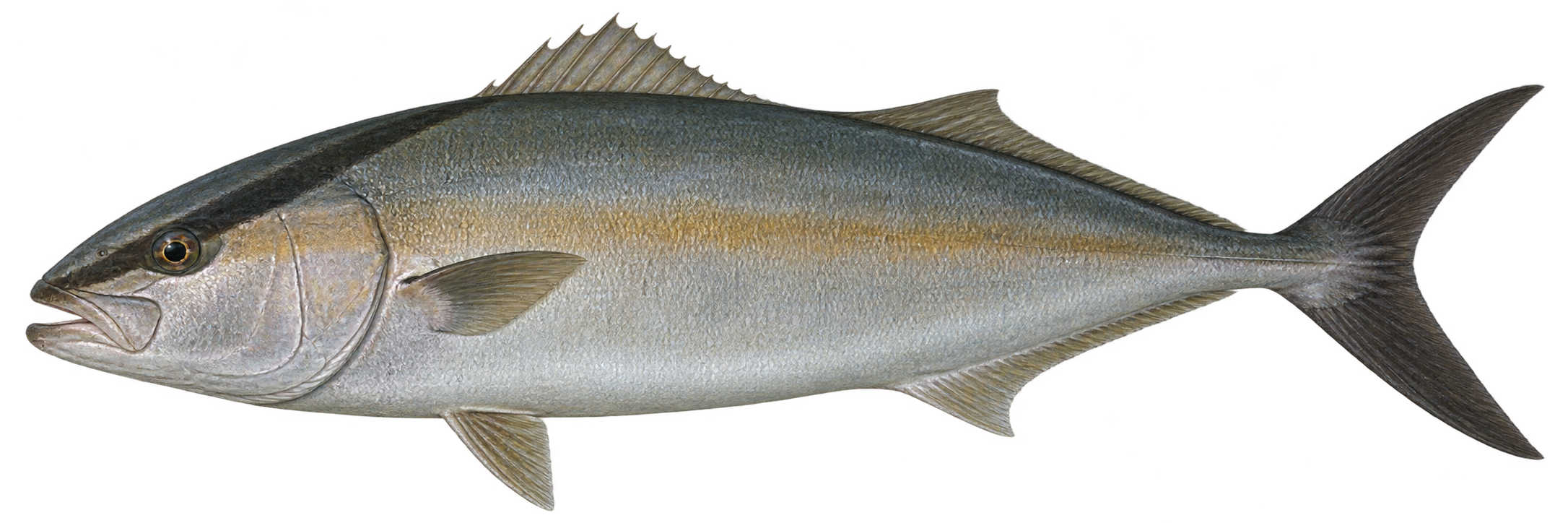
A greater amberjack has a long, muscular spindle-shaped body with a blue-gray or olive back and silvery lower sides. A dusky diagonal band often passes through the eye toward the first dorsal fin. An amber-colored stripe may run along the flank. The second dorsal and anal leading lobes are relatively low compared with those of an almaco jack.
Size and life stages
The species can become very large; Smithsonian reports a maximum near 75 inches, or 190 centimeters. Juveniles below about 20 centimeters may carry six dark, irregularly divided body bars. Those bars do not extend onto the dorsal and anal fins. Large size alone is not diagnostic, because other Seriola species can also grow into substantial fishes.
Habitat and where to look
Adults occur around deep seaward reefs, drop-offs and associated open water, and sometimes enter coastal bays. Many large-fish records fall within roughly 18 to 72 meters, with a much wider overall depth range. Young fish associate with floating plants or debris. Habitat changes through life, so an offshore juvenile is not simply using a smaller adult territory.
Range and local context
Greater amberjacks occur in warm seas widely, including the western Atlantic from Nova Scotia through Florida to Brazil. Florida Museum lists the species for Lake Worth Lagoon without verification. Its documented Florida range warrants this profile, while a lagoon record remains potential. Offshore Palm Beach encounters should be described as possibilities, never as guaranteed attractions or automatic fishing opportunities.
What is on the menu?
Fishes are the main prey, including schooling species such as bigeye scad. Squid and other invertebrates can also be eaten. A large amberjack near a school of small fishes may be hunting, but proximity alone does not establish an attack. Watch for actual pursuit and prey capture rather than assuming every pass around a wreck is feeding.
Daily habits and behavior
Juveniles can occur alone or in small schools and use floating cover. Adults' strong swimming and association with offshore structure can make them conspicuous passing visitors. The relatively short pectoral fins and absence of hard lateral-line scutes help distinguish Seriola from many other jacks. Keep the complete silhouette in view instead of concentrating only on the amber flank color.
Mating and the next generation
Greater amberjack eggs are pelagic, and the larvae develop in the water column. Reproductive timing varies across the species' broad range, so generalized summer-spawning accounts are not presented as a Palm Beach calendar. The April Atlantic harvest closure is a management rule described separately below, not proof that every local fish spawns during that one month.
Look-alikes and identification traps
Almaco jacks are usually deeper-bodied and have a much taller second-dorsal leading lobe. Lesser amberjacks and banded rudderfish can complicate young-fish identifications. Compare the head band, body bars, proportions and fin lobes before deciding. The distinction matters biologically and legally: the greater amberjack's size limits and seasonal rules must not be transferred indiscriminately to other jacks.
Observe without disturbing
Remain within the planned dive route when a fish passes into open water. A side photograph including both dorsal fins is more useful than a close head shot. Do not bait or pursue a fish to keep it nearby. If identification is uncertain, record Seriola species and seek a better image instead of making a harvest decision.
Harvest, protection and eating safety
Seasonal fishery: Gulf closed now; Atlantic closed each April
Can it be hunted or harvested?
Greater amberjack has specific limits. Atlantic state and federal waters: minimum 28 inches fork length and one fish per person per day during an open season. Gulf state and federal waters: minimum 34 inches fork length and one per person per day only when open; the 2026 Gulf season has ended. During the federal Gulf closure, bag and possession are zero. In Biscayne National Park the species also counts toward the 10-fish listed-species aggregate, without increasing the one-fish species limit. Private-boat anglers and divers age 16 or older targeting this species also need the annual State Reef Fish Angler designation unless a listed vessel or activity exemption applies; ordinary fishing-license exemptions do not necessarily exempt this designation.
Florida seasons and areas
Reviewed 2026-11-10: Atlantic state and federal waters are scheduled open January–March and May–December, and closed throughout April. The 2026 Gulf opening was September 1–October 13, not the older August–October pattern. NOAA closed Gulf federal recreational harvest at 12:01 a.m. October 14, 2026 until September 1, 2027; no 2027 season length is promised here. FWC lists the same 2026 open dates for Gulf state waters. The federal Gulf charter/headboat closure also applies when those vessels fish state waters. Check current notices and local closures before any trip.
Can it be speared?
Spears are listed as legal gear for amberjack, but only when the fishery is open and all size, bag and area rules are met. The current Gulf closure means no recreational taking there by spear. Atlantic rules differ, and the general FWC prohibited spearing locations still apply. A legal species or season does not authorize spearing beside a bridge, swimming beach, pier or within a restricted park.
Is it safe to eat?
Greater amberjack can carry ciguatera toxin, and mercury advisories may limit consumption. It is not automatically safe to eat because it meets the legal size limit. Consult current Florida DOH advice for the catch location and consumer group, especially for children and people who are pregnant or may become pregnant. Cooking and freezing do not reliably eliminate ciguatera toxin.
Before you act: This recreational overview is not permission to collect or spear at your dive site. Confirm the species, date, management area, state or federal waters, gear, licenses and current local closures. Identification artwork cannot establish an identification or guarantee seafood safety.
Official rules and health guidance
- FWC current amberjack rules
- NOAA 2026 Gulf greater amberjack season and closure
- FWC Biscayne National Park exceptions
- FWC spearing species and location restrictions
- Florida DOH current fish-consumption advisory portal
- Florida DOH seafood-poisoning guidance
- FDA advice about eating fish
- FWC saltwater recreational licensing
- FWC State Reef Fish Angler designation
Reviewed 2026-11-10. Rules and advisories can change; check the linked authorities before harvesting or eating.
Sources and review
Reviewed 2026-11-10.
Make your next dive happen
Dive With Us
Explore local charters and plan a dive suited to your experience.
View dive calendarTrain With Us
Build your fish identification, buoyancy and diving skills.
Explore trainingTravel With Us
Discover upcoming dive adventures and trip details.
Explore dive travelShop With Us
Browse equipment for your diving and ask our team for help choosing.
Explore dive gearReview current dates, availability, prices, inclusions and requirements on each listing before booking or buying.
Call us now
Ask about marine life identification
Marine Life Identification
Ask about dates, prerequisites or your next step. An inquiry does not reserve a place. Please provide your own contact details; do not include medical, payment or a child's personal information.
We use these details to respond to your inquiry. This form does not sign you up for marketing.
Explore more with Stuart Scuba
Open Water course options · Advanced Adventure training · Technical training · Professional training · All courses · Local dives · Dive trips · Facebook · Instagram · YouTube
Your surface-interval essentials
Questions for Stuart Scuba? info@stuartscuba.com
Check the Stuart Scuba Weather Center · Play scuba trivia
Weather and wildlife vary. Confirm current conditions, trip requirements and departure details with the operator.
Plan Your Next Dive with Stuart Scuba
Dive With Us
Explore upcoming local charters and choose a dive that fits your experience.
Before you book
Check the individual listing for departure time, requirements and availability.
Travel With Us
Find upcoming dive adventures and start planning your next trip.
Plan your trip
Review dates, inclusions and trip details on the travel calendar.
Stay Connected with Stuart Scuba
 Follow pageShare
YouTube
SubscribeWatch & shareFollow on InstagramView & share post
Follow company news, training updates, and dive stories.
Follow on LinkedInGoogle Reviews
See Stuart Scuba’s current Google rating and review count below. Open the listing in Google Maps to browse customer reviews.



