

Fish identification archive / Great star coral
Great star coral
Montastraea cavernosa
Fun facts for your next surface interval
Florida and local context
Studivan and colleagues (2021) report eleven Montastraea cavernosa colonies collected from Breakers Reef (26.6908 N, -80.0181 W) at depths of 13–17 m for their experiment. This is historical field-collection evidence, not a current census.
A documented past record does not establish present abundance or guarantee an encounter.
Sources: Studivan and colleagues (2021): thermal stress and estuarine discharge in southeast Florida corals
How to recognize this animal
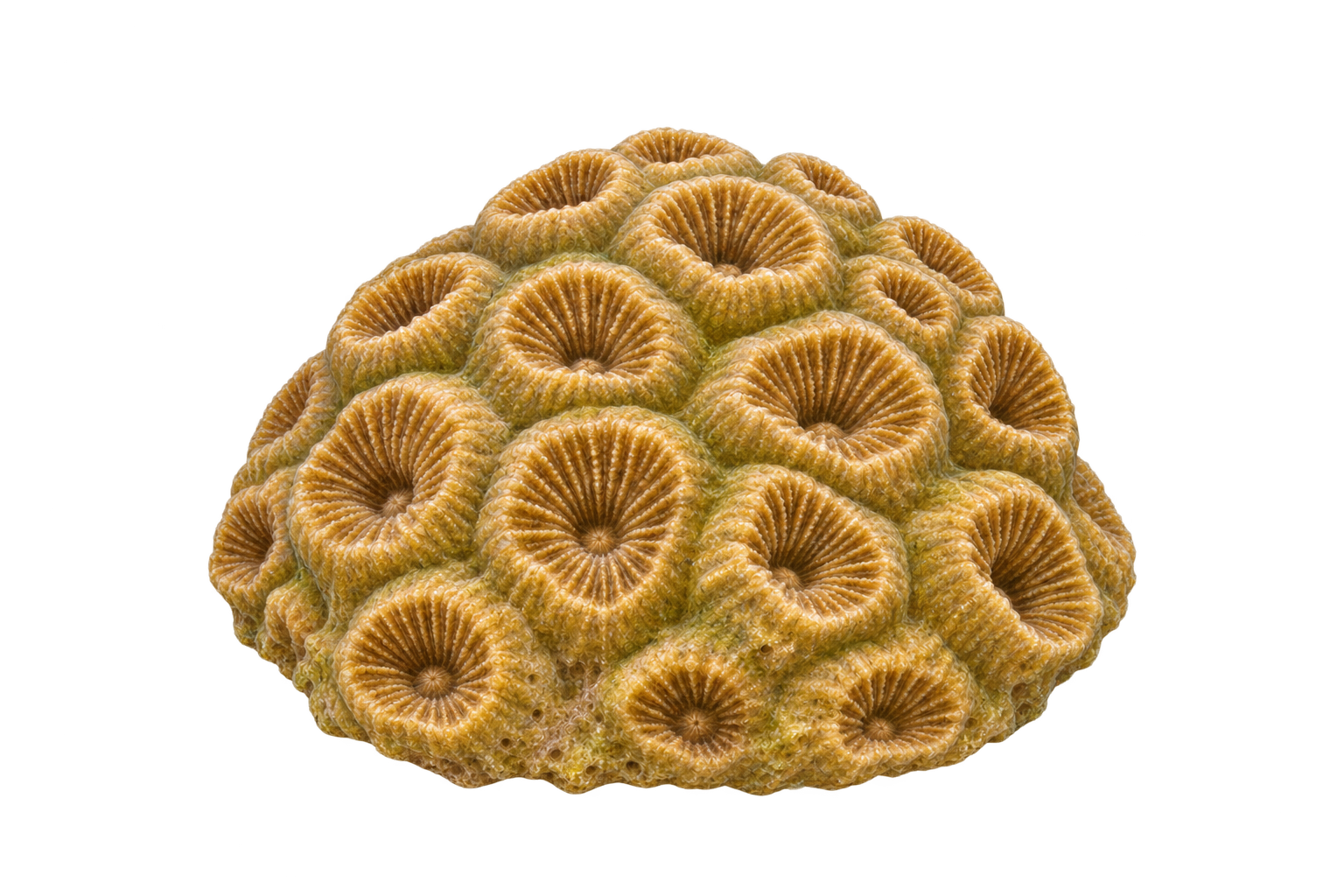
Great star coral forms rounded masses, domes or flatter plates covered in distinct cup-like corallites, the skeletal homes of individual polyps. Raised, often cone-shaped cups and alternating long and short internal ridges are useful features. Colors include green, brown, gray and orange. Examine the repeated cup pattern along with the whole colony shape; color varies too much to stand alone as an identification.
Size and life stages
A colony is a community of connected polyps, not one enormous polyp. The University of the West Indies account reports colony diameters of 10–250 cm, while individual corallites are only several millimeters across. This wide scale difference is useful for photography: take a whole-colony view and a separate, non-contact detail image rather than trying to show everything in one frame.
Sources: University of the West Indies: Great star coral ecology
Habitat and where to look
The species occupies a variety of reef environments, including lower slopes. Its growth can be boulder-like or plate-like, so a flattened colony should not automatically be excluded. Local research provides a precise example: eleven colonies were collected at Breakers Reef from 13–17 m depth for a southeast Florida stress-response study. That collection history does not describe the present condition of every nearby colony.
Sources: Corals of the World: Montastraea cavernosa; Studivan and colleagues (2021): thermal stress and estuarine discharge in southeast Florida corals
Range and local context
Great star coral is an Atlantic species found around the Caribbean, Gulf of Mexico, Bahamas and Bermuda, extending to Brazil and parts of West Africa. In Palm Beach County, Breakers Reef is directly documented in peer-reviewed field work. Different colony colors, shapes and symbiotic partners should not be counted as additional coral species in a regional wildlife total.
Sources: University of the West Indies: Great star coral ecology; Studivan and colleagues (2021): thermal stress and estuarine discharge in southeast Florida corals
What is on the menu?
The coral gains nutrition through both its own feeding and its partnership with photosynthetic algae living in its tissues. Polyps capture suspended animal prey with their tentacles, while the algae supply products of photosynthesis. A living coral surface is therefore active feeding tissue. Treat it as an animal colony rather than as a rock or convenient place to steady a camera.
Sources: University of the West Indies: Great star coral ecology
Daily habits and behavior
Polyp extension varies: some colonies expand during daylight as well as darkness, while others are mainly nocturnal. A colony with retracted polyps is not automatically dead. Conversely, a single image cannot diagnose whether pale tissue is healthy, bleached or recovering. Record what is visible without scraping, brushing or touching the surface to test its response.
Sources: University of the West Indies: Great star coral ecology
Mating and the next generation
Great star coral releases eggs or sperm into the water. A 2024 laboratory study reproduced seasonal temperature and light cycles and observed synchronized summer spawning. It also documented colonies switching sex between years in either direction. The usual description of separate male and female colonies therefore needs that qualification. These controlled observations do not promise spawning on a particular Breakers Reef dive.
Sources: Laforest and colleagues (2024): induced spawning reveals bidirectional sex change
Look-alikes and identification traps
Other massive star corals can share a rounded overall silhouette. For an identification record, photograph the individual corallites and their spacing, not just the colony outline. Montastrea cavernosa is a historical spelling encountered in older sources. Use the accepted Montastraea cavernosa consistently so spelling variants do not create duplicate species records.
Observe without disturbing
Maintain neutral buoyancy and keep fins, hoses, gauges and camera equipment clear. Never rest on a colony, remove pieces or clear sediment from it for a photograph. Keep a written site and date record with natural-light context when possible. Breakers Reef occurrence is documented, but neither a healthy colony nor a particular encounter is guaranteed.
Harvest, protection and eating safety
Protected stony coral; no recreational take or destruction
Red marks the prohibition on ordinary recreational harvest and destruction of this stony coral. It is not a statement about food quality or an unsupported claim of Endangered Species Act listing.
This color is a qualified summary, not permission to collect or a guarantee that a particular animal is safe to eat.
Can it be hunted or harvested?
Great star coral, Montastraea cavernosa, is a stony coral in order Scleractinia. Florida prohibits ordinary taking, attempted taking or destruction of stony corals; there is no recreational bag, size or open-season allowance to use here. Special scientific or aquaculture authorizations are narrow exceptions, not permissions carried by an ordinary diver or fishing license.
Florida seasons and areas
The Florida prohibition is statewide, including Palm Beach. Federal South Atlantic and Gulf prohibited-coral rules separately prohibit take and possession with narrow authorized exceptions. Florida Keys sanctuary rules also prohibit removal or injury of coral. These are coral protections, distinct from the Blue Heron Bridge tropical-ornamental collection closure. A research paper describing permitted collection at Breakers Reef does not authorize public collection there.
Can it be speared?
No. Do not spear, chip, break, detach or take this coral. Maintain neutral buoyancy and keep hands, fins and equipment away from the colony.
Is it safe to eat?
Not lawful recreational food harvest. No recipe or consumption advice is provided.
Montastraea cavernosa is a stony coral, not an octocoral. The limited octocoral harvest provisions do not apply. This review does not label the species ESA-listed.
Palm Beach is Atlantic Florida. Do not transfer Atlantic guidance to the Gulf, Monroe County, or federal waters without checking the applicable rules.
Before you act: Confirm the species, date, exact management area, state or federal waters, gear, licenses and current local closures. A local occurrence record never grants permission to take an animal.
Official rules and health guidance
- FWC recreational marine-life requirements and species list
- FWC: Florida coral protections
- Florida Rule 68B-42.009: coral taking and destruction prohibition
- 50 CFR 622.223: South Atlantic prohibited coral
- 50 CFR 622.73: Gulf prohibited coral
- 50 CFR 622.2: prohibited-coral definitions
- NOAA: Florida Keys sanctuary regulations
- NOAA: Florida Keys sanctuary zones
- 50 CFR 622.220: narrow South Atlantic prohibited-coral permit purposes
- 50 CFR 622.70: narrow Gulf prohibited-coral permit purposes
Reviewed 2026-11-11. Rules and advisories can change; check the linked authorities before acting.
Identification and source cautions
- No current census or colony-health assessment is inferred from historic scientific collections.
- Sex change was documented ex situ; its frequency in local wild colonies is not established here.
- Colony form, color, genotype and symbiont differences are not separate species.
Sources and review
Biology and taxonomy reviewed 2026-11-11. Photographs on cited sites are reference material and are not reproduced here.
- Corals of the World: Montastraea cavernosa
- University of the West Indies: Great star coral ecology
- Studivan and colleagues (2021): thermal stress and estuarine discharge in southeast Florida corals
- Laforest and colleagues (2024): induced spawning reveals bidirectional sex change
- WoRMS: accepted taxonomy
Make your next dive happen
Dive With Us
Explore local charters and plan a dive suited to your experience.
View dive calendarTrain With Us
Build your fish identification, buoyancy and diving skills.
Explore trainingTravel With Us
Discover upcoming dive adventures and trip details.
Explore dive travelShop With Us
Browse equipment for your diving and ask our team for help choosing.
Explore dive gearReview current dates, availability, prices, inclusions and requirements on each listing before booking or buying.
Call us now
Ask about marine life identification
Marine Life Identification
Ask about dates, prerequisites or your next step. An inquiry does not reserve a place. Please provide your own contact details; do not include medical, payment or a child's personal information.
We use these details to respond to your inquiry. This form does not sign you up for marketing.
Explore more with Stuart Scuba
Open Water course options · Advanced Adventure training · Technical training · Professional training · All courses · Local dives · Dive trips · Facebook · Instagram · YouTube
Your surface-interval essentials
Questions for Stuart Scuba? info@stuartscuba.com
Check the Stuart Scuba Weather Center · Play scuba trivia
Weather and wildlife vary. Confirm current conditions, trip requirements and departure details with the operator.
Plan Your Next Dive with Stuart Scuba
Dive With Us
Explore upcoming local charters and choose a dive that fits your experience.
Before you book
Check the individual listing for departure time, requirements and availability.
Travel With Us
Find upcoming dive adventures and start planning your next trip.
Plan your trip
Review dates, inclusions and trip details on the travel calendar.
Stay Connected with Stuart Scuba
 Follow pageShare
YouTube
SubscribeWatch & shareFollow on InstagramView & share post
Follow company news, training updates, and dive stories.
Follow on LinkedInGoogle Reviews
See Stuart Scuba’s current Google rating and review count below. Open the listing in Google Maps to browse customer reviews.



