

Fish identification archive / Gray Triggerfish
Gray Triggerfish
Balistes capriscus
I saw this
Spotted this marine animal? Share the guide with your dive buddies. Review your caption before posting.
For Instagram, copy the caption and link into your own post or message. Nothing is posted automatically and this does not record a verified sighting.
Fun facts for your next surface interval
- Its dorsal spine has a built-in lock, operated by a smaller trigger spine.
- It can use a water jet to uncover a buried meal.
- Baby gray triggerfish may grow up around floating Sargassum rather than an adult reef ledge.
Florida and local context
Lake Worth Lagoon / Blue Heron Bridge, Palm Beach County: Florida Museum checklist explicitly marks this species verified. This documents occurrence, not local abundance.
Documented regional presence is not a guarantee of an encounter or a measure of how common this animal is at your dive site.
How to recognize this animal
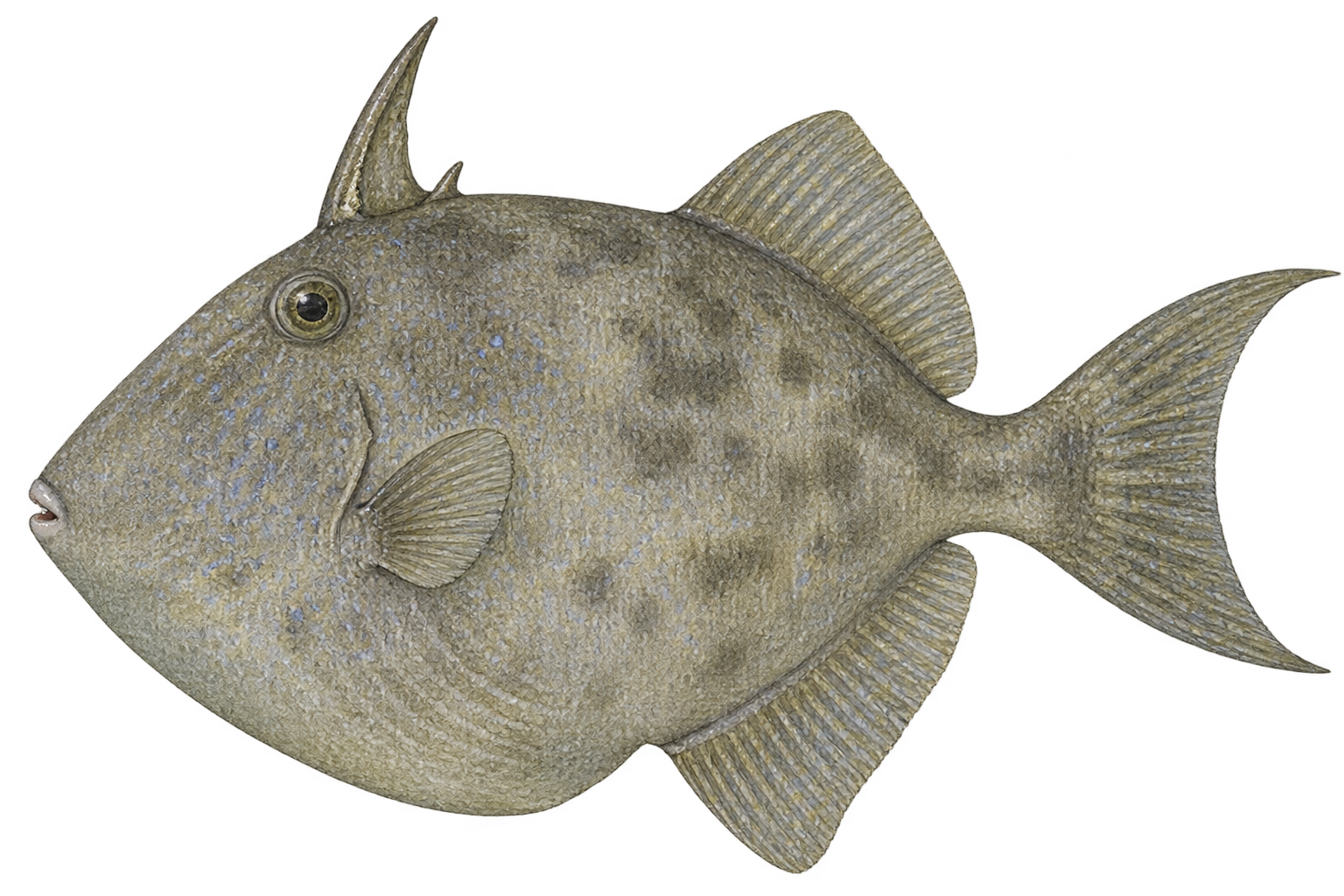
A gray triggerfish has a deep, flattened body, a small mouth and an eye set high and well behind the snout. Its first dorsal spine is strong and can stand upright; a separate soft dorsal fin mirrors the anal fin farther back. Adults are gray to olive-brown, sometimes with blue flecks or faint blotches, and larger fish have pointed tail lobes.
Size and life stages
The published maximum is about 30 inches, or 76 centimeters, in total length. Many fish are appreciably smaller. Because the tail has projecting lobes, total length and fork length are different measurements. This distinction matters when reading harvest rules. For an identification record, note an approximate overall size rather than trying to take a legal measurement from a passing fish.
Habitat and where to look
Hard bottom, reef ledges and artificial structure provide adult habitat. Juveniles can associate with floating Sargassum near the surface, a very different setting from the adult's bottom-oriented routine. Scan nearby sand as well as the structure itself. A triggerfish moving off a reef may be beginning a feeding trip rather than abandoning its habitat.
Range and local context
Gray triggerfish occur on both sides of the Atlantic, including Florida's Atlantic and Gulf waters. Florida Museum explicitly marks the species verified in Lake Worth Lagoon. Its presence in a regional guide does not tell you whether a fishery is open today: Atlantic and Gulf management differ. Local occurrence and current harvest permission are separate pieces of information.
What is on the menu?
The strong small mouth handles bottom-living prey such as crustaceans, mollusks and echinoderms. Gray triggerfish have been observed blowing water into sand to uncover buried food. Their feeding can involve manipulating a sand dollar to reach it more effectively. This is a particularly rewarding behavior to watch quietly, without exposing prey or placing an object in the fish's path.
Daily habits and behavior
The famous trigger is mechanical: the smaller second dorsal spine helps lock and release the larger first spine. That arrangement can help a fish wedge into shelter. During ordinary swimming, the soft dorsal and anal fins provide much of the propulsion. A seemingly stiff-bodied fish is still making many precise fin movements to control its position.
Mating and the next generation
Gray triggerfish build and defend bottom nests. Males establish nesting territories, and females attend eggs rather than simply releasing an unguarded cloud into open water. Nest defense is a reason to give a persistent fish extra room. Do not approach a patch repeatedly to test its reaction or mistake defensive behavior for an invitation to interact.
Look-alikes and identification traps
Queen triggerfish have a much more conspicuous blue facial pattern and striking fin colors. Filefishes generally have a more slender leading dorsal spine and different body proportions. Adult gray triggerfish can be fairly plain, so use the robust spine, separate soft fins, small high eye and tail shape together. A single gray underwater photograph may need cautious identification.
Observe without disturbing
Watch feeding or nest behavior from outside the fish's path and back away if it repeatedly approaches. Keep fingers clear of the powerful mouth. Never pull a triggerfish from a crevice or try its locking spine by hand. Photographs and natural observations are enough. Check the separate regional harvest and seafood guidance before drawing any conclusion from this species' popularity with anglers.
Harvest, protection and eating safety
Regulated food fish: Gulf seasonal closures; Atlantic rules differ
Can it be hunted or harvested?
Gulf state and federal waters: minimum 15 inches fork length and one per person daily; the federal fish also counts toward the twenty-reef-fish aggregate. Atlantic state and federal waters: minimum 12 inches fork length and ten per person daily; in federal waters these count toward the twenty-fish other snapper-grouper aggregate. Biscayne National Park requires 14 inches fork length and includes gray triggerfish in the park ten-fish aggregate. These are gray triggerfish rules, not the live-collection rules for queen triggerfish.
Florida seasons and areas
Gulf annual recreational openings: March 1–May 31 and August 1–December 31; closed January–February and June–July. These dates apply to Gulf state and federal waters, subject to early quota closures. NOAA’s reviewed 2026 table did not list an additional gray-triggerfish quota closure. Atlantic state and federal recreational harvest has no regular annual seasonal closure in the reviewed rules. Local closures still apply, including Biscayne National Park’s mapped bonefish pre-spawning area, closed to fishing and fish possession March 1–May 31 with a properly stowed continuous-transit exception. Check Florida Keys sanctuary zones before fishing. Western Dry Rocks’ designated one-square-mile area is closed to all fishing April 1–July 31 annually.
Can it be speared?
Allowed only where spearfishing is lawful and the fish meets all size, bag and seasonal rules. Florida exclusions include within 100 yards of public swimming beaches, fishing piers and bridges open to fishing, the specified jetty buffer, state-park waters, and Monroe County from Long Key north to the Miami-Dade line. Florida prohibits powerheads and rebreathers under its spearing rules. Check sanctuary and other site restrictions before entering the water. Gray triggerfish is specifically exempted from the ornamental-triggerfish spearing ban. South Atlantic federal spearfishing may not use rebreathers.
Is it safe to eat?
Gray triggerfish is a food fish, but this guide does not guarantee an individual catch is safe. Check Florida DOH local advice. If no advisory exists, FDA/EPA advises its pregnancy, breastfeeding and child audiences to eat only one serving and no other fish that week. Apply reef-fish ciguatera precautions: avoid head and viscera, and do not rely on cooking or freezing to eliminate toxin. Chill promptly and cook to 145°F.
Before you act: This recreational overview is not permission to collect or spear at your dive site. Confirm the species, date, management area, state or federal waters, gear, licenses and current local closures. Identification artwork cannot establish an identification or guarantee seafood safety.
Official rules and health guidance
- FWC gray triggerfish limits and seasons
- 50 CFR 622.37: Gulf federal minimum sizes
- 50 CFR 622.38: Gulf federal bag and aggregate limits
- South Atlantic Council gray triggerfish federal rules
- FWC Biscayne National Park limits and closed areas
- NOAA Gulf seasonal and current fishery closures
- NOAA Gulf recreational quota-closure monitoring
- NOAA Florida Keys sanctuary zones
- FWC species and location restrictions on spearing
- Florida DOH seafood-consumption guidance
- Florida DOH location-specific fish-advisory search
- FDA/EPA advice for pregnancy, breastfeeding and children
- Florida DOH ciguatera and other seafood poisoning
- FDA safe seafood handling and cooking
- FWC Western Dry Rocks seasonal closure
Reviewed 2026-11-10. Rules and advisories can change; check the linked authorities before harvesting or eating.
Sources and review
Reviewed 2026-11-10.
Make your next dive happen
Dive With Us
Explore local charters and plan a dive suited to your experience.
View dive calendarTrain With Us
Build your fish identification, buoyancy and diving skills.
Explore trainingTravel With Us
Discover upcoming dive adventures and trip details.
Explore dive travelShop With Us
Browse equipment for your diving and ask our team for help choosing.
Explore dive gearReview current dates, availability, prices, inclusions and requirements on each listing before booking or buying.
Call us now
Ask about marine life identification
Marine Life Identification
Ask about dates, prerequisites or your next step. An inquiry does not reserve a place. Please provide your own contact details; do not include medical, payment or a child's personal information.
We use these details to respond to your inquiry. This form does not sign you up for marketing.
Explore more with Stuart Scuba
Open Water course options · Advanced Adventure training · Technical training · Professional training · All courses · Local dives · Dive trips · Facebook · Instagram · YouTube
Your surface-interval essentials
Questions for Stuart Scuba? info@stuartscuba.com
Check the Stuart Scuba Weather Center · Play scuba trivia
Weather and wildlife vary. Confirm current conditions, trip requirements and departure details with the operator.
Plan Your Next Dive with Stuart Scuba
Dive With Us
Explore upcoming local charters and choose a dive that fits your experience.
Before you book
Check the individual listing for departure time, requirements and availability.
Travel With Us
Find upcoming dive adventures and start planning your next trip.
Plan your trip
Review dates, inclusions and trip details on the travel calendar.
Stay Connected with Stuart Scuba
 Follow pageShare
YouTube
SubscribeWatch & shareFollow on InstagramView & share post
Follow company news, training updates, and dive stories.
Follow on LinkedInGoogle Reviews
See Stuart Scuba’s current Google rating and review count below. Open the listing in Google Maps to browse customer reviews.



