

Fish identification archive / Gray Snapper
Gray Snapper
Lutjanus griseus
I saw this
Spotted this fish? Share the guide with your dive buddies. Review your caption before posting.
For Instagram, copy the caption and link into your own post or message. Nothing is posted automatically and this does not record a verified sighting.
Fun facts for your next surface interval
- Not fussy about the salt shaker: it tolerates a wide range of salinity.
- Home sweet reef, lease renewed: adults may stay locally for years.
- Late-night takeaway: shrimp and small fish feature on the night menu.
Palm Beach connection
Lake Worth Lagoon / Blue Heron Bridge: Verified species row in Florida Museum local checklist.
Documented regional presence is not a guarantee of an encounter or a measure of how common this fish is at your dive site.
How to recognize this fish
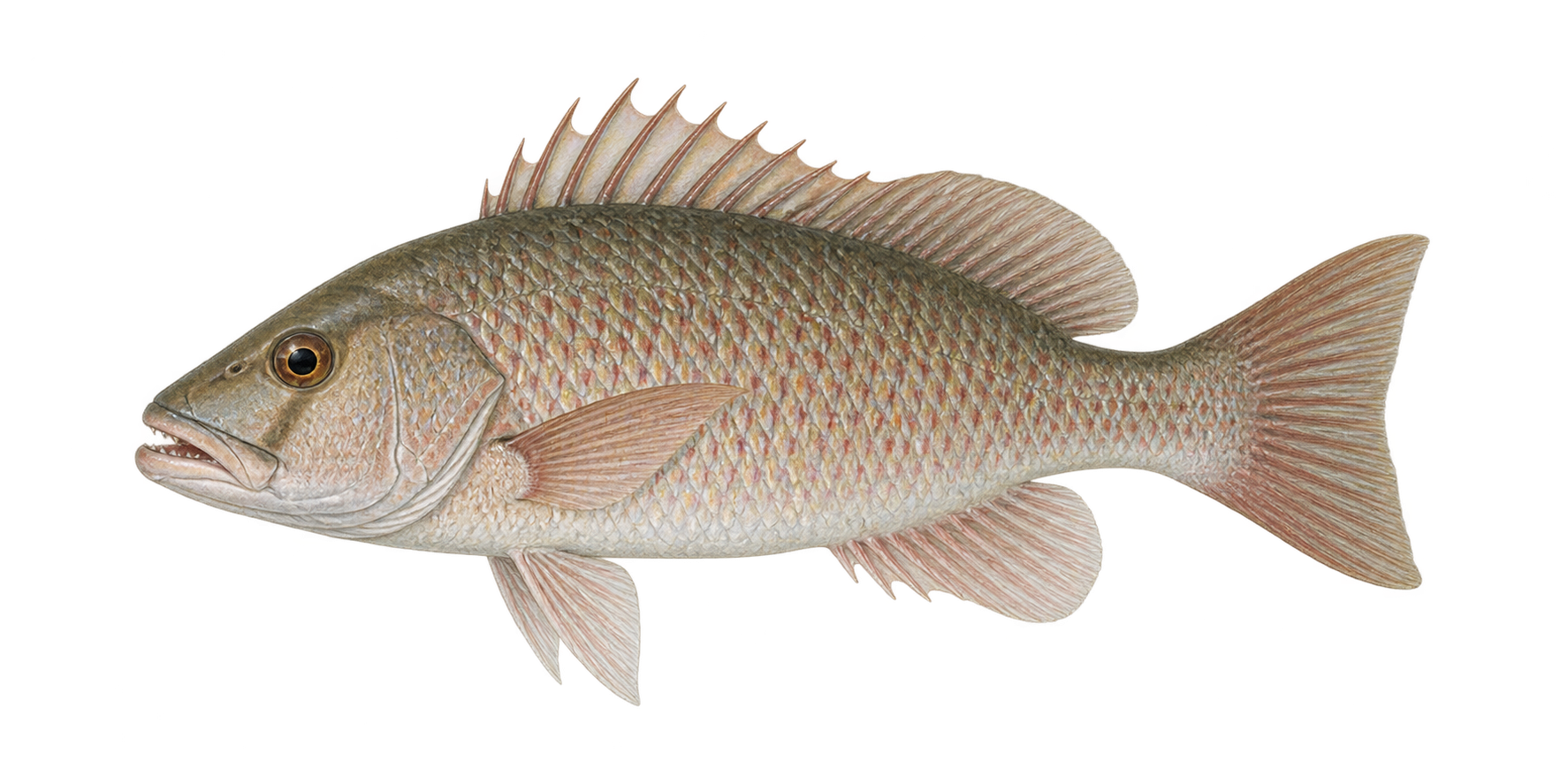
Also called Mangrove Snapper, this fish is relatively slender for a snapper, with a pointed head, substantial mouth and short pectoral fins. Colors range through gray, olive and reddish tones. Young fish often show a dark stripe through the eye. The tail is only slightly concave and the anal fin has a rounded rear outline. Do not expect one uniform shade of gray.
Size and life stages
Smithsonian reports a maximum around 66 cm and cautions that larger records may involve Cubera Snapper. The museum notes that many observed fish are below 45 cm. This guide uses those qualified figures instead of repeating an unverified giant maximum. Juveniles can have stronger bars and cheek markings than adults; pattern intensity alone does not identify a separate species.
Habitat and where to look
Mangroves, estuaries, seagrass, rocky reefs and other structure all feature in its habitat use. The species tolerates a broad salinity range and can occur in lower river reaches. A coastal nursery and an offshore reef may hold different size classes of the same fish. The common name 'Mangrove Snapper' should not make a reef sighting seem out of place.
Range and local context
The western Atlantic range includes the U.S. coast, Gulf of Mexico and Caribbean. Smithsonian warns that Brazilian records have been confused with another species, so this page avoids automatically extending the range to every old published locality. Florida Museum's verified Lake Worth Lagoon entry supplies direct local evidence for the Palm Beach region.
What is on the menu?
Gray Snappers take fish and a variety of small animals, especially crustaceans. Feeding opportunities differ with size and habitat: a small juvenile in seagrass is not using exactly the same prey field as a larger reef fish. Adults commonly forage after dark. A daytime group near a ledge may be sheltering rather than actively hunting at that moment.
Daily habits and behavior
Adults can remain associated with a local area for long periods while making daily movements related to feeding and shelter. Daytime schooling and nighttime foraging are compatible parts of that routine. Avoid assuming that a fish returning toward a ledge is following a diver; its route may simply lead back to familiar cover.
Mating and the next generation
Spawning occurs in aggregations and is associated with seasonal and lunar patterns. Eggs and larvae develop in the water column; this is not a species described here as guarding an attached nest. Exact timing differs with place and conditions, so a general account should not be used to promise a breeding event during a particular Palm Beach dive.
Look-alikes and identification traps
Small Cubera Snappers can be difficult to distinguish from Gray Snappers. Some technical characters involve teeth on the roof of the mouth and are unsuitable for a casual underwater check. Never handle or force open a fish's mouth for identification. Use the visible combination of body shape, fin outlines, markings and locality, and retain uncertainty when those features do not settle it.
Observe without disturbing
Watch from outside shelter entrances and avoid blocking a group's route. Keep fins clear of seagrass and mangrove-associated bottom habitat, and do not offer food to draw fish into a photograph. A whole-body image and a note about approximate size and habitat support later comparison. It is acceptable to log an uncertain snapper rather than disturbing it for a definitive label.
Harvest, protection and eating safety
Regulated recreational harvest; restrictions apply
Can it be hunted or harvested?
Also called mangrove snapper. Florida state waters on either coast: minimum 10 inches total length and five per person daily, within ten combined snappers. Federal waters: minimum 12 inches and ten within the snapper aggregate. Biscayne National Park has special size and aggregate rules.
Florida seasons and areas
No regular seasonal closure is listed for Florida Atlantic/Palm Beach or Gulf recreational harvest. Confirm the fishing location, current notices and protected-area restrictions. State waters extend three nautical miles on the Atlantic and nine in the Gulf, and the state and federal size and bag limits differ.
Can it be speared?
Allowed where lawful, for legal-sized fish within the applicable season and bag limits. Check the site before diving: beaches, piers, parks and parts of the Keys have exclusions. Florida state waters prohibit using rebreathers or powerheads to harvest this species.
Is it safe to eat?
Edible, but not automatically safe. Check Florida DOH consumption advisories for the catch location, especially for children and anyone who is or might become pregnant or is breastfeeding. Reef fish can carry ciguatoxin, which cannot be detected by taste or removed by cooking or freezing. Avoid the head, liver, intestines and roe, and do not eat reef fish from areas under a ciguatera advisory. Mercury meal limits and ciguatera precautions address different risks.
Before you act: This recreational overview is not permission to collect or spear at your dive site. Confirm the species, date, management area, state or federal waters, gear, licenses and current local closures. A fish illustration cannot establish an identification or guarantee seafood safety.
Official rules and health guidance
- FWC snapper recreational rules
- NOAA Gulf seasons and closures
- FWC spearing rules
- Florida DOH seafood poisoning
- Florida DOH local fish advisories
- FDA/EPA fish consumption guidance
- Florida Administrative Code: state-water diving gear
Reviewed 2026-11-10. Rules and advisories can change; check the linked authorities before harvesting or eating.
Sources and review
Reviewed 2026-11-10.
Make your next dive happen
Dive With Us
Explore local charters and plan a dive suited to your experience.
View dive calendarTrain With Us
Build your fish identification, buoyancy and diving skills.
Explore trainingTravel With Us
Discover upcoming dive adventures and trip details.
Explore dive travelShop With Us
Browse equipment for your diving and ask our team for help choosing.
Explore dive gearReview current dates, availability, prices, inclusions and requirements on each listing before booking or buying.
Call us now
Ask about fish identification training
Reef Fish Identification
Ask about dates, prerequisites or your next step. An inquiry does not reserve a place. Please provide your own contact details; do not include medical, payment or a child's personal information.
We use these details to respond to your inquiry. This form does not sign you up for marketing.
Explore more with Stuart Scuba
Open Water course options · Advanced Adventure training · Technical training · Professional training · All courses · Local dives · Dive trips · Facebook · Instagram · YouTube
Your surface-interval essentials
Questions for Stuart Scuba? info@stuartscuba.com
Check the Stuart Scuba Weather Center · Play scuba trivia
Weather and wildlife vary. Confirm current conditions, trip requirements and departure details with the operator.
Plan Your Next Dive with Stuart Scuba
Dive With Us
Explore upcoming local charters and choose a dive that fits your experience.
Before you book
Check the individual listing for departure time, requirements and availability.
Travel With Us
Find upcoming dive adventures and start planning your next trip.
Plan your trip
Review dates, inclusions and trip details on the travel calendar.
Stay Connected with Stuart Scuba
 Follow pageShare
YouTube
SubscribeWatch & shareFollow on InstagramView & share post
Follow company news, training updates, and dive stories.
Follow on LinkedInGoogle Reviews
See Stuart Scuba’s current Google rating and review count below. Open the listing in Google Maps to browse customer reviews.



