

Fish identification archive / Goliath Grouper
Goliath Grouper
Epinephelus itajara
I saw this
Spotted this fish? Share the guide with your dive buddies. Review your caption before posting.
For Instagram, copy the caption and link into your own post or message. Nothing is posted automatically and this does not record a verified sighting.
Fun facts for your next surface interval
- The big move starts small: mangrove nurseries and offshore adult shelters are connected stages of its life.
- Dinner with suction power: a sudden expansion of the mouth draws prey inward.
- Underwater bass section: this grouper can produce a rumbling sound.
Palm Beach connection
Palm Beach County reefs and wrecks: Local dive operator documents seasonal aggregation diving.
Documented regional presence is not a guarantee of an encounter or a measure of how common this fish is at your dive site.
How to recognize this fish
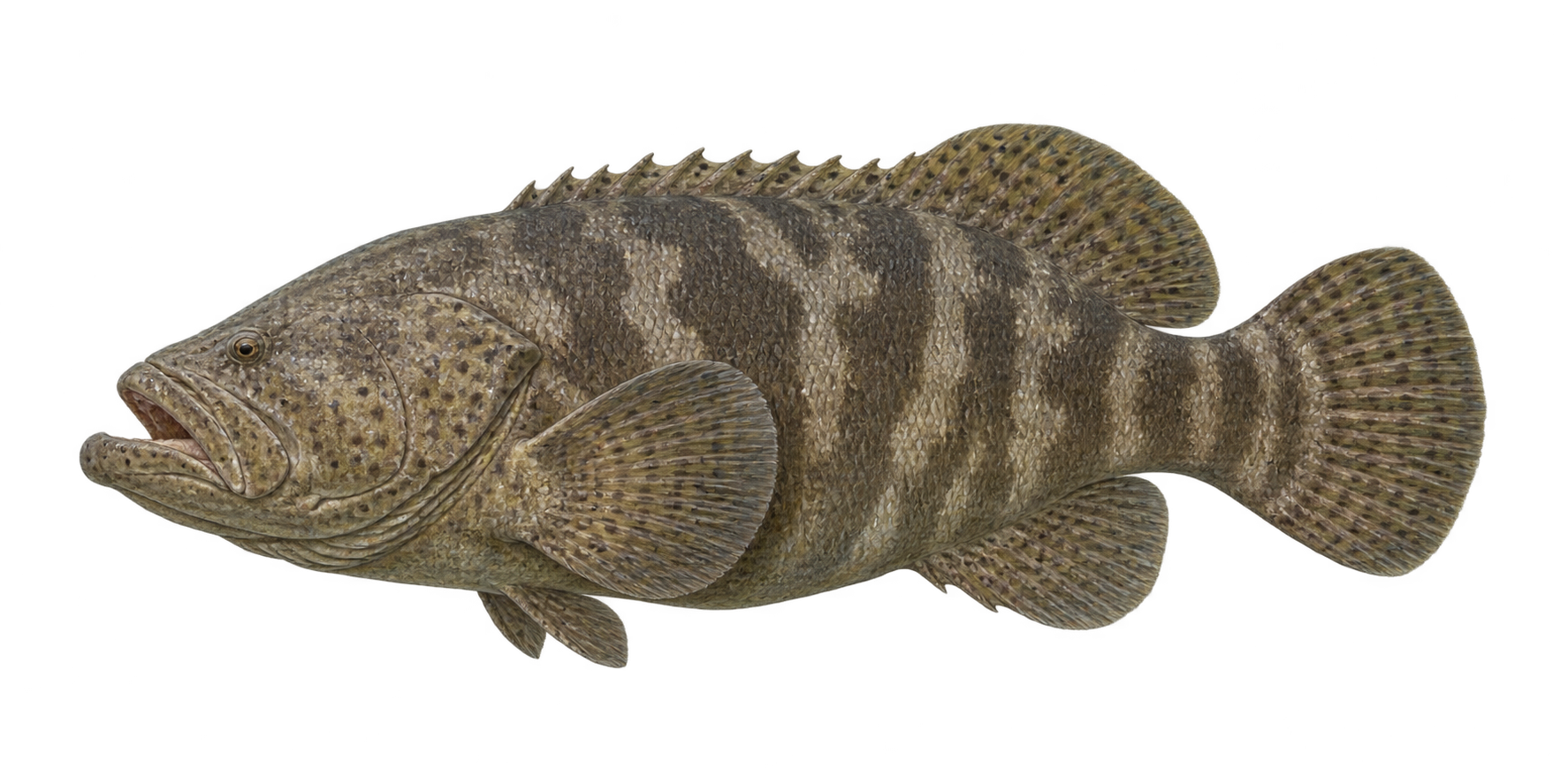
A broad head, small forward-set eyes and heavy body give this grouper an unmistakably substantial appearance. Look for rounded pectoral and tail fins, small dark spotting and irregular body bars that may be clearer on younger fish. The continuous dorsal fin has a lower spiny front portion and a taller soft-rayed rear portion. Size alone is not a complete identification.
Size and life stages
Goliath groupers can reach roughly 8 feet in length, and the largest adults are vastly bigger than many familiar reef fishes. Juveniles, however, are not miniature giants in the visual sense: their stronger pattern and smaller body can make them less immediately recognizable. Estimate length conservatively and never use a photograph’s apparent scale without a reliable comparison.
Habitat and where to look
Adults use reefs, rock ledges, wrecks and other substantial cover. Young fish are closely associated with estuaries and mangrove habitat, including sheltered structure. The nursery and adult environments are therefore parts of the same life story. Around a wreck, look into open sight lines without entering an occupied refuge or pinning a fish between divers and structure.
Range and local context
This is the Atlantic goliath grouper, Epinephelus itajara. Florida, the Caribbean and tropical western Atlantic waters south to Brazil are part of its distribution. The similar Pacific goliath grouper is a different species, Epinephelus quinquefasciatus. Local Palm Beach diving records include seasonal aggregations, but neither a regional record nor the season guarantees a particular encounter.
What is on the menu?
Much of its food consists of slow-moving bottom animals, including crabs and other crustaceans, alongside fish and additional prey. Rapid mouth expansion draws water and food inward. A spectacular photograph of one taking a hooked fish does not describe its whole natural diet: angling makes an otherwise difficult prey item unusually vulnerable.
Daily habits and behavior
Away from spawning gatherings, adults can remain closely associated with a limited area of shelter. They can also produce low-frequency sounds associated with the swim bladder. An audible boom is part of the animal’s behavior, not a performance to request. Keep your distance rather than provoking repeated sounds or an open-mouth display for a camera.
Mating and the next generation
Adults gather at spawning locations during the warmer months. Research off Florida links spawning activity with darkness and the lunar cycle. Eggs and larvae enter the water column, and young fish subsequently rely on coastal nursery habitat. Although sex change is well established in some other groupers, it should not be presented as proven for every goliath grouper.
Look-alikes and identification traps
Other large groupers can seem similar in low visibility. The goliath’s low, comparatively even dorsal spines help distinguish it from Warsaw grouper, whose dorsal spines vary more strongly in height. Also compare the rounded tail, small eyes and spotting. A giant silhouette without these details warrants caution, particularly if part of the dorsal outline is hidden behind a wreck.
Observe without disturbing
Avoid crowding shelter or surrounding spawning fish, and leave a clear route between the animal and open water. Do not touch, feed or chase it, and never put hands into its mouth. Secure cameras and other equipment away from the reef. Observe natural behavior briefly and move on if your presence causes the fish to retreat or display repeatedly.
Harvest, protection and eating safety
Protected; limited permit-only harvest exception
Can it be hunted or harvested?
Ordinary recreational harvest is prohibited. The limited lottery program allows a permit-and-tag holder one fish for the season, 24–36 inches total length. Tagging, reporting and any permit-specific sampling requirements apply. A normal fishing license alone does not authorize keeping one.
Florida seasons and areas
Permit season pattern: March 1–May 31. Closed areas include state waters from Martin County, including the St. Lucie River and tributaries, south through the Atlantic coast of the Keys, plus Dry Tortugas National Park and all federal waters. Palm Beach County is within the closed Atlantic stretch. Everglades National Park requires the appropriate permit category.
Can it be speared?
Spearfishing prohibited, including for permit holders. The harvest exception allows hook-and-line only.
Is it safe to eat?
A legal harvest permit does not guarantee food safety. Mercury exposure depends on the fish and catch location; check Florida DOH’s local consumption advisories, especially for children and people who are pregnant or breastfeeding. Grouper can also carry ciguatoxin, which cooking and freezing do not remove. Avoid eating reef fish from areas under a ciguatera advisory and never eat their head, roe, liver or intestines. FDA’s broad grouper category is not a species-specific clearance for goliath grouper.
Before you act: This recreational overview is not permission to collect or spear at your dive site. Confirm the species, date, management area, state or federal waters, gear, licenses and current local closures. A fish illustration cannot establish an identification or guarantee seafood safety.
Official rules and health guidance
- FWC Goliath Harvest Program
- FWC spearing restrictions
- FDA/EPA fish-consumption advice
- Florida DOH seafood and local advisories
- Florida DOH seafood poisoning and ciguatera guidance
Reviewed 2026-11-10. Rules and advisories can change; check the linked authorities before harvesting or eating.
Sources and review
Reviewed 2026-11-10.
Make your next dive happen
Dive With Us
Explore local charters and plan a dive suited to your experience.
View dive calendarTrain With Us
Build your fish identification, buoyancy and diving skills.
Explore trainingTravel With Us
Discover upcoming dive adventures and trip details.
Explore dive travelShop With Us
Browse equipment for your diving and ask our team for help choosing.
Explore dive gearReview current dates, availability, prices, inclusions and requirements on each listing before booking or buying.
Call us now
Ask about fish identification training
Reef Fish Identification
Ask about dates, prerequisites or your next step. An inquiry does not reserve a place. Please provide your own contact details; do not include medical, payment or a child's personal information.
We use these details to respond to your inquiry. This form does not sign you up for marketing.
Explore more with Stuart Scuba
Open Water course options · Advanced Adventure training · Technical training · Professional training · All courses · Local dives · Dive trips · Facebook · Instagram · YouTube
Your surface-interval essentials
Questions for Stuart Scuba? info@stuartscuba.com
Check the Stuart Scuba Weather Center · Play scuba trivia
Weather and wildlife vary. Confirm current conditions, trip requirements and departure details with the operator.
Plan Your Next Dive with Stuart Scuba
Dive With Us
Explore upcoming local charters and choose a dive that fits your experience.
Before you book
Check the individual listing for departure time, requirements and availability.
Travel With Us
Find upcoming dive adventures and start planning your next trip.
Plan your trip
Review dates, inclusions and trip details on the travel calendar.
Stay Connected with Stuart Scuba
 Follow pageShare
YouTube
SubscribeWatch & shareFollow on InstagramView & share post
Follow company news, training updates, and dive stories.
Follow on LinkedInGoogle Reviews
See Stuart Scuba’s current Google rating and review count below. Open the listing in Google Maps to browse customer reviews.



