

Fish identification archive / Giant Hermit Crab
Giant Hermit Crab
Petrochirus diogenes
Fun facts for your next surface interval
- A right-handed exception: its right claw is larger despite belonging to the “left-handed” hermit family.
- Home can also be dinner: it has been recorded attacking conchs for food and shelter.
- Heavyweight tenant: Gulf Specimen calls it the largest western Atlantic hermit crab.
Florida and local context
Florida, regional occurrence: Tampa Bay collected specimen study; broader Florida, not a claimed Palm Beach record
Documented regional presence is not a guarantee of an encounter or a measure of how common this animal is at your dive site.
How to recognize this animal
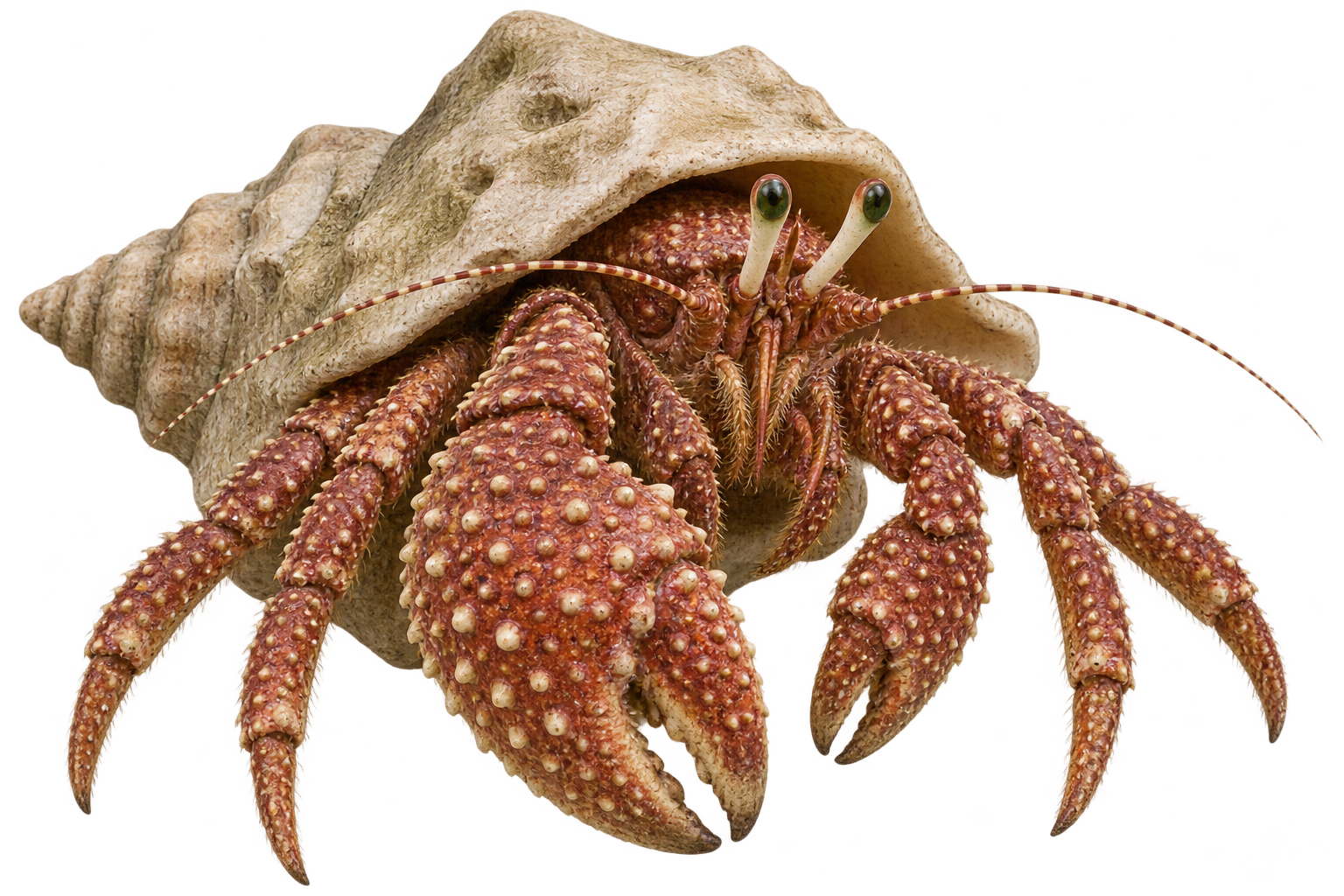
A large borrowed shell containing a reddish, hairy crab with conspicuously knobbly claws is a strong starting point. Cream-colored bumps cover the robust appendages, and stalked eyes project from the front. The right claw is the larger one, an important exception to the usual left-handed reputation of its family. Identify the crab, not the snail that originally built its home.
Size and life stages
This is the largest hermit crab in the western Atlantic according to Gulf Specimen Marine Laboratory. Field guides describe conspicuous individuals roughly twelve to twenty-five centimeters in overall extent, but that is not a standardized shield measurement. Shell choice and extended legs strongly affect apparent size. A shell’s length must never be presented as the crab’s measured body length.
Habitat and where to look
Juveniles are associated with inshore estuaries, while larger animals also occupy offshore inlets and reefs. Mud, sand, shelly bottoms and turtle-grass areas provide suitable settings. A slowly moving large shell on such bottom may contain a hermit rather than a live gastropod. Observe the opening from a distance to see whether jointed legs emerge.
Range and local context
The documented range runs from North Carolina through southern Florida, the Gulf of Mexico and Caribbean. A Tampa Bay collecting study and a Smithsonian Key West specimen provide concrete Florida records. Those records establish regional relevance without claiming the species is common on Palm Beach reefs. Its sporadic occurrence is a reason to inspect a sighting carefully, not manufacture a local abundance estimate.
What is on the menu?
This omnivore consumes macroalgae and other invertebrates rather than serving only as a harmless scavenger. Published observations include attacks on conchs, which can supply food and a potential shell. An empty-looking shell is therefore part of a living ecological resource. Do not offer food or stage an interaction between a hermit and a living snail.
Daily habits and behavior
The shell protects a softer, curved abdomen that lacks the heavily armored appearance of the exposed claws and walking legs. As the crab grows it must obtain suitable accommodation. Larger claws can be involved in defense and competition. Watch the animal’s natural movement rather than pulling it from its home to expose normally hidden body parts.
Mating and the next generation
Male and female giant hermits are separate animals, and reproductive studies have documented egg-bearing females and variation in body size and breeding patterns. Research from southern Brazil cannot supply a Florida spawning calendar. The female carries developing eggs rather than attaching an obvious nest to the reef. A crab disappearing into its shell is not evidence of breeding activity.
Look-alikes and identification traps
Thinstripe hermit crabs have slender pale-striped walking legs and lack this giant’s striking red, cream-knobbled armor. Other large hermits also occupy substantial shells, so shell species and size alone are unreliable. Check the unequal claws, tuberculated surface and eye stalks. An obscured animal may need to remain an unidentified hermit crab rather than being forced into a large-species category.
Observe without disturbing
Allow the crab to withdraw or walk away. Never tap the shell, block the opening, lift it for a close-up or attempt to pull the occupant out. Avoid moving apparently empty shells, which may provide future shelter. Maintain clearance for its claws and your equipment, and photograph the visible front only when it emerges naturally.
Harvest, protection and eating safety
LIVE COLLECTION ONLY — NO FOOD HARVEST
Florida state and adjacent federal waters: limited licensed live collection may be lawful, with live landing/holding, life support, species size rules and bag/possession limits. No species-specific annual closed months are listed, but Blue Heron Bridge, Biscayne and other area closures override that allowance. This is not a blanket ban on lawful live collection or an eating recommendation.
This color is a qualified summary, not permission to collect or a guarantee that a particular catch is safe to eat. Read the current rules and health guidance below.
Conditional live collection; marine-life rules
Can it be hunted or harvested?
Giant Hermit Crab falls within FWC’s regulated marine-life group for marine hermit crabs, family Diogenidae. Recreational collection requires a Florida saltwater fishing license unless a statutory exemption applies. The daily limit is five of this species within twenty total marine-life organisms per person; two-day possession is ten of this species within forty total. No species-specific size limit is listed. Animals must be landed and kept alive with an adequately sized circulating livewell, aeration or oxygenation system. Recreationally collected marine life cannot be sold.
Florida seasons and areas
No species-specific annual closed season is listed, but this is not permission to collect everywhere. Florida marine-life rules also apply in adjacent federal waters on both the Atlantic and Gulf coasts. Collection is prohibited within the designated Blue Heron Bridge dive-site boundary and throughout Biscayne National Park. Other parks, refuges and Florida Keys sanctuary zones may prohibit collection. Western Dry Rocks is closed to all fishing April 1–July 31. Check additional local and occupied-shell restrictions. The Lee/Manatee live-shellfish definition covers mollusks and echinoderms, so this guide does not automatically apply that definition to a crustacean merely because it occupies a shell.
Can it be speared?
No. Recreational marine-life harvest is restricted to authorized non-spearing methods, including hand collection and the listed handheld, drop or barrier nets and slurp gun. A spear is not an authorized collection method; quinaldine is prohibited. The live-landing and live-holding requirements still apply.
Is it safe to eat?
Not presented as a recreational food target. Florida’s marine-life rules require these animals to be landed and kept alive, and an aquarium-collection allowance is not a food-safety finding. No species-specific Florida consumption assessment is established here. Do not infer edibility or safety from the absence of an advisory or from another related species being eaten.
Before you act: This recreational overview is not permission to collect or spear at your dive site. Confirm the species, date, management area, state or federal waters, gear, licenses and current local closures. Identification artwork cannot establish an identification or guarantee seafood safety.
Official rules and health guidance
- FWC: Recreational Marine Life requirements and regulated groups
- FWC: Biscayne National Park fishing regulations
- FWC: Western Dry Rocks April–July fishing closure
- FAC 68B-26.002: Living mollusk and echinoderm definition
- FWC: Recreational Sea Shell Collecting
- Florida Department of Health: Seafood poisoning
Reviewed 2026-11-10. Rules and advisories can change; check the linked authorities before harvesting or eating.
Sources and review
Reviewed 2026-11-10.
- Gulf Research Reports: Florida hermit crab specimen study
- Gulf Specimen Marine Laboratory: Giant Red Hermit Crab
- Florent’s Guide: Giant Hermit Crab identification and diagnostic photographs
- UNESP repository: Petrochirus diogenes population and reproduction study
- FWC: Recreational Marine Life requirements and regulated groups
- ITIS: Petrochirus diogenes taxonomy and supporting references
Make your next dive happen
Dive With Us
Explore local charters and plan a dive suited to your experience.
View dive calendarTrain With Us
Build your fish identification, buoyancy and diving skills.
Explore trainingTravel With Us
Discover upcoming dive adventures and trip details.
Explore dive travelShop With Us
Browse equipment for your diving and ask our team for help choosing.
Explore dive gearReview current dates, availability, prices, inclusions and requirements on each listing before booking or buying.
Call us now
Ask about marine life identification
Marine Life Identification
Ask about dates, prerequisites or your next step. An inquiry does not reserve a place. Please provide your own contact details; do not include medical, payment or a child's personal information.
We use these details to respond to your inquiry. This form does not sign you up for marketing.
Explore more with Stuart Scuba
Open Water course options · Advanced Adventure training · Technical training · Professional training · All courses · Local dives · Dive trips · Facebook · Instagram · YouTube
Your surface-interval essentials
Questions for Stuart Scuba? info@stuartscuba.com
Check the Stuart Scuba Weather Center · Play scuba trivia
Weather and wildlife vary. Confirm current conditions, trip requirements and departure details with the operator.
Plan Your Next Dive with Stuart Scuba
Dive With Us
Explore upcoming local charters and choose a dive that fits your experience.
Before you book
Check the individual listing for departure time, requirements and availability.
Travel With Us
Find upcoming dive adventures and start planning your next trip.
Plan your trip
Review dates, inclusions and trip details on the travel calendar.
Stay Connected with Stuart Scuba
 Follow pageShare
YouTube
SubscribeWatch & shareFollow on InstagramView & share post
Follow company news, training updates, and dive stories.
Follow on LinkedInGoogle Reviews
See Stuart Scuba’s current Google rating and review count below. Open the listing in Google Maps to browse customer reviews.



