

Fish identification archive / French Grunt
French Grunt
Haemulon flavolineatum
I saw this
Spotted this fish? Share the guide with your dive buddies. Review your caption before posting.
For Instagram, copy the caption and link into your own post or message. Nothing is posted automatically and this does not record a verified sighting.
Fun facts for your next surface interval
- A crowded social calendar: daytime gatherings may number in the thousands.
- Straight lines are overrated: its lower stripes take the diagonal route.
- Dinner after dark: the night shift heads toward sand and seagrass.
Palm Beach connection
Lake Worth Lagoon / Blue Heron Bridge: Verified species row in Florida Museum local checklist.
Documented regional presence is not a guarantee of an encounter or a measure of how common this fish is at your dive site.
How to recognize this fish
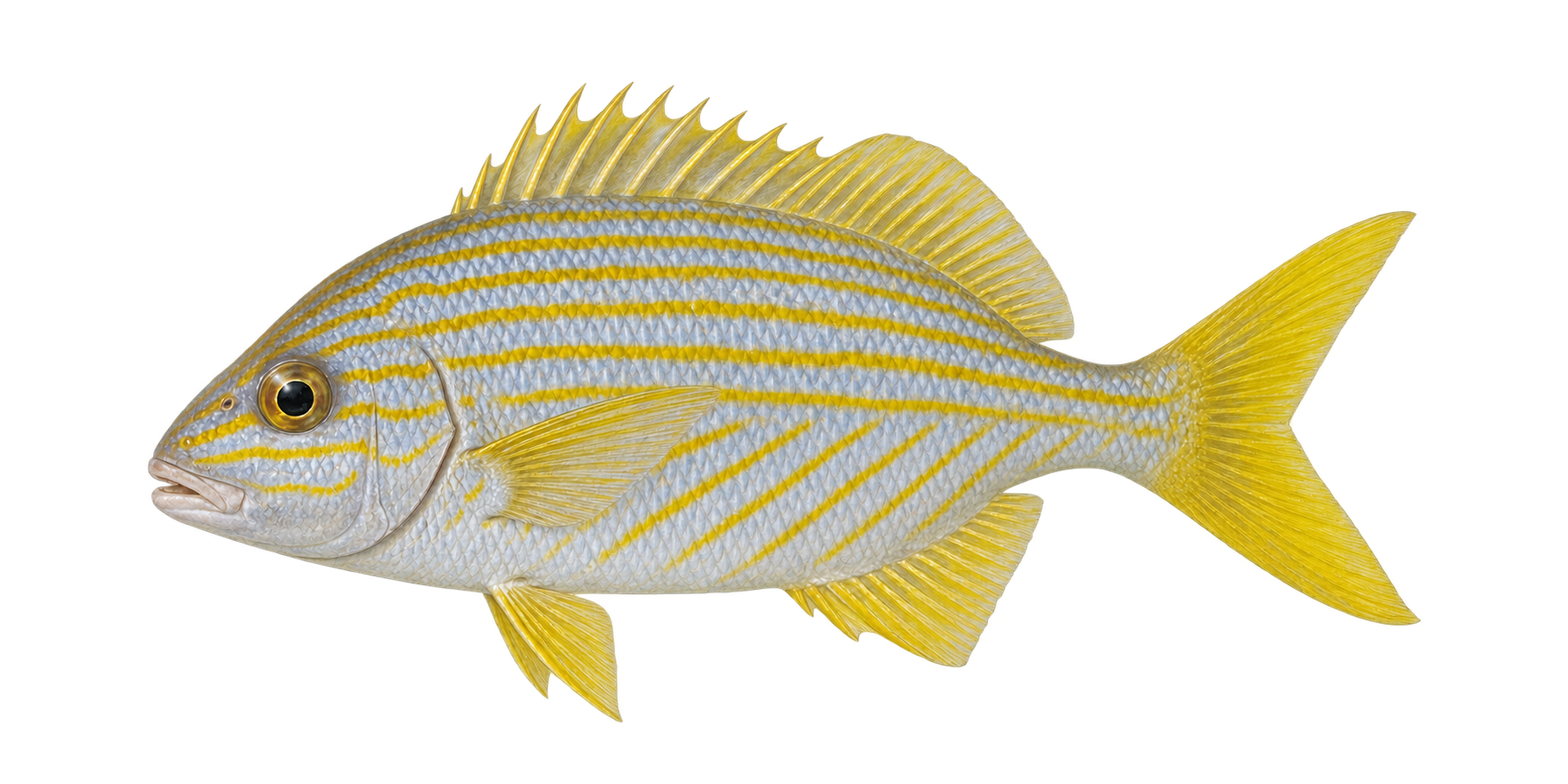
French Grunt is a compact, oblong reef fish with yellow fins and yellow stripes over a pale background. The important stripe clue is direction: lower-body stripes angle diagonally instead of all running straight from head to tail. The mouth is relatively small, and the tail is forked. Look at the lower flank in a side view rather than deciding from yellow color alone.
Size and life stages
The museum profile describes a common length near 17 cm and a reported maximum of 30 cm. Juveniles can differ in pattern and often use sheltered coastal habitat. The reference maximum should not become the assumed length of a school seen at a distance. For a useful dive note, separate estimated size from confidence in the stripe pattern.
Habitat and where to look
Schools occur around coral and rocky reefs, ledges and protective structure. Nearby seagrass and sandy areas matter too, particularly for young fish and nighttime feeding. A reef-associated species can depend on more than the reef itself. Observe the relationship between shelter and adjacent open bottom rather than treating a daytime resting school as a complete picture of its habitat use.
Range and local context
French Grunt is a western Atlantic species familiar across Florida, the Bahamas and Caribbean. Florida Museum's Lake Worth Lagoon inventory verifies it locally, and SDI's Blue Heron Bridge guide includes French Grunts. These records support regional occurrence. They do not provide a current school count or mean that every striped grunt in a local mixed group is the same species.
What is on the menu?
Small crustaceans, worms and mollusks are important foods. Feeding frequently takes the fish onto sand flats and seagrass near the reef after dark. The yellow-striped school seen during daylight may therefore be resting between feeding trips rather than actively searching the same surface. Watch for actual mouth movements and changes of position before describing an individual as feeding.
Daily habits and behavior
French Grunts often gather in conspicuous daytime schools, sometimes with large numbers of individuals. A school is not a single rigid object: a few fish turning or moving near its edge can provide the clearest identification views. The group's presence also does not establish that a nearby diver is being followed or welcomed. Keep its route through the habitat open.
Mating and the next generation
The species produces pelagic eggs, and its larvae develop in the plankton before taking on a recognizable juvenile form. UF/IFAS has reviewed the species as a marine-aquaculture candidate, reflecting research into its early life. This guide does not infer a Palm Beach spawning date from culture observations or describe an ordinary daytime school as a breeding aggregation.
Look-alikes and identification traps
Other grunts share yellow, blue or pale striping. Compare the angle of the lower stripes, fin color and body proportions. Adult Porkfish have two prominent black bars at the front of the body, unlike the French Grunt pattern. A small juvenile may lack the obvious adult clues, so an uncertain observation should remain 'grunt' until a clearer view resolves it.
Observe without disturbing
Stay outside the school rather than swimming through it to create a dramatic scatter. Keep fins above seagrass and sand, and never feed fish to assemble a group. A complete side-view photograph is preferable to chasing a single individual for a close-up. Record what you actually saw, including uncertainty, and let the school continue using its shelter normally.
Harvest, protection and eating safety
General Florida harvest rules; local restrictions apply
Can it be hunted or harvested?
French grunt is not porkfish: it is not included in Florida’s restricted ornamental-fish list. Where harvest is lawful in Florida state waters, the default recreational limit is two fish or 100 pounds per person daily, whichever is greater, with no species-specific statewide minimum size identified. A saltwater license is normally required unless exempt. Do not borrow white-grunt federal limits without checking the species and jurisdiction.
Florida seasons and areas
No species-specific statewide recreational closed season was identified in the FWC rules reviewed. Florida state waters extend to 3 nautical miles on the Atlantic side and 9 on the Gulf side. Verify the exact site, federal rules offshore and current sanctuary/park closures before targeting this species. In Biscayne National Park, French grunt counts toward the park’s 10-fish major-finfish aggregate per person.
Can it be speared?
Not named on FWC’s species-specific no-spearing list. Spearing is possible only where otherwise lawful; public beaches, fishing piers, bridges, parts of Monroe County and protected areas have restrictions. A species allowance does not make a dive site legal.
Is it safe to eat?
French grunt is listed by FDA as a marketed seafood species, but that does not certify a locally caught fish as safe. Check Florida DOH location-specific advice and marine-toxin alerts. Chill promptly and cook fish to 145°F; cooking does not remove ciguatoxin or mercury.
Before you act: This recreational overview is not permission to collect or spear at your dive site. Confirm the species, date, management area, state or federal waters, gear, licenses and current local closures. A fish illustration cannot establish an identification or guarantee seafood safety.
Official rules and health guidance
- FWC: Full Rule Text by Species
- FWC: Recreational Marine Life
- Florida Administrative Code: Marine-life Species, 68B-42.001 (Cornell reproduction)
- FWC: Unregulated Species and Default Bag Limit
- FWC: Saltwater Recreational Licenses and Permits
- FWC: Boundary Maps and Management Zones
- NOAA: Florida Keys National Marine Sanctuary Zones
- NOAA: Gulf Fishing Regulations and Seasonal Closures
- FWC: Biscayne National Park Fishing Rules
- FWC: Spearing
- FDA Seafood List: Haemulon flavolineatum
- Florida Department of Health: Eating Healthy Seafood and Local Advisories
- FDA: Selecting and Serving Seafood Safely
- Florida Department of Health: Seafood Poisoning
- FDA/EPA: Questions and Answers About Eating Fish
Reviewed 2026-11-10. Rules and advisories can change; check the linked authorities before harvesting or eating.
Sources and review
Reviewed 2026-11-10.
Make your next dive happen
Dive With Us
Explore local charters and plan a dive suited to your experience.
View dive calendarTrain With Us
Build your fish identification, buoyancy and diving skills.
Explore trainingTravel With Us
Discover upcoming dive adventures and trip details.
Explore dive travelShop With Us
Browse equipment for your diving and ask our team for help choosing.
Explore dive gearReview current dates, availability, prices, inclusions and requirements on each listing before booking or buying.
Call us now
Ask about fish identification training
Reef Fish Identification
Ask about dates, prerequisites or your next step. An inquiry does not reserve a place. Please provide your own contact details; do not include medical, payment or a child's personal information.
We use these details to respond to your inquiry. This form does not sign you up for marketing.
Explore more with Stuart Scuba
Open Water course options · Advanced Adventure training · Technical training · Professional training · All courses · Local dives · Dive trips · Facebook · Instagram · YouTube
Your surface-interval essentials
Questions for Stuart Scuba? info@stuartscuba.com
Check the Stuart Scuba Weather Center · Play scuba trivia
Weather and wildlife vary. Confirm current conditions, trip requirements and departure details with the operator.
Plan Your Next Dive with Stuart Scuba
Dive With Us
Explore upcoming local charters and choose a dive that fits your experience.
Before you book
Check the individual listing for departure time, requirements and availability.
Travel With Us
Find upcoming dive adventures and start planning your next trip.
Plan your trip
Review dates, inclusions and trip details on the travel calendar.
Stay Connected with Stuart Scuba
 Follow pageShare
YouTube
SubscribeWatch & shareFollow on InstagramView & share post
Follow company news, training updates, and dive stories.
Follow on LinkedInGoogle Reviews
See Stuart Scuba’s current Google rating and review count below. Open the listing in Google Maps to browse customer reviews.



