

Fish identification archive / Florida Stone Crab
Florida Stone Crab
Menippe mercenaria
I saw this
Spotted this marine animal? Share the guide with your dive buddies. Review your caption before posting.
For Instagram, copy the caption and link into your own post or message. Nothing is posted automatically and this does not record a verified sighting.
Fun facts for your next surface interval
- Its powerful claws are tools for opening hard food, not just impressive accessories.
- A replacement claw takes molts and time; it is not an instant spare part.
- Florida’s stone-crab story includes a second species and a hybrid zone, not one uniform crab everywhere.
Florida and local context
Blue Heron Bridge, Palm Beach County: Location-labelled species photograph documents Blue Heron Bridge occurrence.
Documented regional presence is not a guarantee of an encounter or a measure of how common this animal is at your dive site.
How to recognize this animal
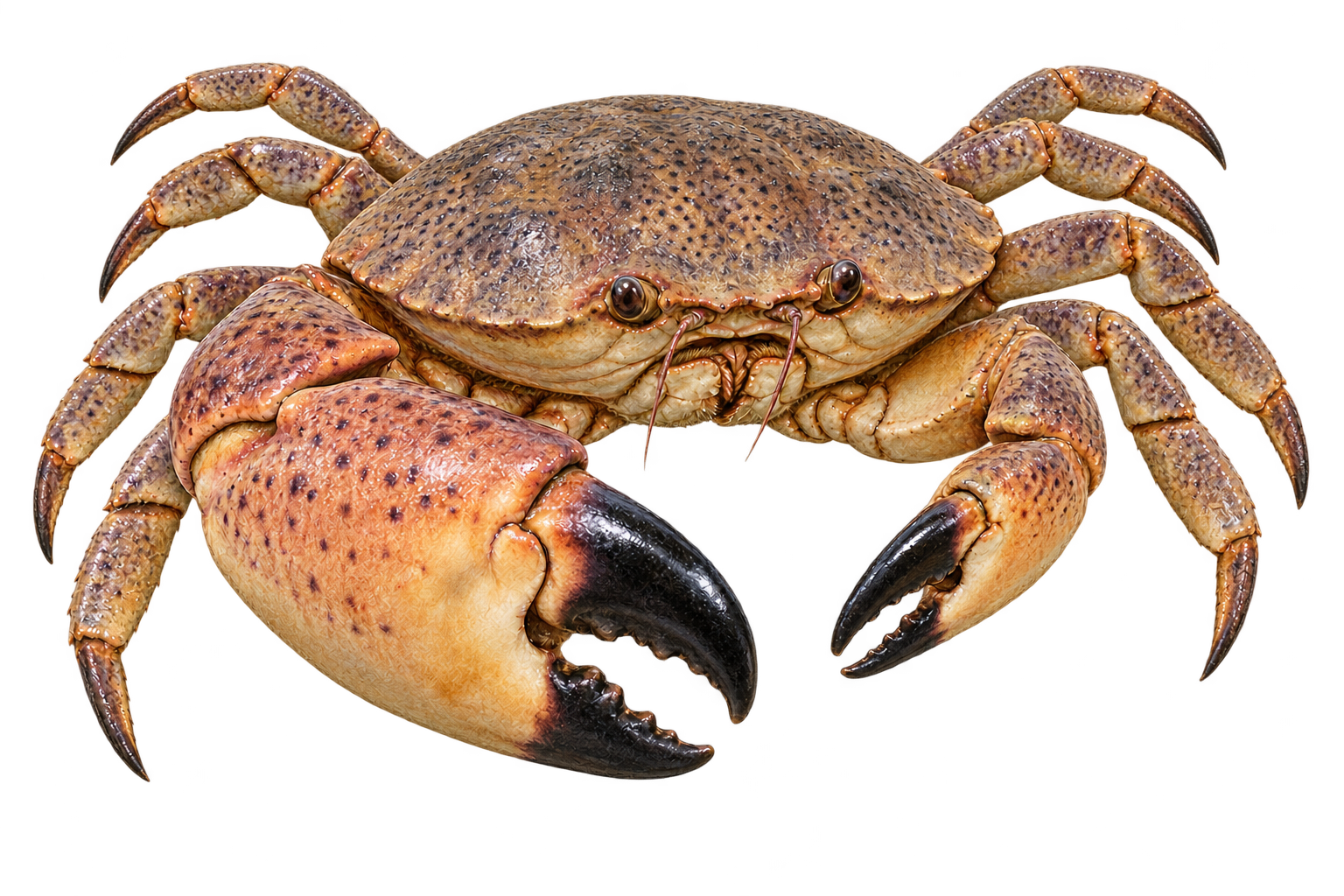
Large, powerful claws with dark tips dominate the appearance of a Florida stone crab. The shell is broad and rounded, usually brownish or mottled, and the legs are relatively stout. One claw may be bulkier than the other, reflecting different roles in handling food.
Size and life stages
Carapace width can reach roughly 13 centimeters, excluding the legs and claws. Harvest regulations instead use a particular claw measurement. A broad shell or impressive pincer does not establish legality, and the animal should not be handled merely to satisfy curiosity about its size.
Habitat and where to look
Stone crabs shelter in holes, crevices and burrows around coastal hard bottom and adjacent softer habitat. Their home may be hidden beneath rock or sediment.
Range and local context
Menippe mercenaria is the familiar peninsular Florida stone crab. A related species, Menippe adina, occurs in the northern and western Gulf, with hybridization in part of the region. State harvest management can group animals that a species profile should distinguish biologically. A location-labelled Blue Heron Bridge photograph supplies direct Palm Beach County evidence.
What is on the menu?
The strong claws process hard-shelled prey such as mollusks, along with other available food. This crushing ability is a feeding adaptation, not an invitation to test a pinch.
Daily habits and behavior
Stone crabs can regenerate lost claws over subsequent molts, but regeneration does not make removal harmless. Survival and future feeding can be affected, especially when both claws are lost. The familiar fishery therefore should not be described as taking a renewable part without consequences. A crab cannot enlarge its rigid existing shell continuously. It grows by molting, and a regenerating claw must develop through that process. Claws are also the tools used to obtain food and defend the animal, so loss affects more than appearance. A living crab returned after claw removal may still face reduced feeding ability and increased vulnerability.
Mating and the next generation
Females carry eggs beneath the abdomen, producing larvae that develop in the water before settling. Reproductive timing and legal season are related management topics but not interchangeable. An egg-bearing female is subject to explicit protection regardless of an observer’s estimate of claw size.
Look-alikes and identification traps
Other robust mud crabs can resemble a small stone crab. Dark claw tips alone are not a complete identification key, and northern Gulf records may involve the related species or hybrids.
Observe without disturbing
Keep clear of burrow entrances instead of probing with a hand or dismantling the surrounding structure. Watch natural handling of prey from a safe distance with hands away from the shelter entrance. Use the full body, locality and an authoritative reference when reviewing an uncertain image. For an observation dive, leave the crab and its shelter untouched. The harvest review below explains the open season and claw-only rules. Do not treat a wildlife identification page as training in claw removal, and never pull or inspect another person’s traps. Dive with Stuart Scuba to explore Florida marine life with an emphasis on careful observation. Ask about current conditions and an appropriate dive plan; wildlife sightings remain unpredictable.
Harvest, protection and eating safety
Seasonal claw-only harvest: October 15–May 1; egg-bearing crabs protected
Can it be hunted or harvested?
Only legal-sized claws may be harvested, not the whole crab. Each claw must measure at least 2⅞ inches using FWC’s prescribed claw measurement. Daily limit is one gallon of claws per person or two gallons per vessel, whichever is less. Never take claws from an egg-bearing crab. Return the body to the water; avoid breaking the joint incorrectly or injuring it. Legal gear includes a dip or landing net and up to five compliant stone-crab traps per person. Recreational trap users age sixteen and older must register their traps, even if otherwise license-exempt. A recreational saltwater fishing license is required unless exempt; a shoreline-only license does not cover collecting while diving.
Florida seasons and areas
Open October 15 through May 1; closed beginning May 2. This includes October 15, 2026–May 1, 2027. Florida manages stone crab in adjacent federal waters as well. Trap placement, marking, escape-ring requirements and retrieval rules also apply. No-take parks, refuges and sanctuary zones can override the general season; verify the actual site before removing claws.
Can it be speared?
No. Stone crab is expressly on FWC’s no-spearing list. Spears, hooks and other devices capable of puncturing, crushing or injuring the crab’s body are prohibited.
Is it safe to eat?
Meat from a legal, correctly identified catch can be eaten when properly handled and thoroughly cooked, but this is not an unconditional safety finding. Keep it cold promptly, avoid raw or undercooked seafood, and do not eat the tomalley or hepatopancreas. Check current local health advisories and personal shellfish-allergy risks. FDA recommends 145°F for most seafood; crabs and lobsters spoil rapidly after death.
Before you act: This recreational overview is not permission to collect or spear at your dive site. Confirm the species, date, management area, state or federal waters, gear, licenses and current local closures. Identification artwork cannot establish an identification or guarantee seafood safety.
Official rules and health guidance
- FWC: Stone Crab
- FWC: Saltwater Recreational Licenses and Permits
- NOAA: Florida management of stone crab in adjacent federal waters
- NOAA: Florida Keys Sanctuary Marine Zones
- FWC: Spearing and Restricted Areas
- FDA: Selecting and Serving Seafood Safely
- Florida Department of Health: Seafood Poisoning
Reviewed 2026-11-10. Rules and advisories can change; check the linked authorities before harvesting or eating.
Sources and review
Reviewed 2026-11-10.
- Florent’s Guide: Florida Stone Crab photographed at Blue Heron Bridge
- Florida Fish and Wildlife Conservation Commission: Florida Stone Crab
- Florida Fish and Wildlife Conservation Commission: Florida Stone Crab
- repository.library.noaa.gov: Florida Stone Crab
- Florida Fish and Wildlife Conservation Commission: Florida Stone Crab
Make your next dive happen
Dive With Us
Explore local charters and plan a dive suited to your experience.
View dive calendarTrain With Us
Build your fish identification, buoyancy and diving skills.
Explore trainingTravel With Us
Discover upcoming dive adventures and trip details.
Explore dive travelShop With Us
Browse equipment for your diving and ask our team for help choosing.
Explore dive gearReview current dates, availability, prices, inclusions and requirements on each listing before booking or buying.
Call us now
Ask about marine life identification
Marine Life Identification
Ask about dates, prerequisites or your next step. An inquiry does not reserve a place. Please provide your own contact details; do not include medical, payment or a child's personal information.
We use these details to respond to your inquiry. This form does not sign you up for marketing.
Explore more with Stuart Scuba
Open Water course options · Advanced Adventure training · Technical training · Professional training · All courses · Local dives · Dive trips · Facebook · Instagram · YouTube
Your surface-interval essentials
Questions for Stuart Scuba? info@stuartscuba.com
Check the Stuart Scuba Weather Center · Play scuba trivia
Weather and wildlife vary. Confirm current conditions, trip requirements and departure details with the operator.
Plan Your Next Dive with Stuart Scuba
Dive With Us
Explore upcoming local charters and choose a dive that fits your experience.
Before you book
Check the individual listing for departure time, requirements and availability.
Travel With Us
Find upcoming dive adventures and start planning your next trip.
Plan your trip
Review dates, inclusions and trip details on the travel calendar.
Stay Connected with Stuart Scuba
 Follow pageShare
YouTube
SubscribeWatch & shareFollow on InstagramView & share post
Follow company news, training updates, and dive stories.
Follow on LinkedInGoogle Reviews
See Stuart Scuba’s current Google rating and review count below. Open the listing in Google Maps to browse customer reviews.



