

Fish identification archive / Florida Pompano
Florida Pompano
Trachinotus carolinus
Fun facts for your next surface interval
- Tooth fairy territory: Adults over about 20 centimeters fork length lack the small jaw teeth found in youngsters.
- Smooth sides: There are no hard scutes along its lateral line.
- Spawning takes it offshore: Its familiar beach habitat is different from the offshore spawning habitat described by FWC.
Florida and local context
Broader Florida; no verified Lake Worth Lagoon checklist claim: FWC documents this as a native Florida saltwater fish.
Documented regional presence is not a guarantee of an encounter or a measure of how common this animal is at your dive site.
How to recognize this animal
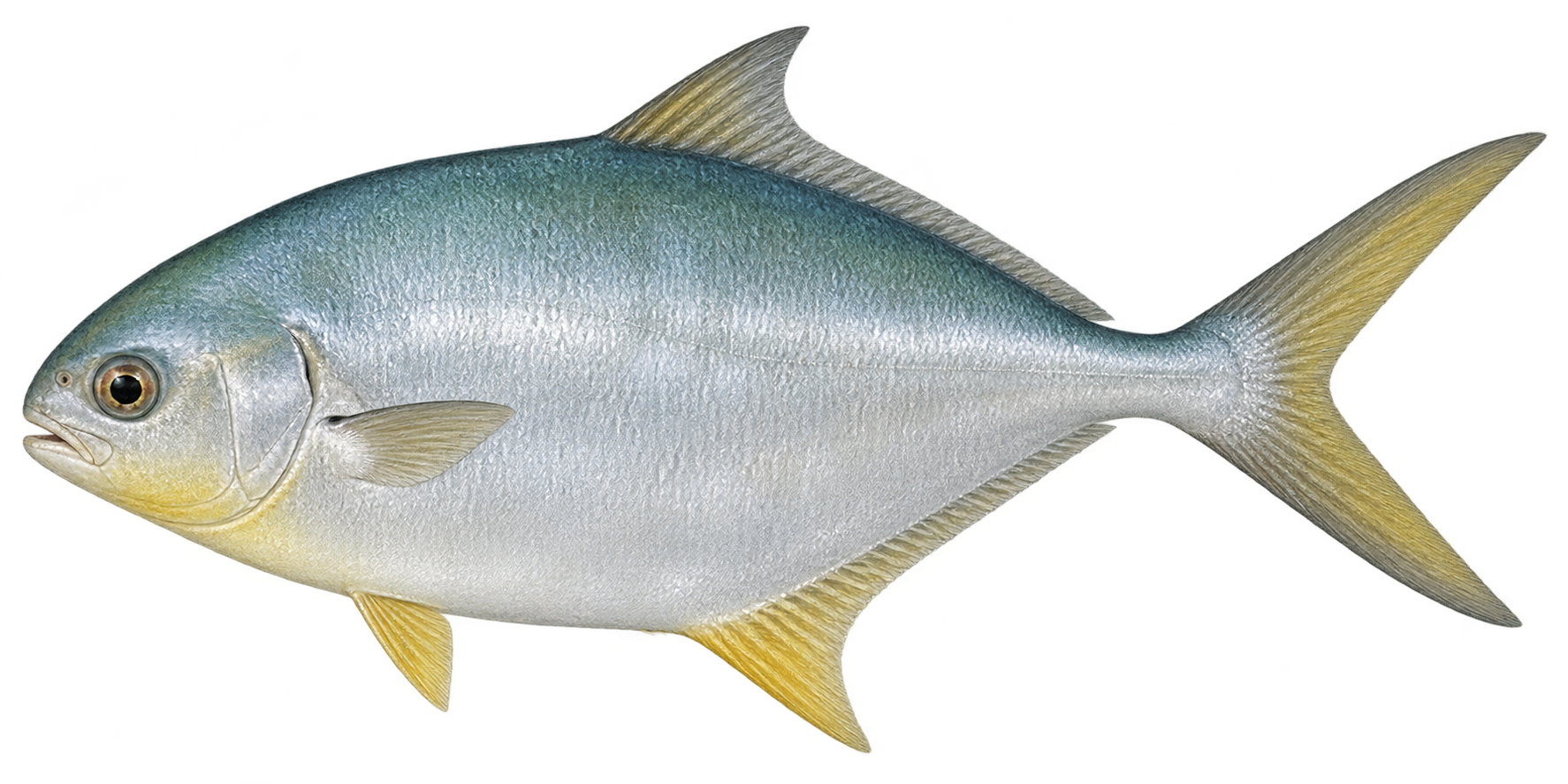
Florida pompano have a deep but relatively elongated silver body, a blunt rounded snout and a deeply forked tail. The pectoral fin is short, and the leading dorsal and anal lobes are raised without the long streamers of some relatives. There are no hard scutes on the lateral line and no bold vertical bars or spots.
Size and life stages
Smithsonian lists a maximum of 64 centimeters and 3.8 kilograms. The upper body can appear blue-green; FWC notes yellow on the throat and lower fins in darker water. Larger individuals lose the small jaw teeth present in young fish. Changes in lighting and size mean that yellow coloration alone cannot distinguish pompano from permit or other jacks.
Habitat and where to look
Shallow sand near beaches, bays and estuaries is typical habitat. FWC also lists oyster bars and seagrass areas, including turbid water. Compiled records extend to 70 meters, but this does not make it primarily a deep-reef species. A passing silver fish over a sandy shore dive deserves a different search image from a coral-sheltering reef resident.
Range and local context
The western Atlantic range extends from Massachusetts to Brazil, and FWC documents it as a native Florida fish of coastal waters. The Lake Worth Lagoon checklist does not mark this species as verified; this profile therefore claims broader Florida presence, not a confirmed local checklist sighting or local abundance.
What is on the menu?
Small crustaceans and mollusks are important foods; FWC specifically describes feeding on mollusks and crustaceans, including sand fleas. The mouth can protrude to take prey near the bottom. Watching a fish work the sand is helpful, but a cloud of disturbed sediment alone does not establish which animal was captured or whether feeding succeeded.
Daily habits and behavior
The matched upper and lower body curves and narrow tail base give it a compact, fast-swimming appearance. Its soft dorsal and anal bases are approximately similar in length. Compared with a permit, the outline is more elongated and the fin lobes less exaggerated. Note the shape before a turn produces the mirror-like silver flash that hides its details.
Mating and the next generation
FWC describes offshore spawning from March through September. Smithsonian records pelagic eggs and larvae, so early development occurs in the water column. The species’ presence in beach shallows does not mean it deposits eggs in surf sand. Juvenile habitat and adult spawning habitat should be distinguished, and a date within that broad season does not prove a photographed fish is breeding.
Look-alikes and identification traps
Permit are generally deeper-bodied with longer dorsal and anal lobes. Palometa have multiple dark vertical bars and very long trailing fins, while African pompano have a steeper forehead and a different adult outline. Do not use the common word pompano as a species identification: the Florida rules for these fishes differ substantially.
Observe without disturbing
Use a side photograph that preserves the complete pectoral fin, forehead and rear fin lobes. Avoid following the fish into a surf zone or boat lane just to get closer. If the photograph cannot separate it from permit, keep the identification tentative. Identification uncertainty is particularly important before any harvest decision because different size and gear rules apply.
Harvest, protection and eating safety
GREEN · GOOD TO HARVEST & EAT WHEN LEGAL
Florida state and adjacent federal waters: 11-inch fork-length minimum, six/day, no spearing, and a year-round species season subject to local closures and Biscayne limits. The Florida DOH 2025 guide lists Florida pompano at one meal per week from all coastal waters. Use its weight-based serving guidance and check the live advisory for the catch area. Cooking does not remove mercury. Green is not a guarantee for an individual catch.
This color is a qualified summary, not permission to collect or a guarantee that a particular catch is safe to eat. Read the current rules and health guidance below.
Parchment-baked Florida pompano recipe →
Florida pompano: 11-inch fork minimum, six daily; no spearing
Can it be hunted or harvested?
Florida pompano has an 11-inch fork-length minimum and a daily bag of six per harvester. These FWC rules apply in Florida state and adjacent federal waters on both coasts unless specifically noted. Only hook and line, cast net, beach seine or haul seine are allowed. Multiple hooks used with live or dead natural bait and snatching are prohibited. A saltwater license is required unless exempt, including for Florida landings from federal waters; a shoreline-only license does not cover swimming/diving harvest. The six-fish daily bag is not an extra possession allowance for additional days.
Florida seasons and areas
FWC expressly lists Florida pompano as open year-round in state and federal waters, subject to area closures. Biscayne National Park includes this species in its ten-fish-per-person recreational aggregate with the other named species, and does not allow transit with more than that aggregate even if caught outside. The designated Western Dry Rocks area closes to all fishing April 1–July 31. In Biscayne National Park, the designated bonefish pre-spawning area closes to fishing and fish possession March 1–May 31; continuous transit with fish and gear properly stowed is allowed. Sanctuary, park and refuge zones may impose additional no-take or gear restrictions. These are area rules, not a claim that every Florida site is closed.
Can it be speared?
No. Florida pompano may not be speared in Florida state or adjacent federal waters. Its allowed recreational gear is hook and line, cast net, beach seine or haul seine. The federal spearing exception for African pompano or permit does not apply to Florida pompano.
Is it safe to eat?
The Florida Department of Health 2025 guide, checked November 10, 2026, lists Florida pompano from all coastal waters at one meal per week because of mercury. Serving size is weight-based; for a 180-pound person, one meal is six ounces cooked. Check the live DOH advisory for current guidance and count other fish eaten during the week. This is consumption guidance, not a guarantee for every catch. Prompt chilling and proper cooking reduce ordinary foodborne-illness risks, but cooking does not remove mercury or marine toxins.
Before you act: This recreational overview is not permission to collect or spear at your dive site. Confirm the species, date, management area, state or federal waters, gear, licenses and current local closures. Identification artwork cannot establish an identification or guarantee seafood safety.
Official rules and health guidance
- FWC Florida pompano recreational rules
- FWC saltwater licensing and Florida landing requirements
- FWC Biscayne National Park rules
- NOAA Florida Keys sanctuary zones
- FWC Western Dry Rocks seasonal closure
- FWC spearing prohibitions and locations
- Florida DOH fish-consumption advisories
- Florida DOH seafood poisoning guidance
- FDA Bad Bug Book: ciguatera and scombrotoxin
- Florida DOH 2025 fish-consumption guide
Reviewed 2026-11-10. Rules and advisories can change; check the linked authorities before harvesting or eating.
Sources and review
Reviewed 2026-11-10.
Make your next dive happen
Dive With Us
Explore local charters and plan a dive suited to your experience.
View dive calendarTrain With Us
Build your fish identification, buoyancy and diving skills.
Explore trainingTravel With Us
Discover upcoming dive adventures and trip details.
Explore dive travelShop With Us
Browse equipment for your diving and ask our team for help choosing.
Explore dive gearReview current dates, availability, prices, inclusions and requirements on each listing before booking or buying.
Call us now
Ask about marine life identification
Marine Life Identification
Ask about dates, prerequisites or your next step. An inquiry does not reserve a place. Please provide your own contact details; do not include medical, payment or a child's personal information.
We use these details to respond to your inquiry. This form does not sign you up for marketing.
Explore more with Stuart Scuba
Open Water course options · Advanced Adventure training · Technical training · Professional training · All courses · Local dives · Dive trips · Facebook · Instagram · YouTube
Your surface-interval essentials
Questions for Stuart Scuba? info@stuartscuba.com
Check the Stuart Scuba Weather Center · Play scuba trivia
Weather and wildlife vary. Confirm current conditions, trip requirements and departure details with the operator.
Plan Your Next Dive with Stuart Scuba
Dive With Us
Explore upcoming local charters and choose a dive that fits your experience.
Before you book
Check the individual listing for departure time, requirements and availability.
Travel With Us
Find upcoming dive adventures and start planning your next trip.
Plan your trip
Review dates, inclusions and trip details on the travel calendar.
Stay Connected with Stuart Scuba
 Follow pageShare
YouTube
SubscribeWatch & shareFollow on InstagramView & share post
Follow company news, training updates, and dive stories.
Follow on LinkedInGoogle Reviews
See Stuart Scuba’s current Google rating and review count below. Open the listing in Google Maps to browse customer reviews.



