

Fish identification archive / Florida Fighting Conch
Florida Fighting Conch
Strombus pugilis
I saw this
Spotted this marine animal? Share the guide with your dive buddies. Review your caption before posting.
For Instagram, copy the caption and link into your own post or message. Nothing is posted automatically and this does not record a verified sighting.
Fun facts for your next surface interval
- The fighting reputation comes with a powerful foot, not tiny boxing gloves.
- Its old scientific name still appears in many Florida guides, but the animal has not changed.
- A youngster’s shell can look different enough to fool a collector who expects the adult shape.
Florida and local context
Florida coastal waters; documented southwest Florida shell fauna: Museum records establish Florida occurrence. This is not a species-confirmed Palm Beach sighting.
Documented regional presence is not a guarantee of an encounter or a measure of how common this animal is at your dive site.
How to recognize this animal
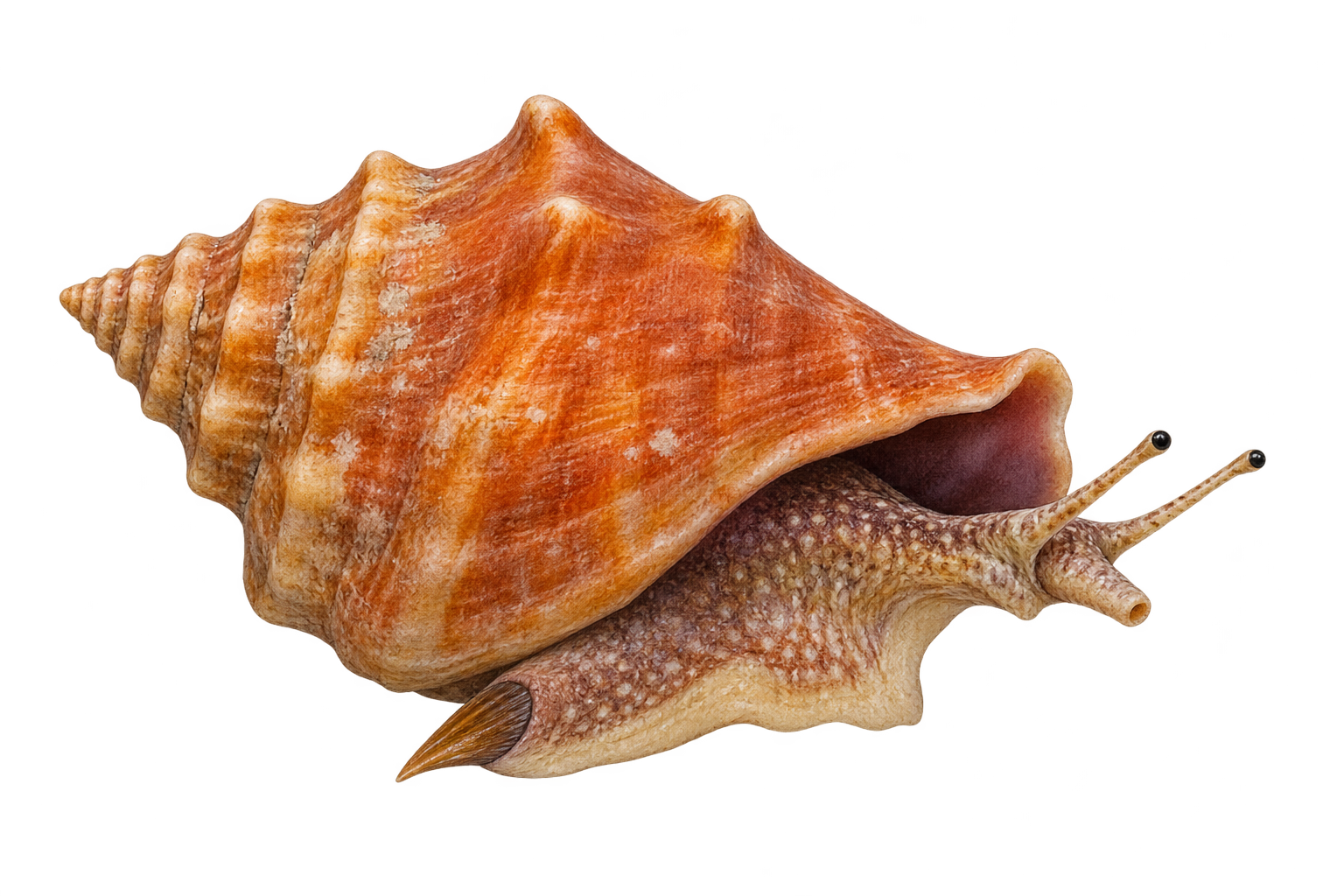
This small true conch has a thick spiral shell with a pointed spire, shoulder knobs and an expanded adult outer lip. Brown, orange and darker tones vary. A living individual may extend stalked eyes and its foot while keeping much of the body inside the shell.
Size and life stages
Shells can reach roughly 10 centimeters, far smaller than the largest queen conch or horse conch. Juvenile shells are proportionally different and lack the developed adult lip.
Habitat and where to look
Shallow sandy areas near seagrass are characteristic habitat. A partly buried shell can be occupied even if no soft tissue is initially visible. The surrounding sediment is part of the animal’s living space, not a display tray to brush clear for a photograph.
Range and local context
Florida shell guides long used Strombus alatus for the familiar fighting conch. Current WoRMS and the Bailey-Matthews National Shell Museum treat that name as a synonym of Strombus pugilis. This page covers the same Florida animal under the accepted name, not an additional species.
What is on the menu?
Fighting conchs graze on algal and organic material associated with the bottom. Their small mouth and feeding apparatus work close to the sediment. The intimidating common name does not turn them into predators of divers or explain every quick movement of the foot.
Daily habits and behavior
The pointed operculum and strong foot produce the characteristic kicking or lunging movements behind the common name. A motionless shell can become surprisingly active when disturbed.
Mating and the next generation
Fighting conchs package their eggs in a conspicuous gelatinous mass, with embryos developing inside before the free-swimming larval phase begins. Shell growth changes the animal’s appearance considerably. A small, thin-lipped specimen should not be assigned a different species solely because it lacks adult features. The egg mass is a tangled, spaghetti-like structure, with a Florida example documented from Collier County by the shell museum. Larval development includes a free-swimming veliger stage before settlement and transformation into a crawling juvenile. This temporary planktonic existence contrasts with the adult’s close association with sand and seagrass and helps explain why the life cycle depends on more than one small patch of bottom.
Look-alikes and identification traps
Queen conch becomes much larger and develops a broad pink-lipped shell. Predatory whelks have different shell architecture and feeding habits. Older guides may separate Florida and West Indian fighting conchs by names now united in current taxonomy, so check the date and authority of a reference.
Observe without disturbing
Compare shell length with shell length, rather than including the extended foot in one animal’s measurement. Leave that response unprovoked; movement observed naturally is more informative than a defensive reaction to handling. Keep live shells where you find them. Photograph visible features without turning or provoking the animal. A shell occupied by a hermit crab is also living habitat. County, park and protected-area restrictions can be stricter than general statewide shell-collecting rules. Dive with Stuart Scuba to explore Florida marine life with an emphasis on careful observation. Ask about current conditions and an appropriate dive plan; wildlife sightings remain unpredictable.
Harvest, protection and eating safety
Live-shell collection restrictions apply; not the queen-conch rule
Can it be hunted or harvested?
Florida fighting conch is not queen conch and is not listed in the reviewed restricted marine-life species schedule. Where lawful, general recreational limits apply: 100 pounds or two individuals of the species per person per day, whichever is greater. A saltwater license is required for a shell containing a live animal, including collection from shore, unless a statutory exemption applies. A genuinely empty shell is different, but a hermit crab or other occupant makes it living wildlife. Hand collection must not damage protected coral or live rock. Leaving the animal in place is the preferred dive practice.
Florida seasons and areas
No species-specific statewide recreational closed season or minimum size was identified in the reviewed rules. Lee County prohibits collecting these live shells; Manatee County allows no more than two live shells of any one species per person per day. Empty shells and protected sites have separate rules. The Blue Heron Bridge area prohibits designated ornamental marine life collection; do not use this profile as permission to collect at the bridge. Park, refuge and Florida Keys sanctuary zones can prohibit collection even where general state rules allow it. Check the exact site and current boundaries before any take. The Lee rule also restricts possession in county waters seaward of mean high water; Manatee’s two-animal restriction applies to possession in those waters as well as daily harvest. Empty shells must not be obtained by killing, mutilating or removing the living mollusk.
Can it be speared?
No species-specific statewide spearing ban was identified in the reviewed rules. Spearing is still prohibited in restricted areas, including within 100 yards of public swimming beaches, public fishing piers and bridge sections where public fishing is allowed. Hand collection or an appropriate lawful net is the practical choice for this animal; do not damage coral or live rock.
Is it safe to eat?
No unconditional safe-to-eat designation is made for this species. Legal shell collection is not food-safety approval, and this archive does not recommend it as a food target. Florida DOH warns that marine gastropods such as conchs and whelks can carry red-tide toxins acquired through their food. Do not harvest or eat them from red-tide-affected or closed areas. Cooking, heating and freezing do not remove these toxins; taste and smell are not reliable tests.
Before you act: This recreational overview is not permission to collect or spear at your dive site. Confirm the species, date, management area, state or federal waters, gear, licenses and current local closures. Identification artwork cannot establish an identification or guarantee seafood safety.
Official rules and health guidance
- FWC: Recreational Sea Shell Collecting
- Florida Administrative Code: Marine Life, Chapter 68B-42
- FAC 68B-42.001: restricted-species definitions (LII reproduction; current effective date checked against official FAC index)
- FWC: Recreational Marine Life
- FWC: Saltwater Recreational Licenses and Permits
- NOAA: Florida Keys Sanctuary Marine Zones
- FWC: Spearing and Restricted Areas
- FWC: Unregulated Species and Default Limits
- Florida Department of Health: Seafood Poisoning
- FDA: Selecting and Serving Seafood Safely
- Florida Administrative Code: Southwest Florida Shells, Chapter 68B-26
- FAC 68B-26.002: live shellfish definition (LII reproduction)
- FAC 68B-26.004: Lee and Manatee restrictions (LII reproduction)
Reviewed 2026-11-10. Rules and advisories can change; check the linked authorities before harvesting or eating.
Sources and review
Reviewed 2026-11-10.
Make your next dive happen
Dive With Us
Explore local charters and plan a dive suited to your experience.
View dive calendarTrain With Us
Build your fish identification, buoyancy and diving skills.
Explore trainingTravel With Us
Discover upcoming dive adventures and trip details.
Explore dive travelShop With Us
Browse equipment for your diving and ask our team for help choosing.
Explore dive gearReview current dates, availability, prices, inclusions and requirements on each listing before booking or buying.
Call us now
Ask about marine life identification
Marine Life Identification
Ask about dates, prerequisites or your next step. An inquiry does not reserve a place. Please provide your own contact details; do not include medical, payment or a child's personal information.
We use these details to respond to your inquiry. This form does not sign you up for marketing.
Explore more with Stuart Scuba
Open Water course options · Advanced Adventure training · Technical training · Professional training · All courses · Local dives · Dive trips · Facebook · Instagram · YouTube
Your surface-interval essentials
Questions for Stuart Scuba? info@stuartscuba.com
Check the Stuart Scuba Weather Center · Play scuba trivia
Weather and wildlife vary. Confirm current conditions, trip requirements and departure details with the operator.
Plan Your Next Dive with Stuart Scuba
Dive With Us
Explore upcoming local charters and choose a dive that fits your experience.
Before you book
Check the individual listing for departure time, requirements and availability.
Travel With Us
Find upcoming dive adventures and start planning your next trip.
Plan your trip
Review dates, inclusions and trip details on the travel calendar.
Stay Connected with Stuart Scuba
 Follow pageShare
YouTube
SubscribeWatch & shareFollow on InstagramView & share post
Follow company news, training updates, and dive stories.
Follow on LinkedInGoogle Reviews
See Stuart Scuba’s current Google rating and review count below. Open the listing in Google Maps to browse customer reviews.



