

Fish identification archive / Florida Blenny
Florida Blenny
Chasmodes saburrae · Blenniidae
I saw this
Spotted this fish? Share the guide with your dive buddies. Review your caption before posting.
For Instagram, copy the caption and link into your own post or message. Nothing is posted automatically and this does not record a verified sighting.
Recognizing the fish
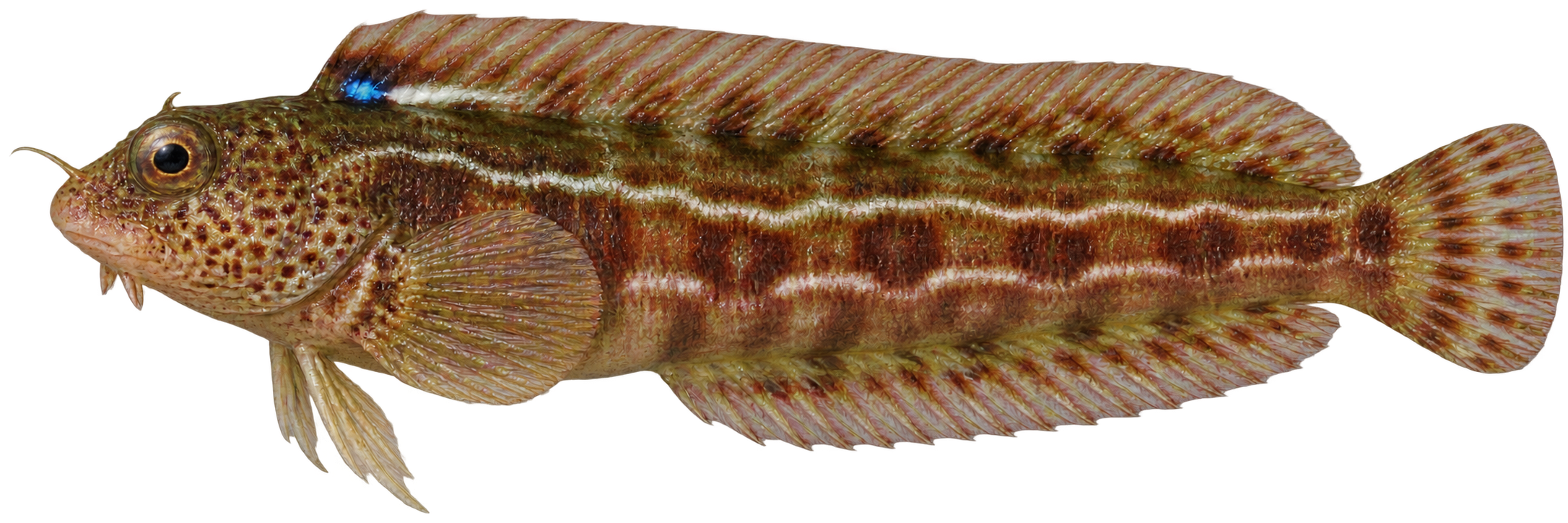
The Florida blenny is a compact bottom-dweller whose head and fins reward a careful look. Its body is elongated and flattened from side to side. The short head has a curved forehead, pointed snout and a small cirrus above each eye. A long dorsal fin runs along the back with only a slight break in its outline. Small skin flaps at the front sides of the lower jaw are useful identification details. Smithsonian Florida-blenny guide.
Olive, reddish-brown and pale markings can form mottling or lengthwise lines. Fine dark dots cover the cheek. A conspicuous blue patch at the front of the dorsal fin, followed by a pale streak, is a helpful clue in suitable individuals, especially adult males. It is not a feature to demand from every fish in every photograph.
Other small blennies can share a similar silhouette. Close relatives in Chasmodes require attention to jaw structure and other diagnostic features, while a quick view of a head protruding from shelter may support only a family-level identification. Do not identify this species merely because a blenny was photographed in Florida.
Local occurrence and habitat
Biscayne National Park lists Florida blenny among fishes reported in the park, placing it within the requested southeast Florida corridor. This is occurrence evidence rather than a measure of current abundance. Biscayne fish checklist.
The species inhabits shallow coastal environments, including seagrass and oyster-associated habitat, and tolerates brackish conditions. Small spaces in bottom structure provide shelter. NOAA’s early-life-history guide records oyster shells, sponges and rock holes among its habitats. These details explain why a quiet pause beside structure may reveal more than a fast swim over it. NOAA blennioid guide, printed page 10.
Food and reproduction
Its diet includes small bottom-living animals. A study of juvenile fishes in Florida seagrass habitat found amphipods especially important to Florida blennies; that study does not establish identical feeding proportions everywhere. Published seagrass food-habits study.
Eggs are attached to a surface and tended by the male. After hatching, larvae enter the plankton. A shelter can therefore serve as a nesting site, not simply a hiding place.
Watching without disturbance
Let a fish emerge on its own. Do not lift oyster shells, probe holes or move it into open water. A side image showing the head and entire dorsal fin is more useful for identification than a heavily cropped face.
Florida regulates blennies as marine-life fish. Check current FWC marine-life rules and local protected-area rules before collection; this identification guide does not grant harvest permission.
Current Florida collection cautions
Reviewed November 12, 2026. FWC includes blennies among regulated marine-life fishes. These rules include licensing, live-maintenance, gear and possession requirements. The defined Blue Heron Bridge dive site is closed to marine-life harvest; parks and sanctuaries may impose additional restrictions. This page does not authorize collection. Official FWC marine-life requirements
Make your next dive happen
Dive With Us
Explore local charters and plan a dive suited to your experience.
View dive calendarTrain With Us
Build your fish identification, buoyancy and diving skills.
Explore trainingTravel With Us
Discover upcoming dive adventures and trip details.
Explore dive travelShop With Us
Browse equipment for your diving and ask our team for help choosing.
Explore dive gearReview current dates, availability, prices, inclusions and requirements on each listing before booking or buying.
Call us now
Ask about fish identification training
Reef Fish Identification
Ask about dates, prerequisites or your next step. An inquiry does not reserve a place. Please provide your own contact details; do not include medical, payment or a child's personal information.
We use these details to respond to your inquiry. This form does not sign you up for marketing.
Explore more with Stuart Scuba
Open Water course options · Advanced Adventure training · Technical training · Professional training · All courses · Local dives · Dive trips · Facebook · Instagram · YouTube
Your surface-interval essentials
Questions for Stuart Scuba? info@stuartscuba.com
Check the Stuart Scuba Weather Center · Play scuba trivia
Weather and wildlife vary. Confirm current conditions, trip requirements and departure details with the operator.
Plan Your Next Dive with Stuart Scuba
Dive With Us
Explore upcoming local charters and choose a dive that fits your experience.
Before you book
Check the individual listing for departure time, requirements and availability.
Travel With Us
Find upcoming dive adventures and start planning your next trip.
Plan your trip
Review dates, inclusions and trip details on the travel calendar.
Stay Connected with Stuart Scuba
 Follow pageShare
YouTube
SubscribeWatch & shareFollow on InstagramView & share post
Follow company news, training updates, and dive stories.
Follow on LinkedInGoogle Reviews
See Stuart Scuba’s current Google rating and review count below. Open the listing in Google Maps to browse customer reviews.



