

Fish identification archive / Flame box crab
Flame box crab
Calappa flammea
Fun facts for your next surface interval
Florida and local context
Florent Charpin’s species gallery identifies the photographed animal as Calappa flammea and explicitly captions the photograph Blue Heron Bridge, Florida.
A documented past record does not establish present abundance or guarantee an encounter.
Sources: Florent’s Guide: Flame box crab at Blue Heron Bridge
How to recognize this animal
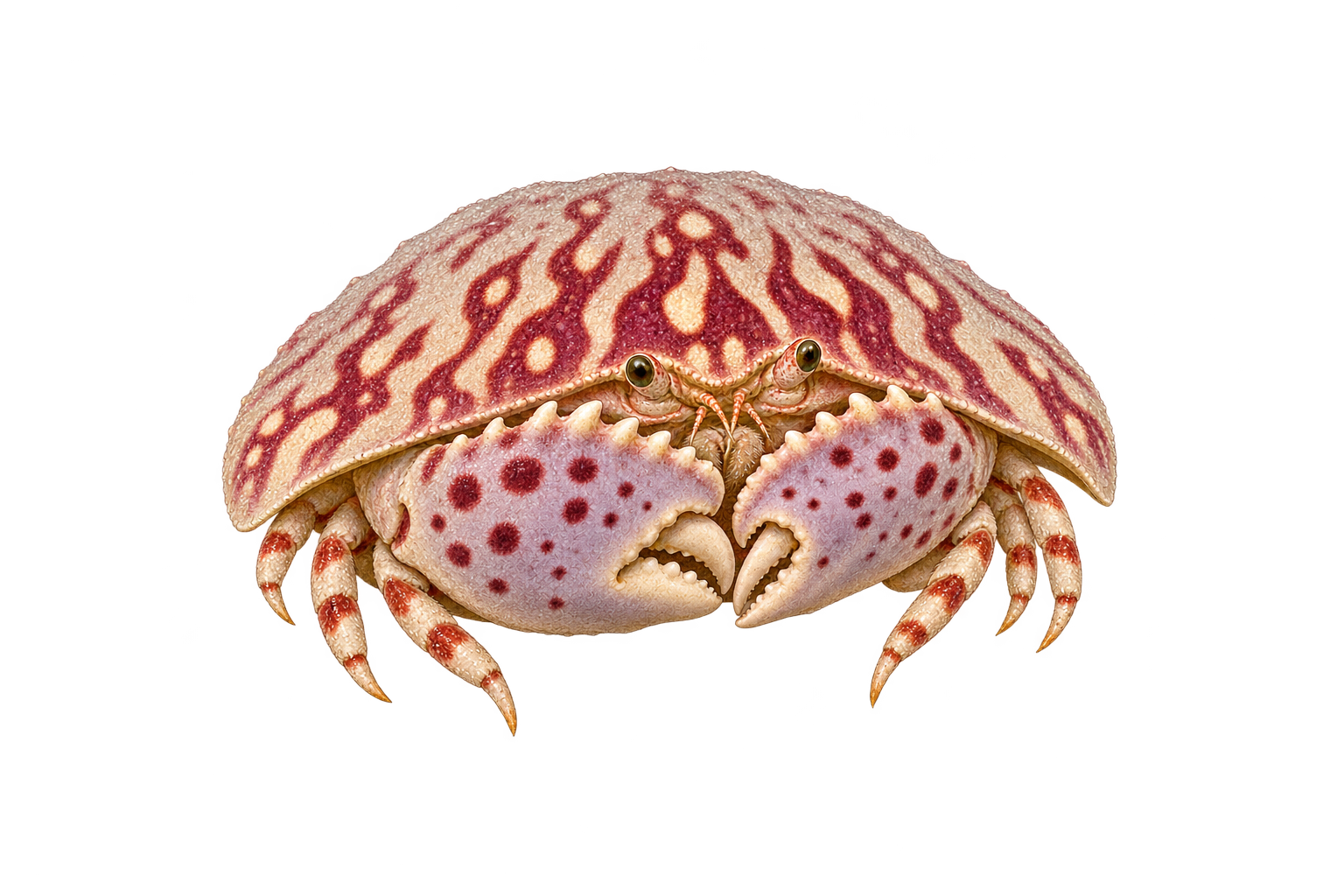
Look for a broad shell carrying irregular lengthwise streaks that give the flame box crab its name. The streaks may appear reddish, brown or lavender against a pale or mottled background, and can fade toward the rear. The substantial claws have toothed upper edges. Pattern and body structure work together as clues; color alone can be distorted by depth, lighting and camera white balance.
Sources: Georgia Southern University: Gray’s Reef flame box crab
Size and life stages
Published guide values disagree. Georgia Southern’s Gray’s Reef guide gives a shell width of 15 cm and length of 11 cm, while Florent’s Guide lists a smaller 10 cm size without specifying the measurement axis. This profile uses the clearly labeled carapace width and keeps the disagreement visible. Neither figure describes the span of an animal with its claws extended.
Sources: Georgia Southern University: Gray’s Reef flame box crab; Florent’s Guide: Flame box crab at Blue Heron Bridge
Habitat and where to look
Adults inhabit sandy areas around reefs, ledges and rocky outcrops and may remain buried in the sediment. Young animals can occur in estuaries. The Gray’s Reef account discusses adults at 10–30 m; Florent’s regional guide gives a broader 3–75 m depth interval. These are different scopes of description, not instructions about where a particular local animal will be found.
Sources: Georgia Southern University: Gray’s Reef flame box crab; Florent’s Guide: Flame box crab at Blue Heron Bridge
Range and local context
This western Atlantic crab has records from the northeastern United States southward into the Bahamas and Gulf of Mexico, with regional dive guides also covering Florida and the Caribbean. For the West Palm Beach area, the strongest evidence used here is direct: Florent’s species photograph is captioned Blue Heron Bridge, Florida.
Sources: Georgia Southern University: Gray’s Reef flame box crab; Florent’s Guide: Flame box crab at Blue Heron Bridge
What is on the menu?
Mollusks and barnacles are listed as prey by the Gray’s Reef guide. Other natural-history accounts report predation on hermit crabs, including Pagurus pollicaris. A shell on the bottom may therefore be food-bearing habitat for a predator rather than an empty object. Leave shells and crabs undisturbed instead of staging a feeding encounter.
Sources: Georgia Southern University: Gray’s Reef flame box crab; Reeflex: Calappa flammea
Daily habits and behavior
Burial can hide most of the crab, so a conspicuous shell pattern does not necessarily make it conspicuous underwater. Observe any exposed animal without clearing sand away. A published description of rarity at Gray’s Reef applies to that sanctuary; it should not be converted into a statement about how common flame box crabs are at Blue Heron Bridge.
Sources: Georgia Southern University: Gray’s Reef flame box crab
Mating and the next generation
Scientific literature reports plankton-collected megalopae and early juvenile stages for this species. A megalopa is a transitional larval stage preceding the juvenile crab form. The sources reviewed here do not establish West Palm Beach spawning months, egg counts or the time spent in each larval stage, so this guide does not supply a breeding calendar.
Sources: Negreiros-Fransozo and colleagues (2007): box-crab megalopa and juvenile development
Look-alikes and identification traps
Compare with the yellow box crab, Calappa sulcata, whose shell lacks the characteristic irregular flame-like markings. A buried crab or a photograph showing only its claws may not expose enough features for separation. Save a cautious box-crab identification when the evidence is incomplete instead of forcing a species name.
Sources: Texas A&M University at Galveston: Yellow box crab identification
Observe without disturbing
Hover clear of the sand and keep hoses, lights and fins from contacting the animal. Do not expose buried crabs, handle their claws or move them into open water. Record the natural pose, substrate, date and dive-site name. Local photographic evidence supports occurrence, but no sighting is guaranteed.
Harvest, protection and eating safety
Unknown: exact harvest rules need verification
The neutral gray status means the rules or scope have not been fully verified. Precise take allowance, annual season and food suitability for Calappa flammea remain unestablished. Do not borrow blue-crab, stone-crab, horseshoe-crab or listed ornamental-crab rules. This is an observation-focused listing, not harvest or spearfishing permission. No local-menu evidence is available.
This color is a qualified summary, not permission to collect or a guarantee that a particular animal is safe to eat.
Can it be hunted or harvested?
Calappa flammea is a box crab in family Calappidae. It is not a blue crab, stone crab, horseshoe crab or one of the enumerated ornamental crabs in the reviewed marine-life list. Do not copy those species’ seasons, claw rules, size limits or five-per-species aquarium limit onto this animal. Florida requires appropriate licensing and lawful gear for recreational take; no species-specific size or numerical take allowance is established here.
Florida seasons and areas
No annual collection season is asserted. The mapped Blue Heron Bridge closure applies to its defined tropical-ornamental categories, and the park has separate sport-fishing restrictions; neither should be generalized into a statewide box-crab rule. Leave this crab in place on local dives. Before any collection elsewhere, confirm the exact taxon, site, state/federal jurisdiction and any protected-area rule with FWC. Monroe County, Gulf waters and Florida Keys sanctuary areas require separate checks.
Can it be speared?
No species-specific spearfishing clearance is supplied. Do not infer one from the separate blue-crab and stone-crab prohibitions or from their absence for box crabs. General location and gear restrictions still apply.
Is it safe to eat?
No edible or safe-to-eat claim and no recipe are provided. Familiar food-crab advice cannot establish the safety of an unidentified or unreviewed box crab. A collection allowance, if one applies, is not food-safety approval.
Palm Beach is Atlantic Florida. Do not transfer Atlantic guidance to the Gulf, Monroe County, or federal waters without checking the applicable rules.
Before you act: Confirm the species, date, exact management area, state or federal waters, gear, licenses and current local closures. A local occurrence record never grants permission to take an animal.
Official rules and health guidance
- FWC recreational marine-life requirements and species list
- Florida Rule 68B-42.001: listed marine-life species
- FWC: default recreational rules for species without specific limits
- Palm Beach County: Phil Foster Park fishing and collection notice
- FWC spearing restrictions
- Florida Department of Health: seafood toxin warnings
- NOAA: Florida Keys sanctuary zones
Reviewed 2026-11-11. Rules and advisories can change; check the linked authorities before acting.
Identification and source cautions
- Size maxima differ among guides; measurement axes are not always specified.
- No verified local breeding calendar or abundance estimate.
Sources and review
Biology and taxonomy reviewed 2026-11-11. Photographs on cited sites are reference material and are not reproduced here.
- Georgia Southern University: Gray’s Reef flame box crab
- Florent’s Guide: Flame box crab at Blue Heron Bridge
- Reeflex: Calappa flammea
- Negreiros-Fransozo and colleagues (2007): box-crab megalopa and juvenile development
- Texas A&M University at Galveston: Yellow box crab identification
- WoRMS: accepted taxonomy
Make your next dive happen
Dive With Us
Explore local charters and plan a dive suited to your experience.
View dive calendarTrain With Us
Build your fish identification, buoyancy and diving skills.
Explore trainingTravel With Us
Discover upcoming dive adventures and trip details.
Explore dive travelShop With Us
Browse equipment for your diving and ask our team for help choosing.
Explore dive gearReview current dates, availability, prices, inclusions and requirements on each listing before booking or buying.
Call us now
Ask about marine life identification
Marine Life Identification
Ask about dates, prerequisites or your next step. An inquiry does not reserve a place. Please provide your own contact details; do not include medical, payment or a child's personal information.
We use these details to respond to your inquiry. This form does not sign you up for marketing.
Explore more with Stuart Scuba
Open Water course options · Advanced Adventure training · Technical training · Professional training · All courses · Local dives · Dive trips · Facebook · Instagram · YouTube
Your surface-interval essentials
Questions for Stuart Scuba? info@stuartscuba.com
Check the Stuart Scuba Weather Center · Play scuba trivia
Weather and wildlife vary. Confirm current conditions, trip requirements and departure details with the operator.
Plan Your Next Dive with Stuart Scuba
Dive With Us
Explore upcoming local charters and choose a dive that fits your experience.
Before you book
Check the individual listing for departure time, requirements and availability.
Travel With Us
Find upcoming dive adventures and start planning your next trip.
Plan your trip
Review dates, inclusions and trip details on the travel calendar.
Stay Connected with Stuart Scuba
 Follow pageShare
YouTube
SubscribeWatch & shareFollow on InstagramView & share post
Follow company news, training updates, and dive stories.
Follow on LinkedInGoogle Reviews
See Stuart Scuba’s current Google rating and review count below. Open the listing in Google Maps to browse customer reviews.



