

Fish identification archive / Emerald Clingfish
Emerald Clingfish
Acyrtops beryllinus · Gobiesocidae
I saw this
Spotted this fish? Share the guide with your dive buddies. Review your caption before posting.
For Instagram, copy the caption and link into your own post or message. Nothing is posted automatically and this does not record a verified sighting.
A fish at seagrass scale
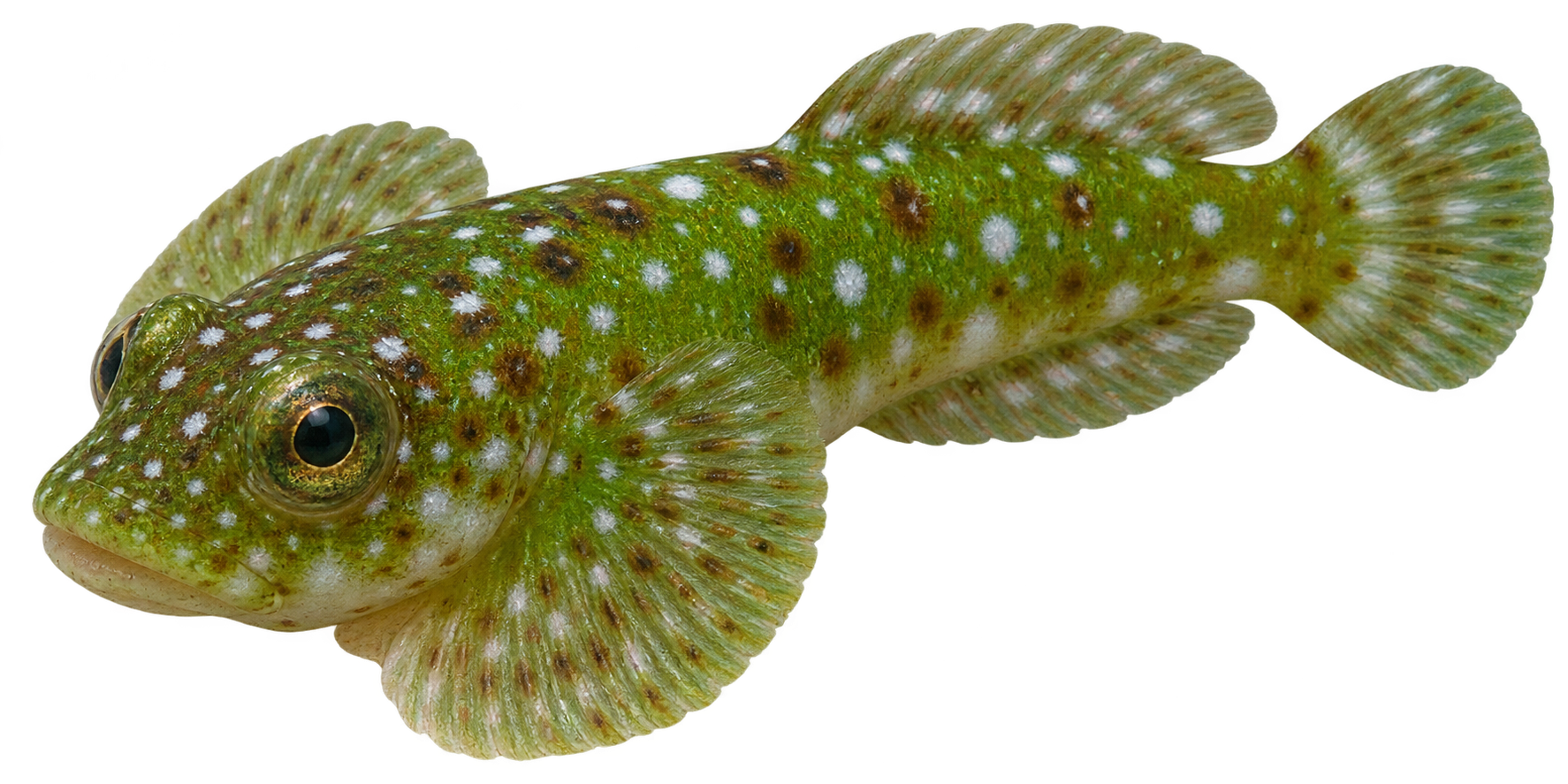
The emerald clingfish is a very small fish that can disappear against a blade of vegetation. Its green coloration may be interrupted by pale or brown spots and patches. A relatively large head and eyes lead into a short body, making it look quite different from the long, narrow outline of a pipefish. University of the West Indies emerald-clingfish guide.
Its most unusual feature is underneath: an adhesive disc incorporates the pelvic fins and associated structures near the pectoral fins. This attachment system helps clingfishes hold onto a surface. Broad pectoral fins, a single soft dorsal fin well back on the body and a similarly placed anal fin complete the basic family shape. It has no scales. FAO clingfish identification guide, pages 1773–1774.
The name is not a shortcut to identification. A green fish in seagrass is not automatically an emerald clingfish, and the closely related Acyrtops amplicirrus is recognized separately. Fine anatomical features can be difficult to resolve without specialist photographs or examination. Leave uncertain observations labeled as a possible clingfish rather than treating color alone as proof.
Southeast Florida context
Biscayne National Park includes emerald clingfish in its list of fishes reported within the park. This supports occurrence inside the Vero Beach–Key Largo corridor without implying that it is routinely found on local dives. Biscayne fish checklist.
Shallow seagrass habitat, particularly turtle grass, is central to its natural history. Individuals can attach to the undersides of leaves, so the fish may be present without being obvious from above. Its small scale makes this an observation challenge rather than a conspicuous reef attraction.
Feeding and early life
Small crustaceans form part of its food. Published accounts describe eggs deposited on seagrass blades, while the Smithsonian database distinguishes bottom-associated eggs from free-swimming larvae. Vegetation can therefore provide more than camouflage: it can also serve as a surface for reproduction. Smithsonian species data.
Protecting a small habitat
Do not pull up seagrass or turn leaves repeatedly to search for a fish. Stay clear of the bottom, avoid dragging equipment through vegetation and photograph any visible individual where it is. Never detach a clingfish to show its adhesive disc. A photograph that leaves its identity uncertain is preferable to damaging its habitat or injuring it.
Florida includes clingfishes among regulated marine-life fishes. Consult the current FWC marine-life rules and any park or sanctuary restrictions before collecting. This profile provides neither an open-harvest badge nor an eating recommendation.
Current Florida collection cautions
Reviewed November 12, 2026. FWC includes clingfishes among regulated marine-life fishes. These rules include licensing, live-maintenance, gear and possession requirements. The defined Blue Heron Bridge dive site is closed to marine-life harvest; parks and sanctuaries may impose additional restrictions. This page does not authorize collection. Official FWC marine-life requirements
Make your next dive happen
Dive With Us
Explore local charters and plan a dive suited to your experience.
View dive calendarTrain With Us
Build your fish identification, buoyancy and diving skills.
Explore trainingTravel With Us
Discover upcoming dive adventures and trip details.
Explore dive travelShop With Us
Browse equipment for your diving and ask our team for help choosing.
Explore dive gearReview current dates, availability, prices, inclusions and requirements on each listing before booking or buying.
Call us now
Ask about fish identification training
Reef Fish Identification
Ask about dates, prerequisites or your next step. An inquiry does not reserve a place. Please provide your own contact details; do not include medical, payment or a child's personal information.
We use these details to respond to your inquiry. This form does not sign you up for marketing.
Explore more with Stuart Scuba
Open Water course options · Advanced Adventure training · Technical training · Professional training · All courses · Local dives · Dive trips · Facebook · Instagram · YouTube
Your surface-interval essentials
Questions for Stuart Scuba? info@stuartscuba.com
Check the Stuart Scuba Weather Center · Play scuba trivia
Weather and wildlife vary. Confirm current conditions, trip requirements and departure details with the operator.
Plan Your Next Dive with Stuart Scuba
Dive With Us
Explore upcoming local charters and choose a dive that fits your experience.
Before you book
Check the individual listing for departure time, requirements and availability.
Travel With Us
Find upcoming dive adventures and start planning your next trip.
Plan your trip
Review dates, inclusions and trip details on the travel calendar.
Stay Connected with Stuart Scuba
 Follow pageShare
YouTube
SubscribeWatch & shareFollow on InstagramView & share post
Follow company news, training updates, and dive stories.
Follow on LinkedInGoogle Reviews
See Stuart Scuba’s current Google rating and review count below. Open the listing in Google Maps to browse customer reviews.



