

Fish identification archive / Eastern Oyster
Eastern Oyster
Crassostrea virginica · Ostreidae
I saw this
Spotted this marine life? Share the guide with your dive buddies. Review your caption before posting.
For Instagram, copy the caption and link into your own post or message. Nothing is posted automatically and this does not record a verified sighting.
Identification overview
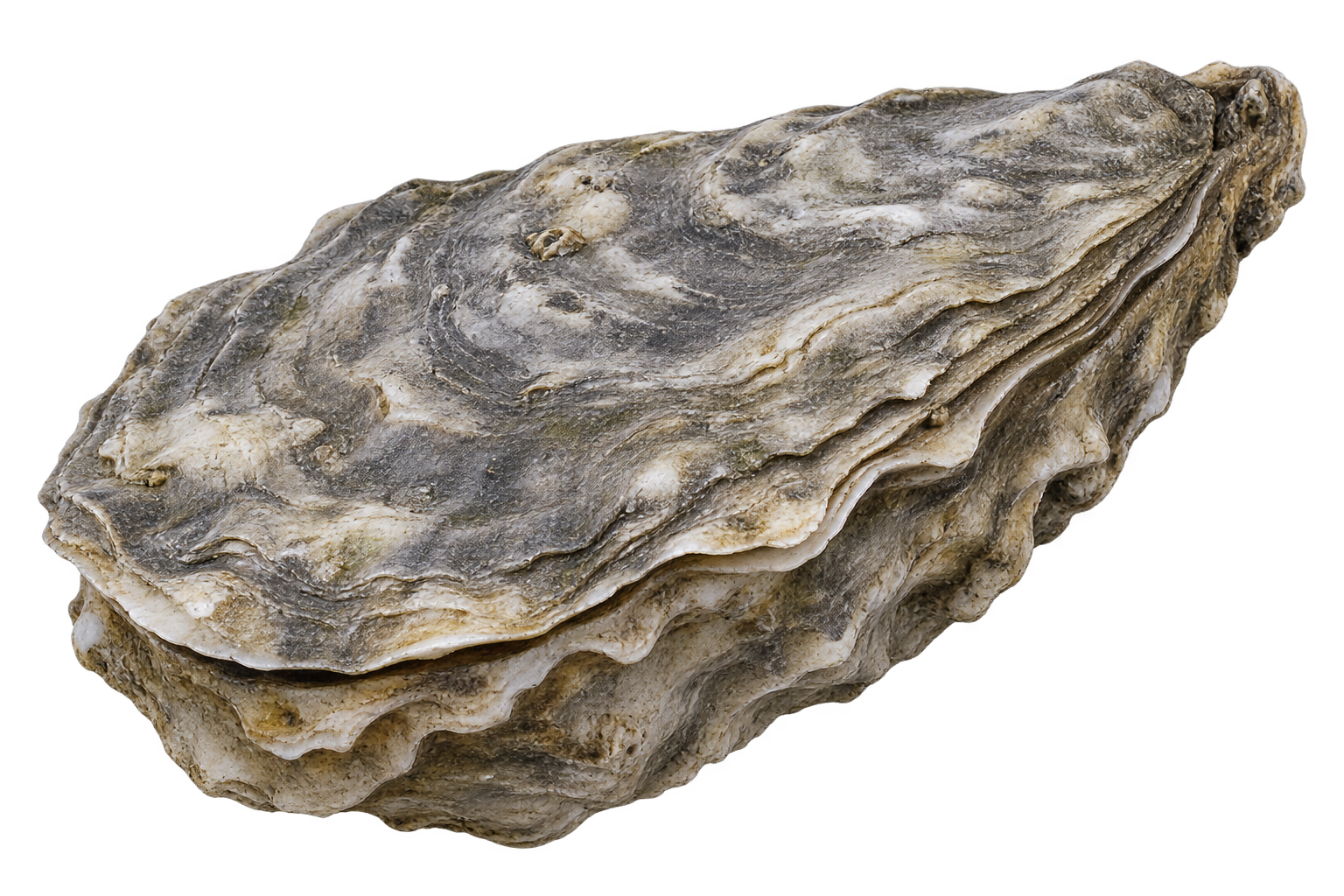
The eastern oyster, Crassostrea virginica, builds habitat as well as a shell. Its heavy, irregular valves grow attached to firm surfaces and other oysters. The lower valve is typically more cupped, while the upper valve acts like a flatter lid. Exterior color is often gray; an empty shell can show a white interior and a darker muscle scar.
Where to look in the regional guide
This species belongs to Atlantic Florida’s estuaries and shorelines. Research has examined living eastern oysters throughout the Indian River Lagoon, including its central and southern portions. Oyster habitat is an appropriate part of a Vero Beach–Key Largo marine-life directory, but an estuarine oyster reef is not the same habitat as an offshore coral reef. Do not use “reef” alone to imply that they are interchangeable.
Individual oyster shells change shape as they grow against neighbors and irregular surfaces. An entire cluster can therefore be easier to recognize than one unusual valve. Keep your distance from sharp shells, and avoid stepping on a living reef to inspect it.
A stationary filter feeder
Adults stay attached while moving water brings microscopic algae and suspended food particles within reach. Oyster reefs create spaces used by other animals, including small fish and invertebrates. A quiet observation may reveal neighbors moving through the shell matrix even when the oysters themselves appear motionless.
Reproduction begins with eggs and sperm released into the water. Early life stages disperse before settling onto suitable hard material. NOAA describes oysters commonly maturing first as males and later functioning as females. This is a biological life-history pattern, not something that can be diagnosed by looking at the outside of a closed shell.
Compare other oysters
Florida also has flat tree oysters and other attached bivalves. Flat tree oysters use bundles of attachment fibers, while eastern oysters cement themselves in place. Do not pry an animal free to examine this difference. Photograph the cluster, surrounding substrate and visible attachment context instead, then compare those images with a reliable identification reference.
Protect the habitat
Oysters are living infrastructure for an estuary. Leave clusters intact and avoid disturbing restoration material. The presence of oysters does not establish safe or legal harvest: area classifications, closures, licenses and protected-site rules must be checked separately. Observe first, document carefully and use current official guidance before considering collection. A useful record includes the date, location and whether the oyster was alive in place, rather than just an attractive shell without context.
Florida DEP’s 2014 St. Lucie Inlet Preserve animal inventory provides an additional dated local record.
References
- National Shell Museum identification reference
- FWC species information
- NOAA Fisheries species profile
- UCF: Living-oyster sampling across the Indian River Lagoon
- Indian River Lagoon oyster and water study
- Florida DEP: 2014 St. Lucie Inlet Preserve State Park plan, local animal record
- FWC: Current recreational saltwater rules
Current Florida collection cautions
Reviewed November 12, 2026. Collecting a shell containing a living organism generally requires a Florida recreational saltwater fishing license. Species rules and park, refuge or sanctuary restrictions apply independently of identification. Leave occupied shells and their habitat undisturbed. FWC requires clams, oysters and mussels to come only from designated approved or conditionally approved shellfish areas that FDACS currently lists as open. Closed waters cannot be harvested. Check the exact area map and daily status; no location is cleared by this profile. Oyster-specific size, season, method and possession rules must also be checked for the exact jurisdiction. This guide gives no harvest permission or assurance that an animal is safe to eat. Official FWC live-shell collection guidance Official FWC oyster and clam rules Official FDACS shellfish classification and status
Make your next dive happen
Dive With Us
Explore local charters and plan a dive suited to your experience.
View dive calendarTrain With Us
Build your fish identification, buoyancy and diving skills.
Explore trainingTravel With Us
Discover upcoming dive adventures and trip details.
Explore dive travelShop With Us
Browse equipment for your diving and ask our team for help choosing.
Explore dive gearReview current dates, availability, prices, inclusions and requirements on each listing before booking or buying.
Call us now
Ask about fish identification training
Reef Fish Identification
Ask about dates, prerequisites or your next step. An inquiry does not reserve a place. Please provide your own contact details; do not include medical, payment or a child's personal information.
We use these details to respond to your inquiry. This form does not sign you up for marketing.
Explore more with Stuart Scuba
Open Water course options · Advanced Adventure training · Technical training · Professional training · All courses · Local dives · Dive trips · Facebook · Instagram · YouTube
Your surface-interval essentials
Questions for Stuart Scuba? info@stuartscuba.com
Check the Stuart Scuba Weather Center · Play scuba trivia
Weather and wildlife vary. Confirm current conditions, trip requirements and departure details with the operator.
Plan Your Next Dive with Stuart Scuba
Dive With Us
Explore upcoming local charters and choose a dive that fits your experience.
Before you book
Check the individual listing for departure time, requirements and availability.
Travel With Us
Find upcoming dive adventures and start planning your next trip.
Plan your trip
Review dates, inclusions and trip details on the travel calendar.
Stay Connected with Stuart Scuba
 Follow pageShare
YouTube
SubscribeWatch & shareFollow on InstagramView & share post
Follow company news, training updates, and dive stories.
Follow on LinkedInGoogle Reviews
See Stuart Scuba’s current Google rating and review count below. Open the listing in Google Maps to browse customer reviews.



