

Fish identification archive / Dwarf Seahorse
Dwarf Seahorse
Hippocampus zosterae · Syngnathidae
I saw this
Spotted this fish? Share the guide with your dive buddies. Review your caption before posting.
For Instagram, copy the caption and link into your own post or message. Nothing is posted automatically and this does not record a verified sighting.
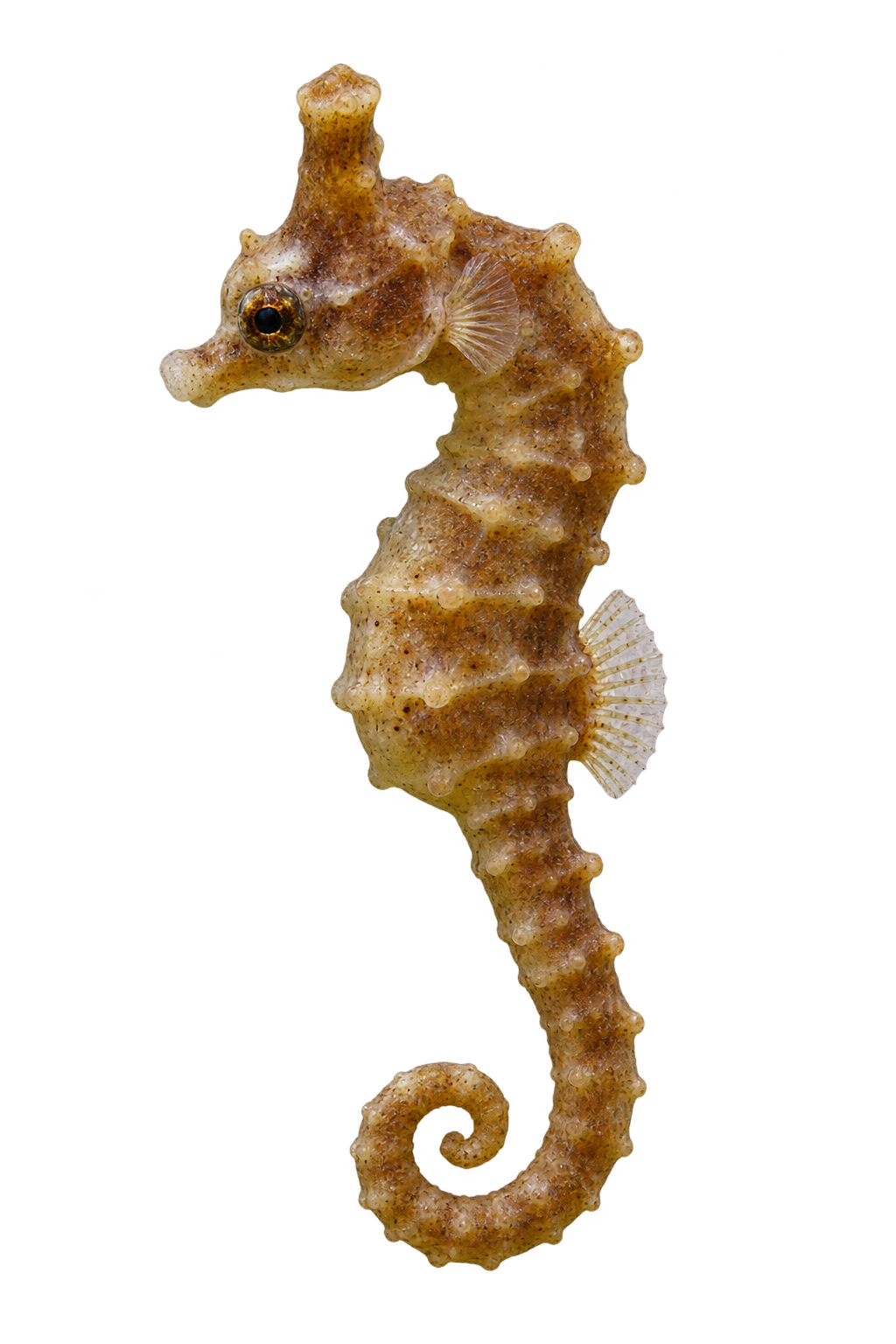
A small seagrass specialist
A dwarf seahorse is a fully formed seahorse in miniature, with an upright posture, a curled grasping tail and a short tubular snout. The crown-like coronet on its head is relatively tall, while its body armature consists of low knobs rather than dramatic long spines. Colors vary, so green, brown or pale coloration alone will not settle the identification. Smithsonian identification guide.
Small size is also not enough: a young lined or longsnout seahorse can be tiny. A useful photograph shows the snout, coronet and body together. Treat a view that hides these features as a possible identification, not a certainty.
Documented in the local corridor
The National Park Service includes dwarf seahorse among fishes reported in Biscayne National Park. Biscayne fish checklist.
Farther north, a 1965 survey of Jupiter Inlet and the Loxahatchee River documented 31 specimens collected during 1959–61. Those records establish historical living occurrence in the corridor. They do not tell us how many remain today or support advertising a guaranteed seahorse encounter. SFWMD-hosted survey, printed pages 80–81.
NOAA places this species in seagrass habitats along Florida’s Atlantic coast, as well as elsewhere in its range. The vegetation provides attachment points and a setting for feeding, making the grass itself part of the animal’s habitat rather than an obstacle to move aside. NOAA dwarf-seahorse profile.
Feeding and reproduction
Tiny crustaceans, including copepods and amphipods, make up its prey. The short snout works at close range as the seahorse feeds among vegetation. During reproduction, the female transfers eggs into the male’s brood pouch. Development takes place there before the male releases living young. Pair bonding can occur through a breeding cycle, but describing every pair as lifelong partners would overstate the evidence. NOAA status review.
Conservation and careful viewing
NOAA currently states that dwarf seahorse is not listed under the U.S. Endangered Species Act and identifies it under CITES Appendix II. Neither statement gives permission to collect one. Florida includes seahorses within its regulated marine-life fish, and location-specific restrictions still matter. FWC marine-life rules.
Keep fins, hands and camera supports clear of seagrass. Never pull a tail loose, remove vegetation to reveal the fish or move an individual onto a photographic perch. A brief, undisturbed view is more valuable than a close-up obtained by damaging the habitat.
Current Florida collection cautions
Reviewed November 12, 2026. FWC includes seahorses among regulated marine-life fishes. These rules include licensing, live-maintenance, gear and possession requirements. The defined Blue Heron Bridge dive site is closed to marine-life harvest; parks and sanctuaries may impose additional restrictions. This page does not authorize collection. Official FWC marine-life requirements
Blue Heron Bridge report
Matthew Sullivan’s 2023 Blue Heron Bridge (BHB) portfolio reports dwarf seahorse at this Riviera Beach dive site. This is a site-specific observation report, not a guarantee of a sighting. Observe without disturbing the animal or its habitat. Matthew Sullivan’s Blue Heron Bridge portfolio.
Make your next dive happen
Dive With Us
Explore local charters and plan a dive suited to your experience.
View dive calendarTrain With Us
Build your fish identification, buoyancy and diving skills.
Explore trainingTravel With Us
Discover upcoming dive adventures and trip details.
Explore dive travelShop With Us
Browse equipment for your diving and ask our team for help choosing.
Explore dive gearReview current dates, availability, prices, inclusions and requirements on each listing before booking or buying.
Call us now
Ask about fish identification training
Reef Fish Identification
Ask about dates, prerequisites or your next step. An inquiry does not reserve a place. Please provide your own contact details; do not include medical, payment or a child's personal information.
We use these details to respond to your inquiry. This form does not sign you up for marketing.
Explore more with Stuart Scuba
Open Water course options · Advanced Adventure training · Technical training · Professional training · All courses · Local dives · Dive trips · Facebook · Instagram · YouTube
Your surface-interval essentials
Questions for Stuart Scuba? info@stuartscuba.com
Check the Stuart Scuba Weather Center · Play scuba trivia
Weather and wildlife vary. Confirm current conditions, trip requirements and departure details with the operator.
Plan Your Next Dive with Stuart Scuba
Dive With Us
Explore upcoming local charters and choose a dive that fits your experience.
Before you book
Check the individual listing for departure time, requirements and availability.
Travel With Us
Find upcoming dive adventures and start planning your next trip.
Plan your trip
Review dates, inclusions and trip details on the travel calendar.
Stay Connected with Stuart Scuba
 Follow pageShare
YouTube
SubscribeWatch & shareFollow on InstagramView & share post
Follow company news, training updates, and dive stories.
Follow on LinkedInGoogle Reviews
See Stuart Scuba’s current Google rating and review count below. Open the listing in Google Maps to browse customer reviews.



