

Fish identification archive / Dwarf Sand Perch
Dwarf Sand Perch
Diplectrum bivittatum
I saw this
Spotted this marine animal? Share the guide with your dive buddies. Review your caption before posting.
For Instagram, copy the caption and link into your own post or message. Nothing is posted automatically and this does not record a verified sighting.
Fun facts for your next surface interval
- Dwarf is relative: the species can reach almost ten inches.
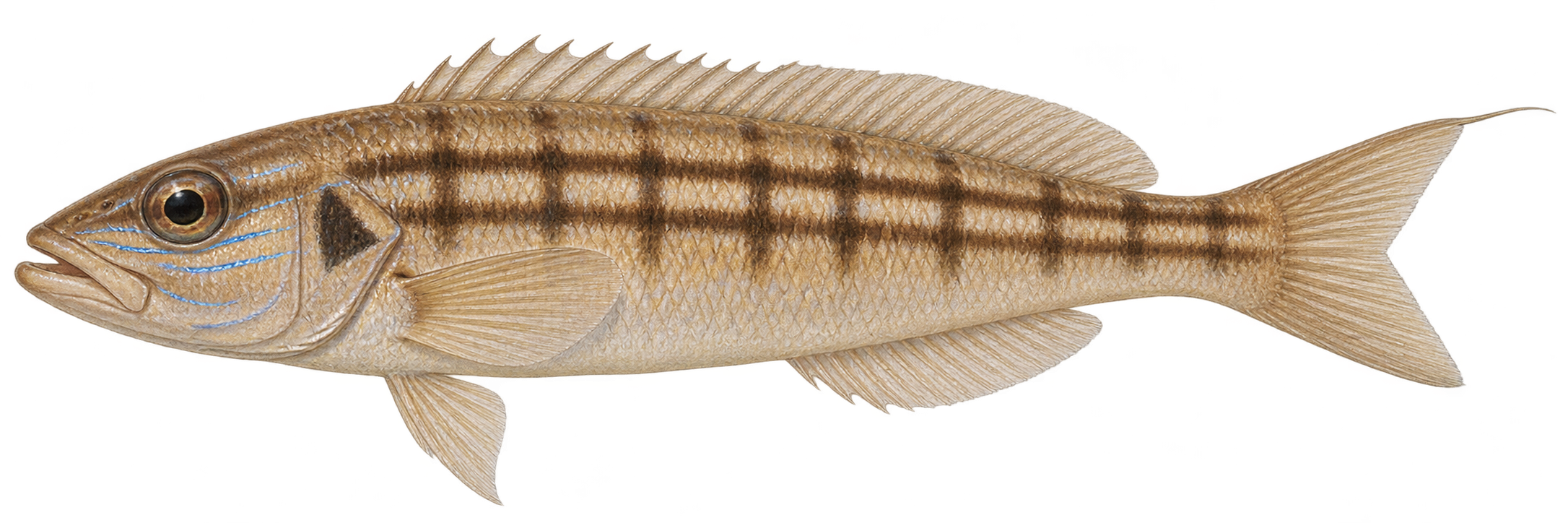
- Young fish have two broad dark stripes ending in blue- or white-edged spots.
- One cheek-corner spine cluster distinguishes it from the common sand perch’s two.
Florida and local context
Florida Keys region; Palm Beach occurrence not verified in the cited museum checklist: Smithsonian species data report includes Florida Keys-region occurrence coordinates, for example [[24.3602, -82.7563], [24.3639, -82.5153]]. Lake Worth Lagoon row has no verified mark; potential only.
Documented regional presence is not a guarantee of an encounter or a measure of how common this animal is at your dive site.
How to recognize this animal
The dwarf sand perch is pale brown with two dark stripes along the upper side and short irregular, often paired dark bars over them. Blue lines decorate the cheek and the area below the eye. A dark mark may show through the upper gill cover. At the cheek corner, one pointed bony spur supports a single cluster of radiating spines.
Size and life stages
Despite the word dwarf, the documented maximum is 25 centimeters, nearly ten inches. Young fish show two broad dark stripes, each ending in a dark spot edged in blue or white. The moderately forked tail can carry a filament on its upper lobe. These proportions and markings should be checked before interpreting the name as a guarantee of tiny size.
Habitat and where to look
Sand and mud bottoms, often near reefs, are documented habitats. Smithsonian gives a full depth interval of two to 140 meters, with 15 to 80 meters as the usual range. A shallow observation is therefore possible, but the species is not exclusively a shallow grass-flat fish. The lower end of its typical range reaches beyond standard recreational diving.
Range and local context
The documented range extends from the Carolinas to Brazil. Smithsonian distribution points document the Florida Keys region. Florida Museum lists this species only as a potential, unverified Lake Worth Lagoon occurrence; it is not a confirmed Palm Beach record in that checklist. This broader Florida inclusion should not be read as a promise of a local encounter.
What is on the menu?
The recorded diet includes small bony fishes, crustaceans and worms. Its mouth and fixed teeth suit capturing animal prey. Two dark side stripes do not indicate a cleaning role or an algae-feeding habit. A diver who sees a brief strike into the sand can record the behavior without claiming to know whether a worm or a crustacean was swallowed.
Daily habits and behavior
The relatively large eye, low continuous dorsal and slim body are useful when the color pattern is faint. The upper tail filament may be difficult to see if the fin is folded or damaged. Its slightly compressed body can present a very narrow head-on view, so an apparent disappearance against the bottom may simply reflect a change in angle.
Mating and the next generation
Smithsonian records pelagic eggs and larvae for this species. That evidence supports a drifting early stage but does not supply a Florida monthly spawning season or demonstrate nest guarding. The small size of a photographed individual also cannot establish reproductive maturity. Keep any observed pair interactions distinct from assumptions about how sand perches reproduce.
Look-alikes and identification traps
Common sand perch, Diplectrum formosum, has two clusters of cheek-corner spines and usually more numerous fine blue side lines. The dwarf species has one cluster and a stronger paired-stripe appearance, especially when young. Photographs that omit the head can be ambiguous. Neither species should be mistaken for a juvenile grouper solely because it is a small sea-bass relative.
Observe without disturbing
Stay clear of the mud or sand while photographing, because suspended sediment quickly hides the fine cheek details. Do not chase the fish into a crevice for a closer view of the spine cluster. Record depth, bottom type and the visible stripe pattern. If the cheek cannot be seen, leave room for uncertainty between the two Diplectrum species.
Harvest, protection and eating safety
Harvest conditionally allowed; default state limits and protected areas apply
Can it be hunted or harvested?
Dwarf Sand Perch (Diplectrum bivittatum) is explicitly excluded from the ornamental marine-life Serranidae category. It is not assigned a grouper season simply because it belongs to the sea-bass family. In Florida state waters, ordinary lawful recreational harvest is subject to a saltwater license unless exempt and the default limit of two fish or 100 pounds per person per day, whichever is greater. This is a legal ceiling, not a recommended catch. Local closures, legal gear and any applicable federal rules still control.
Florida seasons and areas
No species-specific statewide annual closed months or size limit were identified in the current FWC rules reviewed; that does not mean every location is open year-round. Harvest of Diplectrum is prohibited in John Pennekamp Coral Reef State Park. Check the precise sanctuary, park and refuge zone and state-versus-federal jurisdiction before taking. The designated Western Dry Rocks area closes to all fishing April 1 through July 31 annually. This guide does not authorize collecting at the Blue Heron Bridge dive site.
Can it be speared?
Potentially, only where legal. This Diplectrum species is not on the FWC prohibited-spear list and is excluded from the ornamental live-only category. Location restrictions independently apply, including near public swimming beaches, qualifying piers/bridges and jetties, in parks, and the specified Monroe County area. Powerheads, bangsticks and rebreathers are prohibited for spearfishing.
Is it safe to eat?
No species-specific food-safety clearance is established here. Check Florida DOH advisories for the actual species and capture water before eating, especially for children or people who are pregnant or may become pregnant. Do not apply freshwater perch or black sea bass advice merely because the common name sounds similar. Legal harvest does not rule out mercury or marine toxins, and cooking does not remove ciguatoxin.
Before you act: This recreational overview is not permission to collect or spear at your dive site. Confirm the species, date, management area, state or federal waters, gear, licenses and current local closures. Identification artwork cannot establish an identification or guarantee seafood safety.
Official rules and health guidance
- FWC species applicability and Pennekamp restrictions (commercial quantities not used)
- FWC default recreational limits
- NOAA Florida Keys sanctuary zones
- FWC Western Dry Rocks seasonal closure
- FWC spearing rules and area restrictions
- Florida DOH fish-consumption advisories
- Florida DOH seafood poisoning guidance
Reviewed 2026-11-10. Rules and advisories can change; check the linked authorities before harvesting or eating.
Sources and review
Reviewed 2026-11-10.
Make your next dive happen
Dive With Us
Explore local charters and plan a dive suited to your experience.
View dive calendarTrain With Us
Build your fish identification, buoyancy and diving skills.
Explore trainingTravel With Us
Discover upcoming dive adventures and trip details.
Explore dive travelShop With Us
Browse equipment for your diving and ask our team for help choosing.
Explore dive gearReview current dates, availability, prices, inclusions and requirements on each listing before booking or buying.
Call us now
Ask about marine life identification
Marine Life Identification
Ask about dates, prerequisites or your next step. An inquiry does not reserve a place. Please provide your own contact details; do not include medical, payment or a child's personal information.
We use these details to respond to your inquiry. This form does not sign you up for marketing.
Explore more with Stuart Scuba
Open Water course options · Advanced Adventure training · Technical training · Professional training · All courses · Local dives · Dive trips · Facebook · Instagram · YouTube
Your surface-interval essentials
Questions for Stuart Scuba? info@stuartscuba.com
Check the Stuart Scuba Weather Center · Play scuba trivia
Weather and wildlife vary. Confirm current conditions, trip requirements and departure details with the operator.
Plan Your Next Dive with Stuart Scuba
Dive With Us
Explore upcoming local charters and choose a dive that fits your experience.
Before you book
Check the individual listing for departure time, requirements and availability.
Travel With Us
Find upcoming dive adventures and start planning your next trip.
Plan your trip
Review dates, inclusions and trip details on the travel calendar.
Stay Connected with Stuart Scuba
 Follow pageShare
YouTube
SubscribeWatch & shareFollow on InstagramView & share post
Follow company news, training updates, and dive stories.
Follow on LinkedInGoogle Reviews
See Stuart Scuba’s current Google rating and review count below. Open the listing in Google Maps to browse customer reviews.



