

Fish identification archive / Dusky Pipefish
Dusky Pipefish
Syngnathus floridae · Syngnathidae
I saw this
Spotted this fish? Share the guide with your dive buddies. Review your caption before posting.
For Instagram, copy the caption and link into your own post or message. Nothing is posted automatically and this does not record a verified sighting.
Recognizing the fish
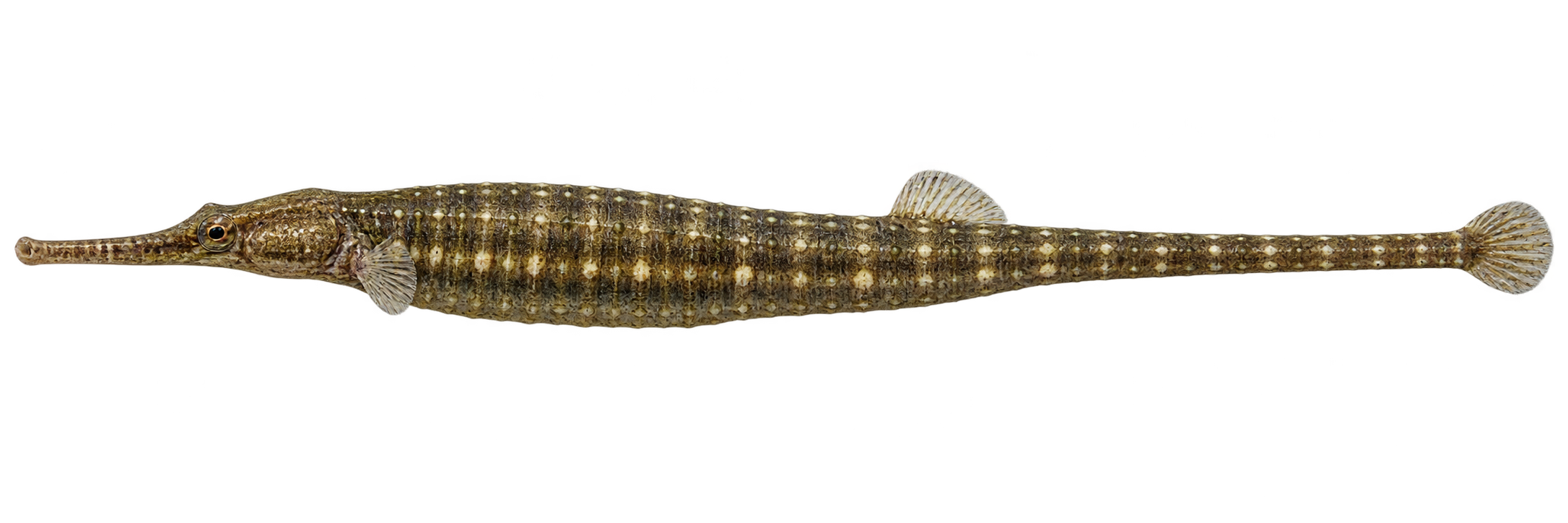
The dusky pipefish has a long, narrow snout and an elongated body enclosed in rings of bony plates. It is a relative of seahorses, but its body extends largely horizontally and ends in a small tail fin. The trunk and front of the tail are relatively deep compared with the especially slender chain pipefish. Small pectoral fins and a delicate dorsal fin are easy to overlook. Smithsonian dusky-pipefish guide.
Its markings vary from pale to brownish, with mottling, rows of small pale spots or indistinct bars. Color alone is a weak identification tool. More useful details include snout proportions, the triangular bony area in front of the eye, body-ring counts and the arrangement of body ridges. These are not all visible in an ordinary underwater photograph, so some sightings should remain identified only as pipefish.
Do not assume that every thin fish in seagrass is this species. Chain, gulf and other pipefishes overlap in general appearance. A sharp side photograph showing the full head, dorsal fin and tail helps with later comparison.
Southeast Florida records
Dusky pipefish appears in the NPS list of fishes reported in Biscayne National Park. Florida Museum’s Lake Worth Lagoon list also marks it as documented, with observer records. These are direct regional records within the Vero Beach–Key Largo corridor, rather than an inference from a statewide range map. Neither source establishes present numbers at a particular dive site. Biscayne checklist; Florida Museum’s documented lagoon fishes.
Coastal seagrass and macroalgae are important habitats. Its subdued outline can make it hard to distinguish from surrounding plant material until it moves.
Food and male care
Dusky pipefish feed on tiny crustaceans. NOAA summarizes copepods, amphipods and small shrimp among recorded prey, drawing on Florida studies. NOAA Florida Bay fish report, printed page 97.
The male carries developing eggs in a pouch beneath the tail. Research on this species has demonstrated transfer of paternal nutrients to embryos, showing that the pouch does more than hold them in place. Published study of paternal nutrient transfer.
Observing responsibly
Leave pipefish where you find them. Do not lift, restrain or reposition one for a photograph. Keep fins and camera supports off vegetation and avoid stirring sediment.
Florida includes pipefishes among regulated marine-life fish. Follow current FWC marine-life rules and local protected-area restrictions. This guide does not authorize collection.
Current observation and collection guidance
Checked November 12, 2026: Florida includes pipefishes in its regulated marine-life fish list. Collection is subject to licensing, permitted gear, live-condition and life-support requirements, and applicable limits. The Blue Heron Bridge dive site is closed to marine-life harvest within its designated boundaries. Check park, sanctuary and other local restrictions before any collection; an occurrence record is not permission to remove an animal. Biscayne National Park fish checklist FWC marine-life collection regulations Florida Museum Lake Worth Lagoon fish checklist
Blue Heron Bridge report
A 2016 DiverTrek photographic trip account labels a dusky pipefish at Blue Heron Bridge (BHB). Identification is attributed to the photographer, not an independently examined specimen. This historical report does not establish current abundance or guarantee a sighting. Site-specific observation source.
Make your next dive happen
Dive With Us
Explore local charters and plan a dive suited to your experience.
View dive calendarTrain With Us
Build your fish identification, buoyancy and diving skills.
Explore trainingTravel With Us
Discover upcoming dive adventures and trip details.
Explore dive travelShop With Us
Browse equipment for your diving and ask our team for help choosing.
Explore dive gearReview current dates, availability, prices, inclusions and requirements on each listing before booking or buying.
Call us now
Ask about fish identification training
Reef Fish Identification
Ask about dates, prerequisites or your next step. An inquiry does not reserve a place. Please provide your own contact details; do not include medical, payment or a child's personal information.
We use these details to respond to your inquiry. This form does not sign you up for marketing.
Explore more with Stuart Scuba
Open Water course options · Advanced Adventure training · Technical training · Professional training · All courses · Local dives · Dive trips · Facebook · Instagram · YouTube
Your surface-interval essentials
Questions for Stuart Scuba? info@stuartscuba.com
Check the Stuart Scuba Weather Center · Play scuba trivia
Weather and wildlife vary. Confirm current conditions, trip requirements and departure details with the operator.
Plan Your Next Dive with Stuart Scuba
Dive With Us
Explore upcoming local charters and choose a dive that fits your experience.
Before you book
Check the individual listing for departure time, requirements and availability.
Travel With Us
Find upcoming dive adventures and start planning your next trip.
Plan your trip
Review dates, inclusions and trip details on the travel calendar.
Stay Connected with Stuart Scuba
 Follow pageShare
YouTube
SubscribeWatch & shareFollow on InstagramView & share post
Follow company news, training updates, and dive stories.
Follow on LinkedInGoogle Reviews
See Stuart Scuba’s current Google rating and review count below. Open the listing in Google Maps to browse customer reviews.



