

Fish identification archive / Dushia flabellina
Dushia flabellina
Edmundsella dushia
Fun facts for your next surface interval
Florida and local context
A May 2025 Blue Heron Bridge dive diary identifies and photographs an 8–10 mm individual as Flabellina dushia.
A documented past record does not establish present abundance or guarantee an encounter.
How to recognize this animal
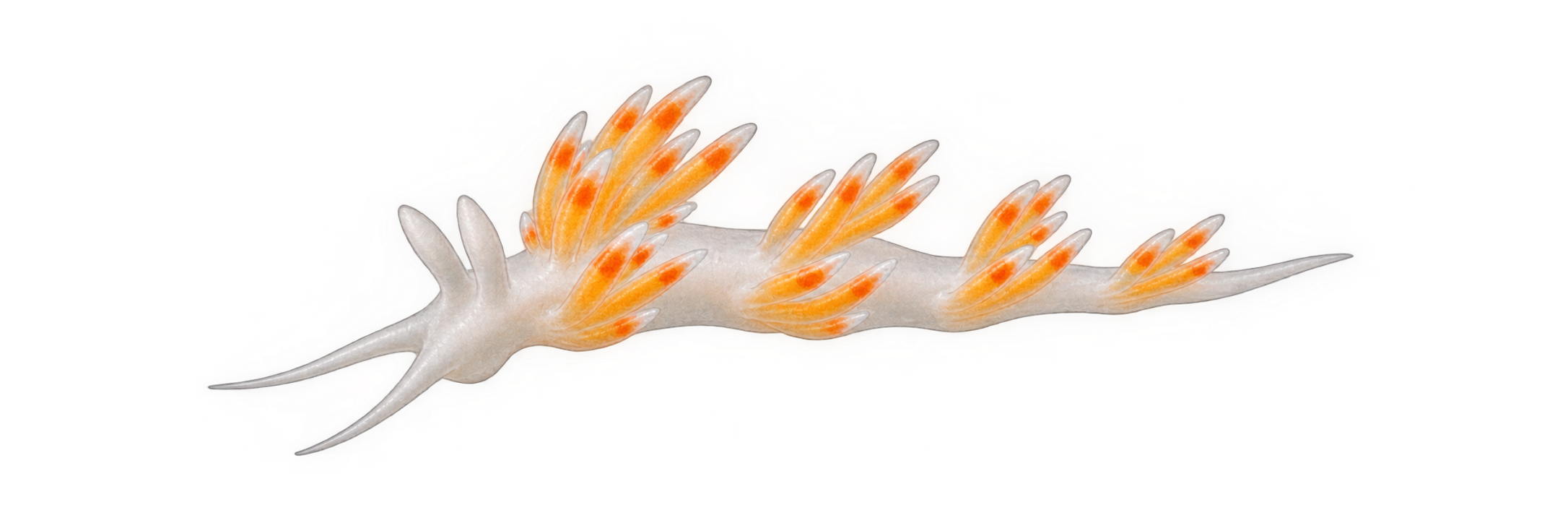
Dushia flabellina is a tiny aeolid with a pale, often opaque-white body and contrasting red, orange or yellow digestive branches visible inside its back projections, called cerata. The relatively short rhinophores are smooth rather than conspicuously ringed or covered with papillae. Some animals show a stronger reddish band near the upper end of each colored digestive branch. Use the whole combination of body pattern, cerata and head structures, rather than matching a single orange patch.
Sources: Australian Museum Sea Slug Forum: Flabellina dushia
Size and life stages
The 2006 redescription reports living animals up to 15 mm long. A Blue Heron Bridge diary estimated its pictured individual at 8–10 mm, and a separate Lake Worth Lagoon photograph near Peanut Island records about 14 mm. These local observations are individual estimates, not a measured population size range. At this scale, a stable close-up photograph is more useful than a hurried underwater guess.
Sources: Laura Kushner: DIVE! DIVE! DIVE! (18 May 2025); JaxShells: Anne DuPont’s 8 July 2007 dushia photograph; Millen and Hamann (2006): Caribbean Flabellina descriptions and redescriptions (author-hosted University of British Columbia copy)
Habitat and where to look
Published natural-history accounts associate this species with seagrass, Sargassum and hydroids. Its local records include shallow lagoon diving, but that does not establish that every nearby reef or sand flat supports it. The Florida Museum also lists the species, under its older name Flabellina dushia, among Lake Worth Lagoon invertebrates. Search visually along existing growth without pulling material apart.
Sources: Millen and Hamann (2006): Caribbean Flabellina descriptions and redescriptions (author-hosted University of British Columbia copy); Florida Museum: Invertebrates of Lake Worth Lagoon
Range and local context
The museum account reports the Caribbean, Canary Islands and Cape Verde Islands. For the West Palm Beach diving area, the evidence is more precise: one diary explicitly names Blue Heron Bridge, while an older photograph names Lake Worth Lagoon near Peanut Island at Palm Beach Inlet. These are separate locality descriptions and should remain separate when logging your own observations.
Sources: Australian Museum Sea Slug Forum: Flabellina dushia; Laura Kushner: DIVE! DIVE! DIVE! (18 May 2025); JaxShells: Anne DuPont’s 8 July 2007 dushia photograph
What is on the menu?
Hydroid polyps are reported as prey. These are animals, despite their sometimes plantlike colonies. A slug resting on algae or seagrass is therefore not evidence that it eats that substrate. The sources reviewed do not establish which hydroid species this nudibranch takes at Blue Heron Bridge, so a local prey name would be premature.
Sources: Reeflex: Edmundsella dushia
Daily habits and behavior
Its small size makes careful observation especially valuable. Record whether an animal is simply crossing a surface or repeatedly putting its mouth against a colony; those are different kinds of evidence. No dependable local activity schedule or seasonal encounter rate was verified for this profile. The dated records document presence, not predictable abundance.
Mating and the next generation
The 2006 redescription documents an ovotestis with male and female follicles, confirming hermaphroditic reproductive anatomy in this species. That anatomical knowledge does not provide a local spawning calendar. This guide does not assign an egg count or larval duration, and an egg string nearby should not be attributed to the species without stronger evidence.
Look-alikes and identification traps
Other pale, red-cerata aeolids can give a similar first impression. The 2006 revision compares dushia with the animal then called Flabellina verta, noting dushia’s shorter, tightly grouped cerata and broader white markings. Older names Coryphella dushia and Flabellina dushia refer to this same species, now accepted as Edmundsella dushia; they are not extra animals for a checklist.
Sources: Millen and Hamann (2006): Caribbean Flabellina descriptions and redescriptions (author-hosted University of British Columbia copy); WoRMS / MolluscaBase: Edmundsella dushia
Observe without disturbing
Keep fins, camera housings and fingers clear of the animal and its support. Photograph the head and back from naturally available angles, then add date, depth and site to the record. Leave it where you found it. A useful identification image does not require moving a millimeter-sized slug into a cleaner background.
Harvest, protection and eating safety
Live-only ornamental collection; no collection at Blue Heron Bridge
Yellow means legal or safety conditions require attention. It is not an edible badge or permission to take an animal.
This color is a qualified summary, not permission to collect or a guarantee that a particular animal is safe to eat.
Can it be hunted or harvested?
Dushia flabellina falls under Florida’s expressly named nudibranch/sea-slug category. A recreational saltwater fishing license is required unless exempt. Where collection is lawful, the animal must be landed alive and maintained alive in a suitably sized circulating, aerated or oxygenated system. The recreational limit is five of this species within 20 marine-life organisms per person per day; the two-day possession limit is ten of this species within 40 total. Recreational sale is prohibited. No species-specific size limit is stated in the reviewed marine-life table.
Florida seasons and areas
The designated Blue Heron Bridge Special Marine Life Area, including Phil Foster Park and its mapped surrounding waters, is closed to collection of listed tropical ornamental marine life. Narrow motorized-vessel transit and landing exceptions concern animals lawfully taken elsewhere, not collection here. The Florida marine-life requirements also apply in adjacent federal waters. No species-specific annual closed months are stated in the reviewed marine-life table. Biscayne National Park, state parks, wildlife refuges and Florida Keys sanctuary zones can impose additional closures; check the actual location before collecting.
Can it be speared?
No recreational spearing under these live-only marine-life requirements. Collection uses authorized nonlethal hand/net/slurp-gun methods, subject to species and site restrictions. Quinaldine is prohibited.
Is it safe to eat?
This is live-only ornamental collection, not food harvest. Do not kill a collected animal for a meal. No recipe or safe-to-eat claim is provided.
The regulatory wording uses the older umbrella “Subclass Opisthobranchia.” Modern taxonomy uses different higher groups; the rule expressly names nudibranchs/sea slugs. This is not permission to collect substrate, host colonies or other animals. Edmundsella dushia is the accepted name; Flabellina dushia is the older combination on the local photograph.
Palm Beach is Atlantic Florida. Do not transfer Atlantic guidance to the Gulf, Monroe County, or federal waters without checking the applicable rules.
Before you act: Confirm the species, date, exact management area, state or federal waters, gear, licenses and current local closures. A local occurrence record never grants permission to take an animal.
Official rules and health guidance
- FWC recreational marine-life requirements and species list
- Florida Rule 68B-42.001: listed marine-life species
- Florida Rule 68B-42.0036: mapped marine-life collection closures
- Palm Beach County: Phil Foster Park fishing and collection notice
- FWC spearing restrictions
- NOAA: Florida Keys sanctuary zones
- Florida Rule 68B-42.005: final-adopted recreational bag rule register
Reviewed 2026-11-11. Rules and advisories can change; check the linked authorities before acting.
Identification and source cautions
- Local hydroid prey identity and breeding season not verified.
- Local 8–14 mm figures are individual estimates; published 15 mm upper length is from the 2006 study.
- Common name is a field-guide label, not a standardized taxonomic name.
Sources and review
Biology and taxonomy reviewed 2026-11-11. Photographs on cited sites are reference material and are not reproduced here.
- Australian Museum Sea Slug Forum: Flabellina dushia
- Laura Kushner: DIVE! DIVE! DIVE! (18 May 2025)
- JaxShells: Anne DuPont’s 8 July 2007 dushia photograph
- Millen and Hamann (2006): Caribbean Flabellina descriptions and redescriptions (author-hosted University of British Columbia copy)
- Florida Museum: Invertebrates of Lake Worth Lagoon
- Reeflex: Edmundsella dushia
- WoRMS / MolluscaBase: Edmundsella dushia
Make your next dive happen
Dive With Us
Explore local charters and plan a dive suited to your experience.
View dive calendarTrain With Us
Build your fish identification, buoyancy and diving skills.
Explore trainingTravel With Us
Discover upcoming dive adventures and trip details.
Explore dive travelShop With Us
Browse equipment for your diving and ask our team for help choosing.
Explore dive gearReview current dates, availability, prices, inclusions and requirements on each listing before booking or buying.
Call us now
Ask about marine life identification
Marine Life Identification
Ask about dates, prerequisites or your next step. An inquiry does not reserve a place. Please provide your own contact details; do not include medical, payment or a child's personal information.
We use these details to respond to your inquiry. This form does not sign you up for marketing.
Explore more with Stuart Scuba
Open Water course options · Advanced Adventure training · Technical training · Professional training · All courses · Local dives · Dive trips · Facebook · Instagram · YouTube
Your surface-interval essentials
Questions for Stuart Scuba? info@stuartscuba.com
Check the Stuart Scuba Weather Center · Play scuba trivia
Weather and wildlife vary. Confirm current conditions, trip requirements and departure details with the operator.
Plan Your Next Dive with Stuart Scuba
Dive With Us
Explore upcoming local charters and choose a dive that fits your experience.
Before you book
Check the individual listing for departure time, requirements and availability.
Travel With Us
Find upcoming dive adventures and start planning your next trip.
Plan your trip
Review dates, inclusions and trip details on the travel calendar.
Stay Connected with Stuart Scuba
 Follow pageShare
YouTube
SubscribeWatch & shareFollow on InstagramView & share post
Follow company news, training updates, and dive stories.
Follow on LinkedInGoogle Reviews
See Stuart Scuba’s current Google rating and review count below. Open the listing in Google Maps to browse customer reviews.



