

Fish identification archive / Lemon-drop doris
Lemon-drop doris
Doriopsilla pharpa
Fun facts for your next surface interval
Florida and local context
The JaxShells species page identifies Cariopsilla pharpa in a credited photograph and expressly locates the photographed animal at Lake Worth Lagoon near Peanut Island, Palm Beach Inlet, Palm Beach County, Florida. This supports only the named historical record.
A documented past record does not establish present abundance or guarantee an encounter.
Sources: JaxShells: credited named-site photograph and caption
How to recognize this animal
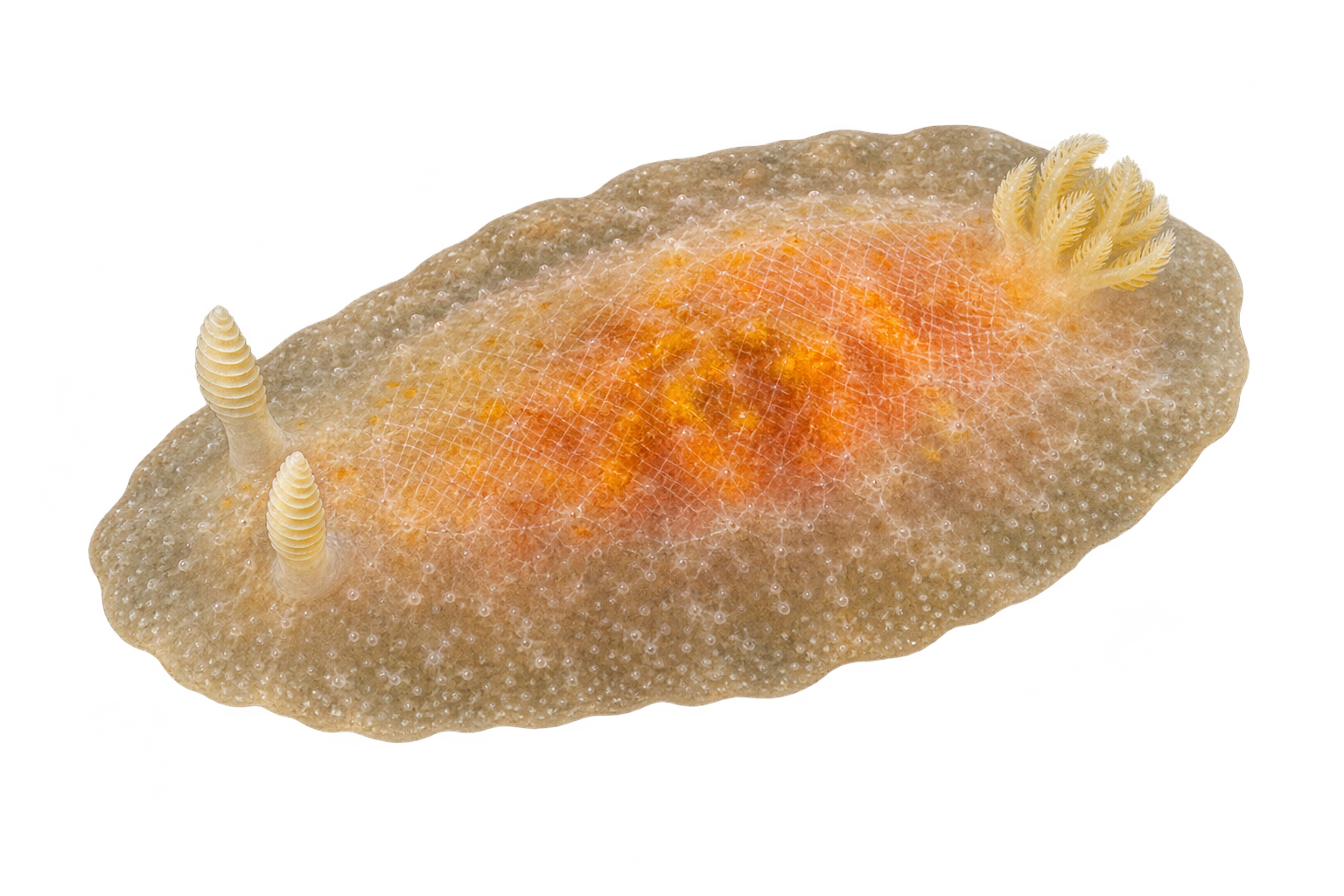
A small, flattened oval nudibranch, described as bright yellow-orange in a 2025 primary study. Specialists used body shape and the arrangement of gills and head tentacles as well as color. The local page uses the synonym Cariopsilla pharpa; color alone is not a secure diagnosis.
Sources: JaxShells: credited named-site photograph and caption
Size and life stages
Nine adults in the Long Island Sound study averaged 11 mm. That small sample is not a maximum, a juvenile growth curve or a size measurement of the Florida photograph.
Sources: JaxShells: credited named-site photograph and caption
Habitat and where to look
The credited photograph is from Lake Worth Lagoon near Peanut Island, Palm Beach Inlet, Palm Beach County, Florida. A measured local depth is not supplied in the caption used here. This is a documented observation setting, not the species’ complete habitat or depth range. Do not relabel a Peanut Island vicinity record as Blue Heron Bridge unless the source says so.
Sources: JaxShells: credited named-site photograph and caption
Range and local context
The corridor evidence here is restricted to the named locality in the photograph caption. A historical record is not proof of present abundance, a continuous Vero Beach–Key Largo distribution or a guaranteed sighting.
Sources: JaxShells: credited named-site photograph and caption
Feeding and diet
The primary study identifies it as a sponge predator, especially on the boring sponge Cliona celata. Captive animals appeared to consume that sponge, with the authors treating detailed feeding work as ongoing.
Sources: JaxShells: credited named-site photograph and caption
Daily habits and behavior
Behavior information is limited. In Long Island Sound, animals were found on worn or encrusted shells, sometimes without visible sponge. Presence on a shell does not prove feeding at that moment or establish social grouping.
Sources: JaxShells: credited named-site photograph and caption
Mating and the next generation
Species-specific reproductive details remain limited in the reviewed evidence. No Florida spawning season, egg identification, maturity size or larval schedule is claimed. An egg mass near an animal does not alone establish parentage.
Look-alikes and identification traps
The study also covers Archidoris pseudoargus, a different yellowish sponge-eating nudibranch. Do not transfer its larger size, egg-laying observations or tested sponge preferences to Doriopsilla pharpa.
Sources: JaxShells: credited named-site photograph and caption
Observe without disturbing
Use careful buoyancy and photograph the animal where it is. Do not touch, feed, chase, move, turn over its shelter or pull apart its algae or sponge. Leave eggs and attached organisms undisturbed. This observation guidance is not a conservation-status assessment or permission to collect; consult the separate scoped legal review and exact site restrictions before any collection.
Live collection only; site restrictions
Doriopsilla pharpa is reviewed as a nudibranch in Dendrodorididae, matching FWC's explicitly listed nudibranch/sea-slug marine-life group. Yellow means live collection subject to limits and site restrictions, not food harvest.
This scoped status is not permission to collect or a guarantee of food safety.
Harvest, collection and food status
Checked 2026-11-11.
Harvest status
Live collection only; site restrictions. Doriopsilla pharpa is reviewed as a nudibranch in Dendrodorididae, matching FWC's explicitly listed nudibranch/sea-slug marine-life group. Yellow means live collection subject to limits and site restrictions, not food harvest. For covered marine-life organisms, FWC requires live landing and continued live maintenance with an adequately sized circulating, aerated or oxygenated system, and a recreational saltwater license unless exempt. Limits are 20 organisms combined per person per day, at most five of one species; two-day possession is 40 combined, at most ten of one species. Use authorized collection gear. Recreational sales are prohibited. FWC states its marine-life rules also apply in federal waters. These requirements do not authorize killing for food.
Season and jurisdiction
Vero Beach–Key Largo Atlantic corridor; recreational collection only. Exact state/federal jurisdiction, park and sanctuary boundaries, method, possession, landing and trip date must be checked. This is not trip clearance. The reviewed FWC recreational marine-life summary specifies no scheduled annual closure for this nudibranch group. This is not a year-round collection guarantee and does not override permanent, temporary or seasonal area closures.
Closed areas and possession
The mapped Blue Heron Bridge dive site is closed to marine-life harvest; do not relabel every Peanut Island record as inside that boundary. Biscayne National Park prohibits ornamental collection without a superintendent collecting permit. Florida State Parks require express permission for animal collection; an ordinary fishing allowance at John Pennekamp is not clearance to collect sea slugs. In Key Largo Management Area, taking or injuring marine invertebrates is prohibited: the lobster/crab exceptions do not cover these mollusks. Sanctuary Preservation Areas, Ecological Reserves and research-only areas restrict taking and possession; lawful transit exceptions require their exact conditions. Overlapping zones apply together. Check mapped boundaries and posted restrictions before entry.
Collection method
Live-collection rules are not permission to spear or kill an animal. Key Largo Management Area independently prohibits spearfishing and carrying spearfishing equipment except specified uninterrupted transit or law-enforcement circumstances. Collection and possession restrictions can apply even when no spear is used.
Food and menu status
Not offered here as a food-harvest species. Exact-species food suitability and a dated local restaurant menu have not been verified. This is not a claim of proven toxicity, universal inedibility, or absence from every menu. Recipes are disabled; menu status is unknown.
Official sources
Identification and source cautions
- This is a source-identified photograph, not independent anatomical or molecular reidentification.
- Historical occurrence does not establish present abundance or guarantee a sighting.
- Use only the stated locality; Peanut Island records must not automatically be relabelled as Blue Heron Bridge.
- Photographs remain copyrighted; no reuse permission is implied.
- Source photographs are copyrighted reference material and are not reproduced in this draft.
Sources and review
Biological claims and depicted anatomy independently reviewed on 2026-11-11; publication and public-render verification remain pending. Photographs on cited sites are reference material and are not reproduced here.
Make your next dive happen
Dive With Us
Explore local charters and plan a dive suited to your experience.
View dive calendarTrain With Us
Build your fish identification, buoyancy and diving skills.
Explore trainingTravel With Us
Discover upcoming dive adventures and trip details.
Explore dive travelShop With Us
Browse equipment for your diving and ask our team for help choosing.
Explore dive gearReview current dates, availability, prices, inclusions and requirements on each listing before booking or buying.
Call us now
Ask about marine life identification
Marine Life Identification
Ask about dates, prerequisites or your next step. An inquiry does not reserve a place. Please provide your own contact details; do not include medical, payment or a child's personal information.
We use these details to respond to your inquiry. This form does not sign you up for marketing.
Explore more with Stuart Scuba
Open Water course options · Advanced Adventure training · Technical training · Professional training · All courses · Local dives · Dive trips · Facebook · Instagram · YouTube
Your surface-interval essentials
Questions for Stuart Scuba? info@stuartscuba.com
Check the Stuart Scuba Weather Center · Play scuba trivia
Weather and wildlife vary. Confirm current conditions, trip requirements and departure details with the operator.
Plan Your Next Dive with Stuart Scuba
Dive With Us
Explore upcoming local charters and choose a dive that fits your experience.
Before you book
Check the individual listing for departure time, requirements and availability.
Travel With Us
Find upcoming dive adventures and start planning your next trip.
Plan your trip
Review dates, inclusions and trip details on the travel calendar.
Stay Connected with Stuart Scuba
 Follow pageShare
YouTube
SubscribeWatch & shareFollow on InstagramView & share post
Follow company news, training updates, and dive stories.
Follow on LinkedInGoogle Reviews
See Stuart Scuba’s current Google rating and review count below. Open the listing in Google Maps to browse customer reviews.



