

Fish identification archive / Dondice juansanchezi
Dondice juansanchezi
Dondice juansanchezi
Fun facts for your next surface interval
Florida and local context
A peer-reviewed sequence/voucher table assigns specimen USNM 140886 to Dondice juansanchezi and Blue Heron Bridge, with COI KX889729 and 16S MK100952.
A documented past record does not establish present abundance or guarantee an encounter.
Sources: Nanuca systematic revision (2025), Table 1: voucher localities and sequences
How to recognize this animal
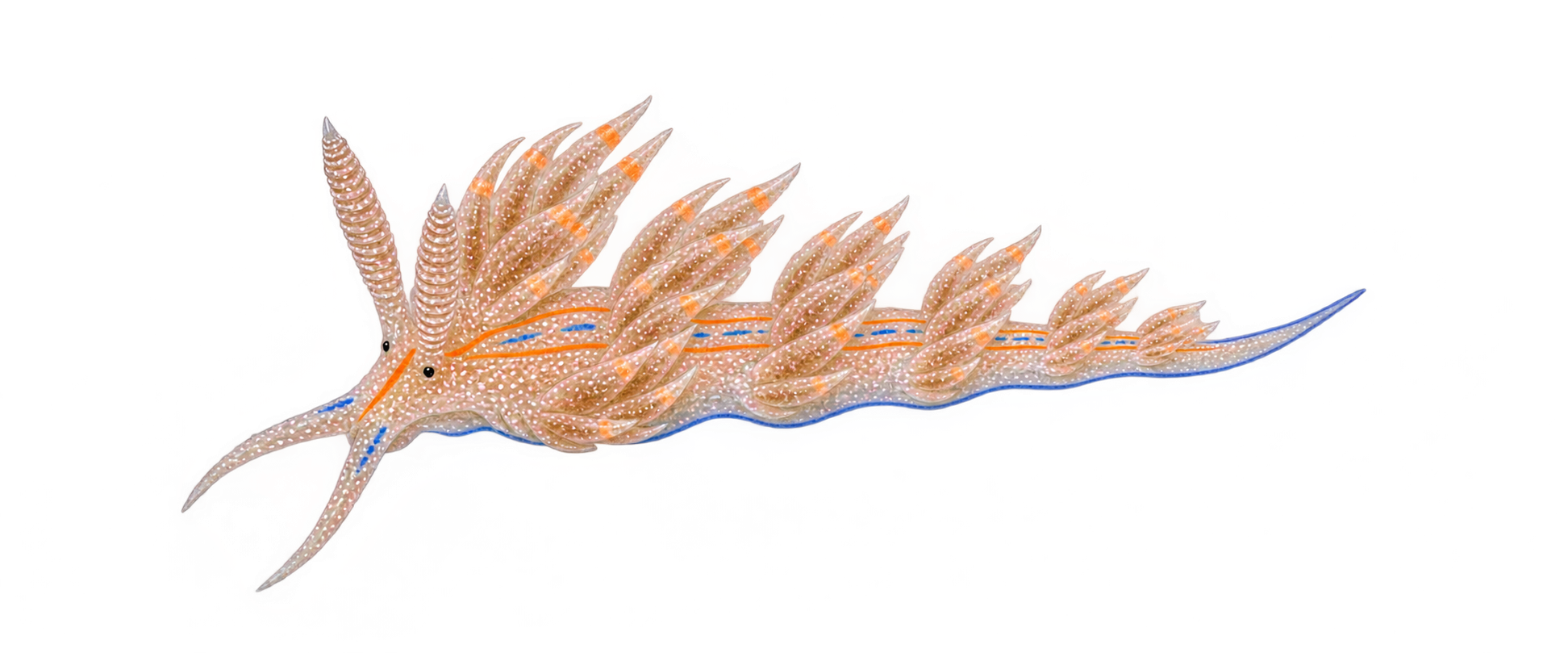
Dondice juansanchezi is a slender aeolid with pinkish-white speckles, a broken blue dorsal line and distinctive paired orange, helix-like markings. The rhinophores are ringed. Photograph those dorsal markings together with the head; an isolated close-up of colorful cerata leaves out important identification evidence. A pattern match is useful, but a poor photograph should not be treated as equivalent to a specimen examined by a specialist.
Sources: García-Méndez, Padula and Valdés (2022): Integrative systematics of Dondice
Size and life stages
The original description illustrates living animals measuring 10 and 14 mm. Those are documented individuals, not an established maximum. They provide a more defensible scale for this guide than transferring the larger size sometimes given for the old, broad Dondice occidentalis concept. A different length in a photograph does not independently settle the identification.
Sources: García-Méndez, Padula and Valdés (2022): Integrative systematics of Dondice
Habitat and where to look
The describing study reports hydroid feeding in sandy patches at 1–5 m depth. That gives divers a relevant habitat association, not a guarantee that every hydroid patch holds this species. Observe exposed growth from a stable position and record the substrate without disturbing it. Sand that looks empty at a distance can support animals too small to distinguish in a wide view.
Sources: García-Méndez, Padula and Valdés (2022): Integrative systematics of Dondice
Range and local context
The original revision reports Florida. A later peer-reviewed sequence table explicitly lists both Jupiter Bridge and Blue Heron Bridge for D. juansanchezi. The Blue Heron row links its identification to voucher USNM 140886 and genetic accessions KX889729 and MK100952. This is stronger locality evidence than a generic Florida range map. It still documents past occurrence, not present-day abundance or a guaranteed encounter.
Sources: García-Méndez, Padula and Valdés (2022): Integrative systematics of Dondice; Nanuca systematic revision (2025), Table 1: voucher localities and sequences
What is on the menu?
Hydroids are documented prey in the species description. The guide does not assign a named local hydroid species because that detail was not verified. Look for actual mouth contact if recording feeding, and distinguish the animal being eaten from the larger surface on which both organisms happen to live. Do not offer food or move a slug onto a colony to test a guess.
Sources: García-Méndez, Padula and Valdés (2022): Integrative systematics of Dondice
Daily habits and behavior
As general aeolid anatomy, the fingerlike cerata contain branches of the digestive gland. They are living body structures, not ornaments or external parasites. Most aeolids also have specialized sacs that can hold stinging cells obtained from prey; this general explanation is not a species-specific experiment on D. juansanchezi. Local movement rates, daily activity patterns and seasonality remain unverified in this profile.
Sources: Australian Museum Sea Slug Forum: Cerata in aeolids
Mating and the next generation
Nudibranchs possess both male and female reproductive organs. That group-level information is useful context, but it cannot supply an undocumented egg-laying season or development time for this species. Neither a close pair of slugs nor a nearby egg string alone demonstrates parentage. Photograph such associations without separating animals, and describe what was visible rather than completing the story by inference.
Sources: Western Australia Department of Primary Industries: Nudibranchs
Look-alikes and identification traps
The 2022 revision separated several species previously grouped under Dondice occidentalis. Older local occidentalis photographs therefore need reassessment, not automatic relabeling. Compare complete dorsal patterns rather than orange coloration alone. Keep D. juansanchezi as a single accepted species, while leaving photographs without sufficient diagnostic detail at a tentative identification.
Sources: García-Méndez, Padula and Valdés (2022): Integrative systematics of Dondice
Observe without disturbing
Keep the animal, its hydroids and surrounding sand untouched. Record the exact site rather than replacing Jupiter Bridge with Blue Heron Bridge, or vice versa. A sequence-backed regional record helps validate a checklist; your own encounter still needs its own date, locality and identification evidence. Leave uncertain images open for specialist review.
Harvest, protection and eating safety
Live-only ornamental collection; no collection at Blue Heron Bridge
Yellow means legal or safety conditions require attention. It is not an edible badge or permission to take an animal.
This color is a qualified summary, not permission to collect or a guarantee that a particular animal is safe to eat.
Can it be hunted or harvested?
Dondice juansanchezi falls under Florida’s expressly named nudibranch/sea-slug category. A recreational saltwater fishing license is required unless exempt. Where collection is lawful, the animal must be landed alive and maintained alive in a suitably sized circulating, aerated or oxygenated system. The recreational limit is five of this species within 20 marine-life organisms per person per day; the two-day possession limit is ten of this species within 40 total. Recreational sale is prohibited. No species-specific size limit is stated in the reviewed marine-life table.
Florida seasons and areas
The designated Blue Heron Bridge Special Marine Life Area, including Phil Foster Park and its mapped surrounding waters, is closed to collection of listed tropical ornamental marine life. Narrow motorized-vessel transit and landing exceptions concern animals lawfully taken elsewhere, not collection here. The Florida marine-life requirements also apply in adjacent federal waters. No species-specific annual closed months are stated in the reviewed marine-life table. Biscayne National Park, state parks, wildlife refuges and Florida Keys sanctuary zones can impose additional closures; check the actual location before collecting.
Can it be speared?
No recreational spearing under these live-only marine-life requirements. Collection uses authorized nonlethal hand/net/slurp-gun methods, subject to species and site restrictions. Quinaldine is prohibited.
Is it safe to eat?
This is live-only ornamental collection, not food harvest. Do not kill a collected animal for a meal. No recipe or safe-to-eat claim is provided.
The regulatory wording uses the older umbrella “Subclass Opisthobranchia.” Modern taxonomy uses different higher groups; the rule expressly names nudibranchs/sea slugs. This is not permission to collect substrate, host colonies or other animals. Do not relabel older Dondice occidentalis records automatically as Dondice juansanchezi.
Palm Beach is Atlantic Florida. Do not transfer Atlantic guidance to the Gulf, Monroe County, or federal waters without checking the applicable rules.
Before you act: Confirm the species, date, exact management area, state or federal waters, gear, licenses and current local closures. A local occurrence record never grants permission to take an animal.
Official rules and health guidance
- FWC recreational marine-life requirements and species list
- Florida Rule 68B-42.001: listed marine-life species
- Florida Rule 68B-42.0036: mapped marine-life collection closures
- Palm Beach County: Phil Foster Park fishing and collection notice
- FWC spearing restrictions
- NOAA: Florida Keys sanctuary zones
- Florida Rule 68B-42.005: final-adopted recreational bag rule register
Reviewed 2026-11-11. Rules and advisories can change; check the linked authorities before acting.
Identification and source cautions
- Catalog-number discrepancy: USNM 140886 in 2025 table versus USNM1408868 in earlier indexed revision. Genetic accessions retained for traceability.
- 10 and 14 mm are illustrated individual lengths, not maximum size.
- Local prey species, reproduction timings and seasonality unverified.
Sources and review
Biology and taxonomy reviewed 2026-11-11. Photographs on cited sites are reference material and are not reproduced here.
- García-Méndez, Padula and Valdés (2022): Integrative systematics of Dondice
- Nanuca systematic revision (2025), Table 1: voucher localities and sequences
- Australian Museum Sea Slug Forum: Cerata in aeolids
- Western Australia Department of Primary Industries: Nudibranchs
- WoRMS / MolluscaBase: Dondice juansanchezi
Make your next dive happen
Dive With Us
Explore local charters and plan a dive suited to your experience.
View dive calendarTrain With Us
Build your fish identification, buoyancy and diving skills.
Explore trainingTravel With Us
Discover upcoming dive adventures and trip details.
Explore dive travelShop With Us
Browse equipment for your diving and ask our team for help choosing.
Explore dive gearReview current dates, availability, prices, inclusions and requirements on each listing before booking or buying.
Call us now
Ask about marine life identification
Marine Life Identification
Ask about dates, prerequisites or your next step. An inquiry does not reserve a place. Please provide your own contact details; do not include medical, payment or a child's personal information.
We use these details to respond to your inquiry. This form does not sign you up for marketing.
Explore more with Stuart Scuba
Open Water course options · Advanced Adventure training · Technical training · Professional training · All courses · Local dives · Dive trips · Facebook · Instagram · YouTube
Your surface-interval essentials
Questions for Stuart Scuba? info@stuartscuba.com
Check the Stuart Scuba Weather Center · Play scuba trivia
Weather and wildlife vary. Confirm current conditions, trip requirements and departure details with the operator.
Plan Your Next Dive with Stuart Scuba
Dive With Us
Explore upcoming local charters and choose a dive that fits your experience.
Before you book
Check the individual listing for departure time, requirements and availability.
Travel With Us
Find upcoming dive adventures and start planning your next trip.
Plan your trip
Review dates, inclusions and trip details on the travel calendar.
Stay Connected with Stuart Scuba
 Follow pageShare
YouTube
SubscribeWatch & shareFollow on InstagramView & share post
Follow company news, training updates, and dive stories.
Follow on LinkedInGoogle Reviews
See Stuart Scuba’s current Google rating and review count below. Open the listing in Google Maps to browse customer reviews.



