

Fish identification archive / Doctorfish
Doctorfish
Acanthurus chirurgus
I saw this
Spotted this marine animal? Share the guide with your dive buddies. Review your caption before posting.
For Instagram, copy the caption and link into your own post or message. Nothing is posted automatically and this does not record a verified sighting.
Fun facts for your next surface interval
- The doctor carries scalpels, but takes no appointments: sharp spines sit beside the tail.
- Sand in the digestive system is part of the equipment: a gizzard-like structure helps process food.
- Baby identity crisis: the very different larvae were once treated as a separate genus, Acronurus.
Florida and local context
Lake Worth Lagoon, Palm Beach County: Verified observation mark in Florida Museum regional fish checklist; no abundance or encounter guarantee inferred.
Documented regional presence is not a guarantee of an encounter or a measure of how common this animal is at your dive site.
How to recognize this animal
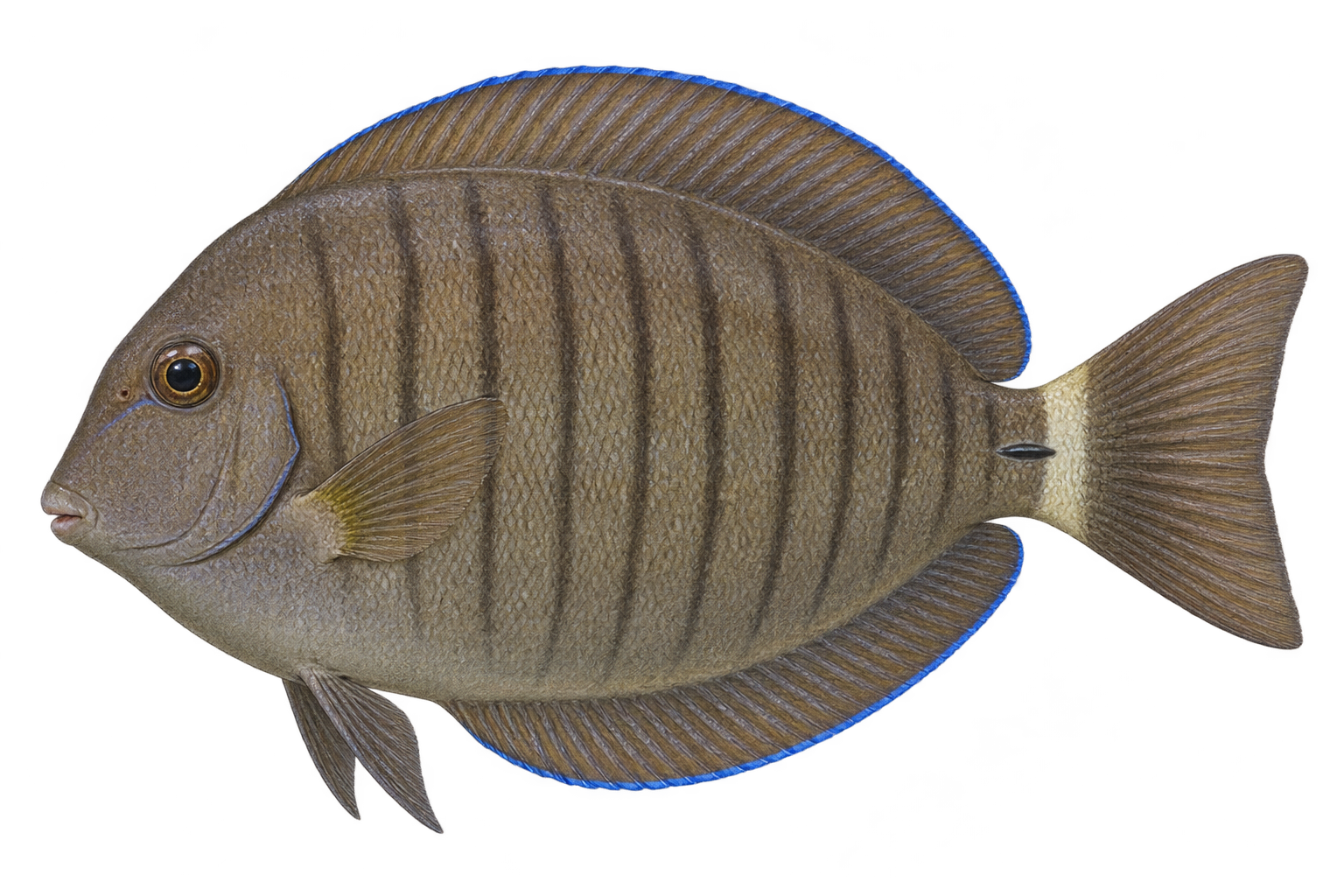
Doctorfish have a deep, flattened gray-brown body marked by roughly eight to twelve narrow dark vertical bars. Those fine stripes are the best first clue. A pale band often crosses the tail base, beside a dark sheath containing the sharp caudal spine. The tail edge is nearly straight or gently concave, with blunt tips rather than the pointed outline of an Ocean Surgeonfish.
Size and life stages
Published maximum lengths are approximately 34–35 cm; Florida Museum describes fish around 30 cm as frequent. These are reference sizes, not a prediction for your next dive. Young individuals can be much smaller. Try to judge body proportions as well as length, especially when a school contains a mixture of surgeonfish species and sizes.
Habitat and where to look
Reefs, rocky bottom and adjacent seagrass provide feeding habitat. A fish over pale sand may look considerably lighter than one beside a dark reef. That change in appearance should prompt another look at its stripes, not an immediate new species label. Watch the bottom-facing members of a group when looking for active feeding.
Range and local context
Florida Museum verifies Doctorfish in its Lake Worth Lagoon checklist. The broader distribution extends through much of the western Atlantic, including the Gulf of Mexico and Caribbean. A verified regional record confirms occurrence; it does not establish daily abundance at Blue Heron Bridge or promise an encounter on a particular charter. Habitat and conditions still matter.
What is on the menu?
The menu includes algae and organic detritus. Doctorfish often tip the head downward while picking at the bottom, using specialized teeth to gather food. Florida Museum describes a sand-containing, gizzard-like digestive structure that helps process what they swallow. This is not a fish that needs a diver to supply snacks; its ordinary grazing is the interesting behavior.
Daily habits and behavior
Small feeding groups may join other surgeonfishes. Body color can become darker or paler, while the bars remain a useful identification feature when visible. Rather than following the group from behind, stay still and watch its route. That approach gives a clearer view of individual fish and avoids turning a feeding observation into a chase.
Mating and the next generation
Doctorfish release eggs into the water during group spawning, often described in the evening. The tiny eggs contain an oil droplet that aids flotation. Larvae look very different from adults and were historically called acronurus. Their transformation illustrates why an adult field-guide image cannot identify every transparent fish seen drifting above a reef.
Look-alikes and identification traps
Ocean Surgeonfish lack the characteristic narrow bars and usually show a more deeply concave, pale-edged tail. Blue Tangs differ in adult coloration and other markings. Because bars may be difficult to see in poor light, combine several clues rather than trusting a single silhouette. An uncertain photograph is better recorded as surgeonfish than assigned a confident but unsupported species name.
Observe without disturbing
Do not touch or corner Doctorfish. Their tail-base spines can cut, even though an undisturbed fish is an ordinary grazing neighbor. Maintain buoyancy clear of its feeding surface, and leave space for a school to pass. On a Stuart Scuba dive, a calm side-on photograph showing the stripes and tail is more useful than a close view of a fleeing fish.
Harvest, protection and eating safety
Restricted marine life: live collection only; spearing prohibited
Can it be hunted or harvested?
Doctorfish is regulated ornamental marine life, not an ordinary food-fishing target. Recreational collection requires the appropriate saltwater license unless exempt, lawful marine-life gear, and landing and keeping the fish alive in adequately aerated or circulating water. Maximum 9 inches fork length. The daily limit is five of this species within 20 marine-life organisms total; the two-day possession limit is ten of this species within 40 total. Recreational sale is prohibited.
Florida seasons and areas
No species-specific recreational closed months are listed in the reviewed marine-life rules. This is not permission to collect anywhere: the designated Blue Heron Bridge dive site is closed to marine-life harvest. Florida marine-life rules also apply in adjacent federal waters. Check sanctuary zones, parks, refuges and current local closures before any collection.
Can it be speared?
Prohibited. FWC expressly includes surgeonfish among ornamental reef fishes that may not be harvested by spearing. Live ornamental collection is a separate, restricted activity, not an exception allowing a spear.
Is it safe to eat?
Doctorfish have documented ciguatera risk. Do not treat live-collection status as permission or evidence that this fish is safe to eat. Ciguatoxin cannot be removed by cooking or freezing. FDA/EPA mercury-based meal advice is not a ciguatera clearance for an individual reef fish.
Before you act: This recreational overview is not permission to collect or spear at your dive site. Confirm the species, date, management area, state or federal waters, gear, licenses and current local closures. Identification artwork cannot establish an identification or guarantee seafood safety.
Official rules and health guidance
- FWC: Recreational Marine Life
- FWC: Spearing
- Florida Administrative Code: Marine Life Chapter 68B-42
- NOAA: Florida Keys Sanctuary Marine Zones
- Florida Department of Health: Seafood Poisoning
- FDA/EPA: Advice about Eating Fish
- Florida Museum: Doctorfish
Reviewed 2026-11-10. Rules and advisories can change; check the linked authorities before harvesting or eating.
Sources and review
Reviewed 2026-11-10.
Make your next dive happen
Dive With Us
Explore local charters and plan a dive suited to your experience.
View dive calendarTrain With Us
Build your fish identification, buoyancy and diving skills.
Explore trainingTravel With Us
Discover upcoming dive adventures and trip details.
Explore dive travelShop With Us
Browse equipment for your diving and ask our team for help choosing.
Explore dive gearReview current dates, availability, prices, inclusions and requirements on each listing before booking or buying.
Call us now
Ask about marine life identification
Marine Life Identification
Ask about dates, prerequisites or your next step. An inquiry does not reserve a place. Please provide your own contact details; do not include medical, payment or a child's personal information.
We use these details to respond to your inquiry. This form does not sign you up for marketing.
Explore more with Stuart Scuba
Open Water course options · Advanced Adventure training · Technical training · Professional training · All courses · Local dives · Dive trips · Facebook · Instagram · YouTube
Your surface-interval essentials
Questions for Stuart Scuba? info@stuartscuba.com
Check the Stuart Scuba Weather Center · Play scuba trivia
Weather and wildlife vary. Confirm current conditions, trip requirements and departure details with the operator.
Plan Your Next Dive with Stuart Scuba
Dive With Us
Explore upcoming local charters and choose a dive that fits your experience.
Before you book
Check the individual listing for departure time, requirements and availability.
Travel With Us
Find upcoming dive adventures and start planning your next trip.
Plan your trip
Review dates, inclusions and trip details on the travel calendar.
Stay Connected with Stuart Scuba
 Follow pageShare
YouTube
SubscribeWatch & shareFollow on InstagramView & share post
Follow company news, training updates, and dive stories.
Follow on LinkedInGoogle Reviews
See Stuart Scuba’s current Google rating and review count below. Open the listing in Google Maps to browse customer reviews.



