

Fish identification archive / Dark Cerith
Dark Cerith
Cerithium atratum · Cerithiidae
I saw this
Spotted this marine life? Share the guide with your dive buddies. Review your caption before posting.
For Instagram, copy the caption and link into your own post or message. Nothing is posted automatically and this does not record a verified sighting.
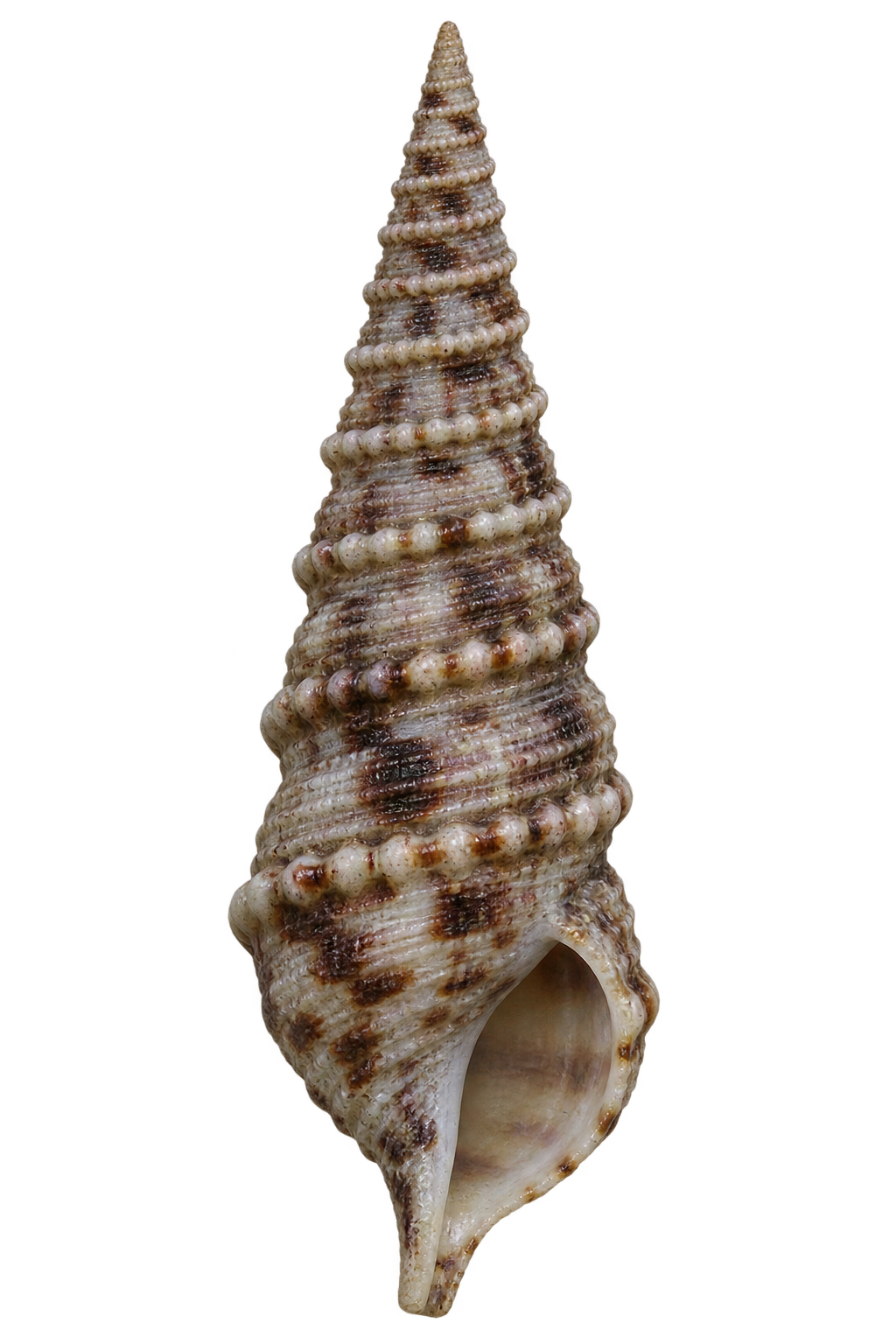
The dark cerith, Cerithium atratum, carries a narrow, turret-shaped shell decorated with beaded spiral cords. Finer spiral lines run between the stronger rows. Despite its common name, the shell need not be uniformly black: the National Shell Museum describes gray to off-white backgrounds with irregular brown markings. Shape and sculpture are therefore better starting points than darkness alone.
Documented Atlantic Florida encounters
This species has unusually useful local photographic records. Identified living animals were photographed while diving near Peanut Island in Palm Beach Inlet in 2012, and a feeding observation was documented in nearby Lake Worth Lagoon in 2013. A separate photograph records egg-strand deposition there in 2011. These dated observations establish genuine local marine-life encounters, rather than only empty shells collected on a beach.
They do not establish present abundance, a particular seasonal schedule or a guaranteed sighting on a future dive. Biscayne National Park also includes the species in its published mollusk inventory, supporting a second Atlantic South Florida context without implying continuous occupancy between the two locations.
Feeding and reproduction
The museum identifies the dark cerith as a detritus feeder associated with shallow bays and sandy-muddy flats. Detritus is organic material in the environment, not a reason to describe the animal as a universal aquarium cleaner or to make claims about its ability to fix polluted water.
Eggs are deposited in an attached strand. The Palm Beach photographic record supports that behavior, but a single dated observation cannot define the entire breeding season. Leave an attached egg strand in place; its appearance is biological information, not an invitation to lift it for a clearer photograph.
Identification practice
Florida has several similar ceriths. Photograph the entire shell, its opening when naturally visible, and a close view of the beaded cords. Do not assume every small pointed snail belongs to this species. An obscured opening or worn surface can prevent a confident identification even when the general outline looks right.
A useful observation also records the substrate and whether the living snail, an empty shell or another occupant was present. Keep the animal on its original bottom and avoid stirring sediment or moving vegetation for a picture.
Consult current FWC marine-life guidance and site-specific restrictions before any collecting. Historic photographs near a familiar dive location do not authorize removal today. The best encounter preserves the snail, its egg material and the surrounding habitat.
References
Collection and seafood safety
Identification is not permission to collect. FWC distinguishes empty shells from shells containing living animals; a recreational saltwater fishing license is generally required for live-shell harvest. Species rules and park or sanctuary restrictions must also be checked. Leave animals undisturbed while identifying them. Current FWC guidance. Guidance reviewed November 12, 2026. No location-specific harvest or sanitation clearance is given.
Make your next dive happen
Dive With Us
Explore local charters and plan a dive suited to your experience.
View dive calendarTrain With Us
Build your fish identification, buoyancy and diving skills.
Explore trainingTravel With Us
Discover upcoming dive adventures and trip details.
Explore dive travelShop With Us
Browse equipment for your diving and ask our team for help choosing.
Explore dive gearReview current dates, availability, prices, inclusions and requirements on each listing before booking or buying.
Call us now
Ask about fish identification training
Reef Fish Identification
Ask about dates, prerequisites or your next step. An inquiry does not reserve a place. Please provide your own contact details; do not include medical, payment or a child's personal information.
We use these details to respond to your inquiry. This form does not sign you up for marketing.
Explore more with Stuart Scuba
Open Water course options · Advanced Adventure training · Technical training · Professional training · All courses · Local dives · Dive trips · Facebook · Instagram · YouTube
Your surface-interval essentials
Questions for Stuart Scuba? info@stuartscuba.com
Check the Stuart Scuba Weather Center · Play scuba trivia
Weather and wildlife vary. Confirm current conditions, trip requirements and departure details with the operator.
Plan Your Next Dive with Stuart Scuba
Dive With Us
Explore upcoming local charters and choose a dive that fits your experience.
Before you book
Check the individual listing for departure time, requirements and availability.
Travel With Us
Find upcoming dive adventures and start planning your next trip.
Plan your trip
Review dates, inclusions and trip details on the travel calendar.
Stay Connected with Stuart Scuba
 Follow pageShare
YouTube
SubscribeWatch & shareFollow on InstagramView & share post
Follow company news, training updates, and dive stories.
Follow on LinkedInGoogle Reviews
See Stuart Scuba’s current Google rating and review count below. Open the listing in Google Maps to browse customer reviews.



