

Fish identification archive / Cushion Sea Star
Cushion Sea Star
Oreaster reticulatus
I saw this
Spotted this marine animal? Share the guide with your dive buddies. Review your caption before posting.
For Instagram, copy the caption and link into your own post or message. Nothing is posted automatically and this does not record a verified sighting.
Fun facts for your next surface interval
- The name says Bahama, but the animal also belongs in Florida’s marine-life story.
- A green youngster may look quite different from the familiar orange adult.
- Its walking equipment is underneath: many tiny tube feet move that hefty-looking star.
Florida and local context
Florida coastal waters, including the Keys and Indian River Lagoon region: Florida natural-history accounts establish regional occurrence; no precise Palm Beach site claim.
Documented regional presence is not a guarantee of an encounter or a measure of how common this animal is at your dive site.
How to recognize this animal
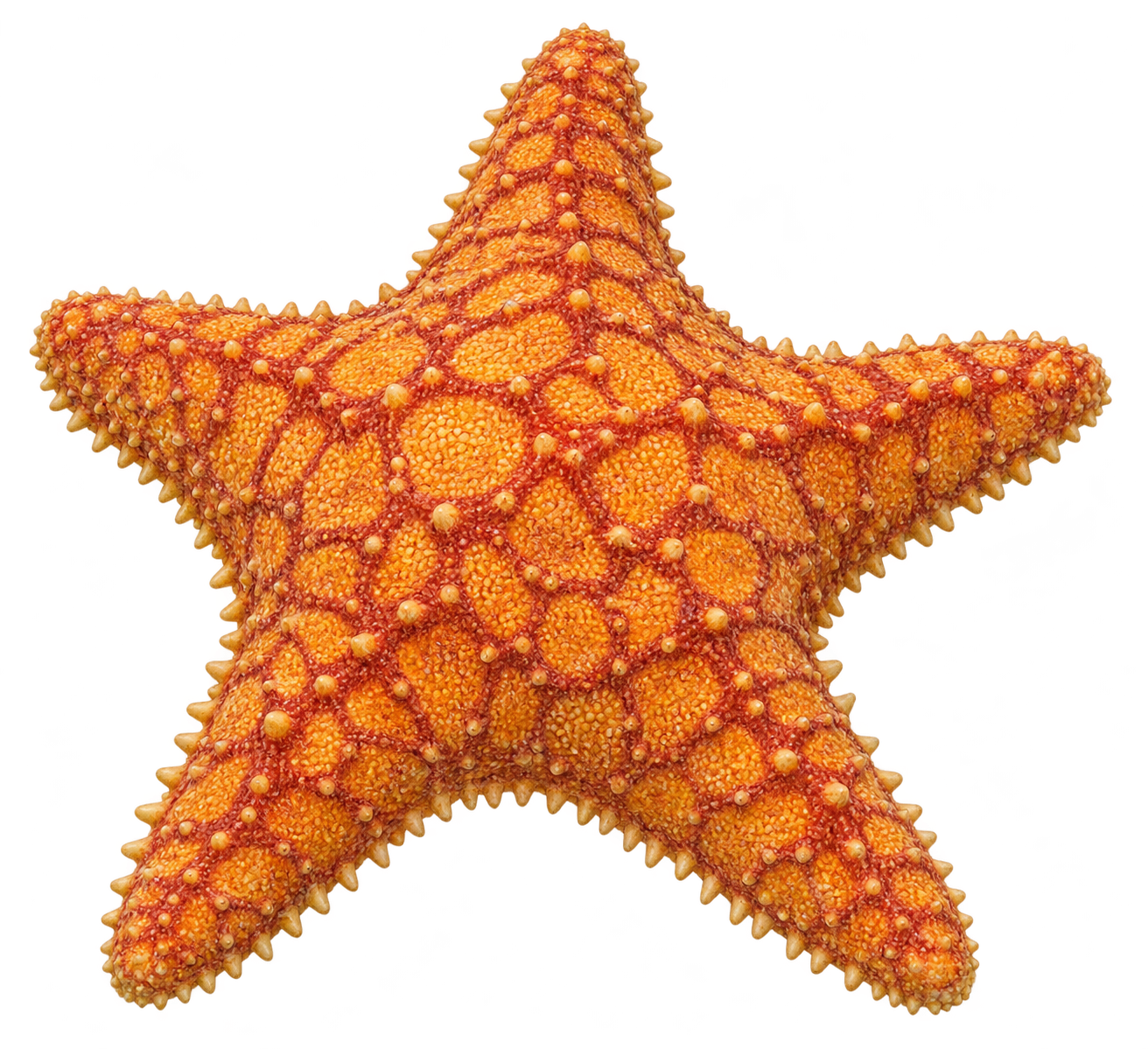
A broad, raised central disc and five thick, tapering arms give this sea star its cushioned appearance. Knobby plates form a coarse surface pattern. Adults may be orange, reddish, yellowish or brown, while juveniles can be green and blend into seagrass. The rough upper surface is supported by small skeletal elements called ossicles, rather than a single snail-like shell. The broad disc blends into the bases of the five arms, producing the characteristic inflated outline. Beneath it, rows of tube feet provide contact with the bottom. Its orange upper surface is therefore only one part of a much more complex animal.
Size and life stages
Many adults measure about 20–35 centimeters across, with large animals approaching 50 centimeters. This is the span from arm tip to opposite side, not the width of the central disc alone. Young sea stars are smaller and may have less familiar colors.
Habitat and where to look
Calm shallow water with sand, seagrass and nearby coastal habitat is characteristic. The animal lives on the bottom rather than swimming like a fish. A seemingly bare sandy patch can contain feeding surfaces and small organisms, so avoid kneeling there to photograph it.
Range and local context
The species occurs in Florida and the wider tropical western Atlantic. Florida accounts include the Keys and the Indian River Lagoon region. The common name Bahama sea star does not restrict it to the Bahamas, and regional presence does not guarantee a sighting at every lagoon site.
What is on the menu?
Cushion sea stars feed on material associated with the bottom, including small organisms and organic particles. They can extend the stomach outward during feeding. That remarkable process should be watched without lifting or turning the animal to expose its underside.
Daily habits and behavior
Movement comes from many tube feet beneath the arms, and progress can be almost imperceptible in a short visit. A stationary individual is not automatically dead. Give it time and compare its position with a fixed bottom feature rather than prodding it to produce movement.
Mating and the next generation
Eggs and sperm are released into the water, followed by planktonic larval development and settlement. Juveniles often use seagrass habitat and differ in color from adults. Protecting the surrounding nursery environment therefore matters alongside leaving the conspicuous adult sea stars alone.
Look-alikes and identification traps
Other sea stars may have much slimmer arms or a flatter body. Brittle stars have slender, more clearly separated arms and move differently.
Observe without disturbing
Use the thick disc, tapered arms and surface pattern together, and do not rely on orange color as a species-level identification. Protected from Florida recreational harvest: this is the Bahama sea star named in the prohibited list. Leave it submerged in its original position. Do not lift it for a portrait, stack animals, turn it over or carry it toward shore, even briefly. Dive with Stuart Scuba to explore Florida marine life with an emphasis on careful observation. Ask about current conditions and an appropriate dive plan; wildlife sightings remain unpredictable.
Harvest, protection and eating safety
PROTECTED: recreational harvest prohibited in Florida
Can it be hunted or harvested?
No. Florida expressly prohibits harvesting cushion sea star, also called Bahama starfish (Oreaster reticulatus). Do not take one for an aquarium, food, a souvenir or a staged photograph on shore. The five-per-species limit for some other marine-life organisms does not override this prohibition. Observe it in place without lifting, breaking spines, detaching tube feet or removing habitat. The prohibition also covers possession and landing, not just capture.
Florida seasons and areas
No open recreational season: the Florida prohibition is year-round. The regulated marine-life framework covers adjacent federal waters as specified by the rules, and parks or sanctuary zones can add protections. Blue Heron Bridge is also closed to regulated marine-life collection. Do not infer a live-animal exemption from rules about empty shells.
Can it be speared?
No. Harvest is prohibited regardless of method, including hands, nets and spears.
Is it safe to eat?
Do not collect this animal for food. It is protected from recreational harvest in Florida. An edible relative, a restaurant dish, or customary use elsewhere does not make a wild Florida animal legal or safe to eat.
Before you act: This recreational overview is not permission to collect or spear at your dive site. Confirm the species, date, management area, state or federal waters, gear, licenses and current local closures. Identification artwork cannot establish an identification or guarantee seafood safety.
Official rules and health guidance
- FWC: Recreational Marine Life
- Florida Administrative Code: Marine Life, Chapter 68B-42
- NOAA: Florida Keys Sanctuary Marine Zones
- FDA: Selecting and Serving Seafood Safely
- Florida Department of Health: Seafood Poisoning
- FAC 68B-42.003: prohibition of harvest, possession and landing (LII reproduction)
Reviewed 2026-11-10. Rules and advisories can change; check the linked authorities before harvesting or eating.
Sources and review
Reviewed 2026-11-10.
Make your next dive happen
Dive With Us
Explore local charters and plan a dive suited to your experience.
View dive calendarTrain With Us
Build your fish identification, buoyancy and diving skills.
Explore trainingTravel With Us
Discover upcoming dive adventures and trip details.
Explore dive travelShop With Us
Browse equipment for your diving and ask our team for help choosing.
Explore dive gearReview current dates, availability, prices, inclusions and requirements on each listing before booking or buying.
Call us now
Ask about marine life identification
Marine Life Identification
Ask about dates, prerequisites or your next step. An inquiry does not reserve a place. Please provide your own contact details; do not include medical, payment or a child's personal information.
We use these details to respond to your inquiry. This form does not sign you up for marketing.
Explore more with Stuart Scuba
Open Water course options · Advanced Adventure training · Technical training · Professional training · All courses · Local dives · Dive trips · Facebook · Instagram · YouTube
Your surface-interval essentials
Questions for Stuart Scuba? info@stuartscuba.com
Check the Stuart Scuba Weather Center · Play scuba trivia
Weather and wildlife vary. Confirm current conditions, trip requirements and departure details with the operator.
Plan Your Next Dive with Stuart Scuba
Dive With Us
Explore upcoming local charters and choose a dive that fits your experience.
Before you book
Check the individual listing for departure time, requirements and availability.
Travel With Us
Find upcoming dive adventures and start planning your next trip.
Plan your trip
Review dates, inclusions and trip details on the travel calendar.
Stay Connected with Stuart Scuba
 Follow pageShare
YouTube
SubscribeWatch & shareFollow on InstagramView & share post
Follow company news, training updates, and dive stories.
Follow on LinkedInGoogle Reviews
See Stuart Scuba’s current Google rating and review count below. Open the listing in Google Maps to browse customer reviews.



