

Fish identification archive / Crown Conch
Crown Conch
Melongena corona · Melongenidae
I saw this
Spotted this marine life? Share the guide with your dive buddies. Review your caption before posting.
For Instagram, copy the caption and link into your own post or message. Nothing is posted automatically and this does not record a verified sighting.
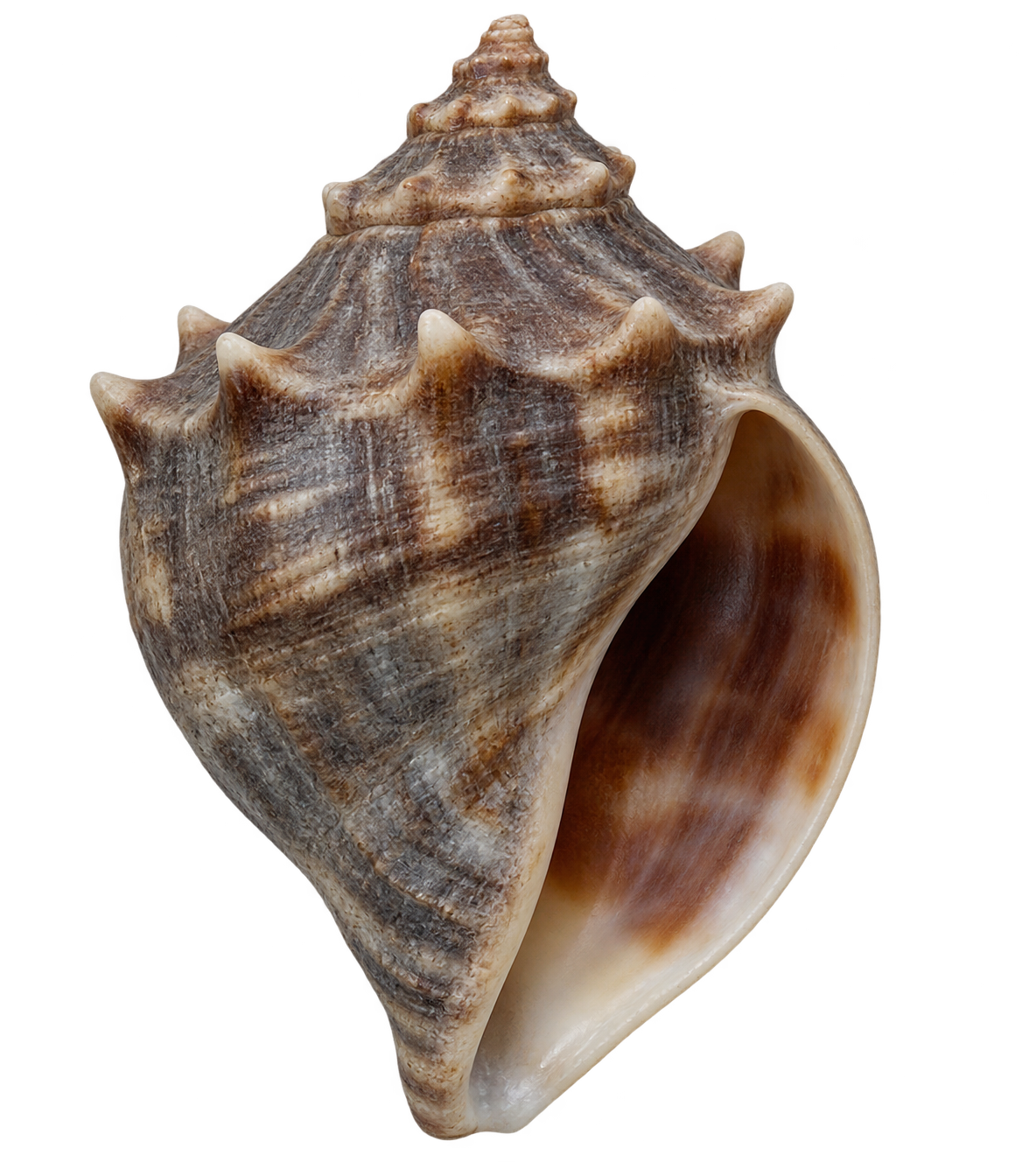
The crown conch, Melongena corona, belongs in the shallow-water chapter of a Florida marine-life guide. Its stocky spiral shell and crownlike shoulder spines are useful first clues. Look for a broad final whorl, a generous opening and darker bands across a grayish or pale background. A shell alone does not prove that the original snail still occupies it: hermit crabs also use empty crown-conch shells.
Where it fits on the Atlantic coast
Crown conchs are associated with estuary sediments, grass beds, marsh edges and oyster habitat rather than clear-water offshore coral reefs. Living animals and egg-laying females have been photographed in the Indian River Lagoon system. These records support an Atlantic Florida estuary context, but they do not establish a sighting at every location between Vero Beach and Key Largo. When recording an encounter, keep the exact location, date and habitat separate from the species’ wider range.
Feeding and behavior
This snail is both hunter and scavenger. Oysters, clams and other slow-moving mollusks can become prey, and dead animals can provide a meal as well. The extended dark siphon brings water into the mantle cavity and helps the snail detect chemical cues. Watching an undisturbed animal moving over sediment is more informative than picking up the shell and waiting for it to emerge.
Reproduction
Females attach strings of disk-shaped egg capsules to firm material in the habitat. Each capsule connects by a short stalk rather than floating freely in the water. The capsules are developing animal life, not litter or decorations. Leave them attached and photograph their arrangement without pulling the string away from its support.
Identification notes
A long, smoother, spindle-shaped tulip snail has a different outline from the broad, spiny crown conch. Compare shape, shoulder sculpture and the opening together; shell size or one band of color is not enough. A broken shell can lose exactly the features needed for identification.
Observe responsibly
Keep the snail, its prey and its substrate where they are. Do not turn an interesting feeding event into a staged photograph. Florida’s live-shell rules and local protected-area restrictions must be checked before any collecting; this identification page is not a collection permit. For a useful photo record, include an overall view and a close view of the shell sculpture without handling the animal.
Florida DEP’s 2014 St. Lucie Inlet Preserve plan also names this species in its estuarine habitat.
References
- National Shell Museum identification reference
- FWC species information
- Species biology reference
- UF/IFAS: Crown-conch ecology
- Photographic record: Indian River Lagoon egg-laying crown conch
- Florida DEP: 2014 St. Lucie Inlet Preserve State Park plan, local animal record
- FWC: Current recreational saltwater rules
Collection and shellfish safety
Identification is not permission to collect. FWC distinguishes empty shells from shells containing living animals; a recreational saltwater fishing license is generally required for live-shell harvest. Species rules and park or sanctuary restrictions must also be checked. Leave animals undisturbed while identifying them. FWC live-shell collection guidance and FWC hard-clam and oyster rules. Official guidance reviewed November 12, 2026; no location-specific harvest or sanitation clearance is given.
Make your next dive happen
Dive With Us
Explore local charters and plan a dive suited to your experience.
View dive calendarTrain With Us
Build your fish identification, buoyancy and diving skills.
Explore trainingTravel With Us
Discover upcoming dive adventures and trip details.
Explore dive travelShop With Us
Browse equipment for your diving and ask our team for help choosing.
Explore dive gearReview current dates, availability, prices, inclusions and requirements on each listing before booking or buying.
Call us now
Ask about fish identification training
Reef Fish Identification
Ask about dates, prerequisites or your next step. An inquiry does not reserve a place. Please provide your own contact details; do not include medical, payment or a child's personal information.
We use these details to respond to your inquiry. This form does not sign you up for marketing.
Explore more with Stuart Scuba
Open Water course options · Advanced Adventure training · Technical training · Professional training · All courses · Local dives · Dive trips · Facebook · Instagram · YouTube
Your surface-interval essentials
Questions for Stuart Scuba? info@stuartscuba.com
Check the Stuart Scuba Weather Center · Play scuba trivia
Weather and wildlife vary. Confirm current conditions, trip requirements and departure details with the operator.
Plan Your Next Dive with Stuart Scuba
Dive With Us
Explore upcoming local charters and choose a dive that fits your experience.
Before you book
Check the individual listing for departure time, requirements and availability.
Travel With Us
Find upcoming dive adventures and start planning your next trip.
Plan your trip
Review dates, inclusions and trip details on the travel calendar.
Stay Connected with Stuart Scuba
 Follow pageShare
YouTube
SubscribeWatch & shareFollow on InstagramView & share post
Follow company news, training updates, and dive stories.
Follow on LinkedInGoogle Reviews
See Stuart Scuba’s current Google rating and review count below. Open the listing in Google Maps to browse customer reviews.



