

Fish identification archive / Crevalle Jack
Crevalle Jack
Caranx hippos
I saw this
Spotted this fish? Share the guide with your dive buddies. Review your caption before posting.
For Instagram, copy the caption and link into your own post or message. Nothing is posted automatically and this does not record a verified sighting.
Fun facts for your next surface interval
- Youngsters wear bars; adults generally retire the striped outfit.
- A crevalle jack can travel with a crowd or go solo: size and circumstances change the social plan.
- It can make grunting or croaking sounds, although handling a fish to hear them is never part of a dive.
Palm Beach connection
Lake Worth Lagoon / Blue Heron Bridge, Palm Beach County: Verified species row (x).
Documented regional presence is not a guarantee of an encounter or a measure of how common this fish is at your dive site.
How to recognize this fish
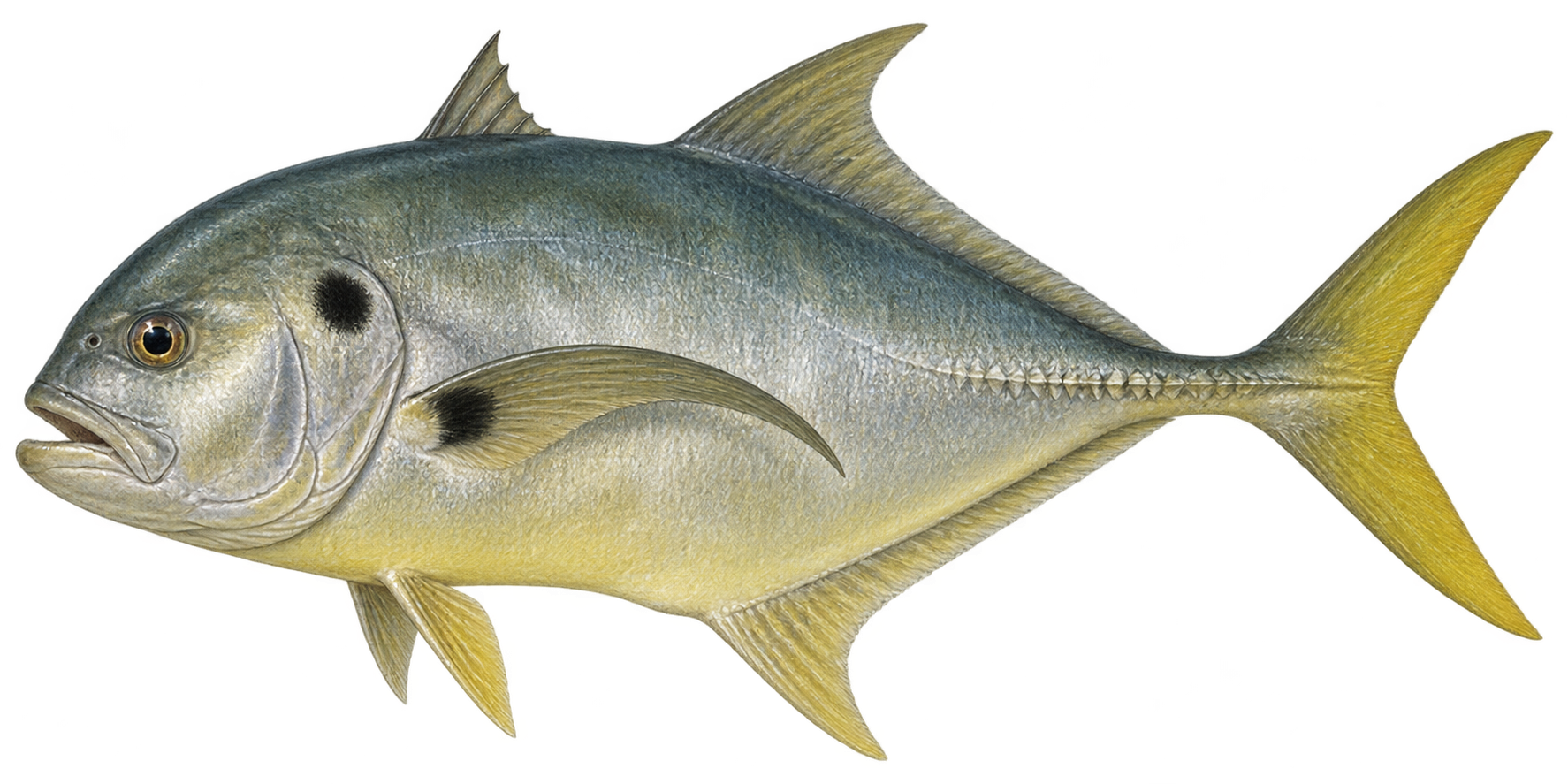
A crevalle jack looks built for sustained movement: a powerful body, steep forehead, narrow tail base and deeply forked tail. Look for the dark mark on the gill cover and another on the pectoral fin. The back is darker than the silvery or brassy sides, and the tail often has a yellow cast.
Size and life stages
Common length estimates differ among references, roughly 60–75 centimeters, or two to two-and-a-half feet. FishBase reports a maximum around 124 centimeters. Use that range as perspective rather than a promise. Small juveniles wear dark body bars that disappear with growth, so a young fish should not be expected to match the unbarred adult illustration.
Habitat and where to look
Crevalle jacks use coastal waters, reefs, channels and estuaries. Juveniles occupy sheltered brackish habitats as well as beach and seagrass areas. Scan beyond the immediate reef face and occasionally look up from macro subjects. If a school passes, remain with your buddy and dive plan rather than trying to keep pace with it.
Range and local context
The species is an Atlantic coastal-shelf fish and is documented from the western Atlantic through Florida and farther south. Its Lake Worth Lagoon record is explicitly verified. That supports the regional listing, while leaving encounter frequency open. A traveling school can be conspicuous for a moment and absent when another group arrives at the same spot.
What is on the menu?
Crevalle jacks prey on smaller fishes, shrimp and other invertebrates. Their foraging can turn a quiet patch of water into a fast-moving scene. Watch the surrounding small fish as well as the jack: their spacing and movement may explain what you are seeing. Do not introduce bait or try to create a chase for the camera.
Daily habits and behavior
Both young and adult fish can travel in schools, while large individuals may be alone. Their speed and coordinated turns make a broad view especially rewarding. Avoid interpreting every tight group as a feeding event. Note whether the fish were simply traveling, circling structure or actually pursuing prey, and keep those observations distinct in your log.
Mating and the next generation
Crevalle jacks spawn offshore, releasing eggs that drift in the water column. Estuaries play an important role in the early life history. A shallow-water juvenile and a large reef visitor therefore represent different parts of the same life cycle. A passing school alone does not tell a diver whether reproduction is occurring.
Look-alikes and identification traps
Horse-eye jacks and other local jacks can produce a similar silver flash. The steep head and dark pectoral marking are useful crevalle clues, alongside the gill-cover spot and overall proportions. Fin marks may be obscured by glare or angle. If the fish passes too quickly, a broader jack identification is a perfectly useful starting point.
Observe without disturbing
Let the school choose its route and avoid swimming into it to force a dramatic split. Never feed or pursue the fish, and do not follow into current beyond your plan. A short video from a steady position may preserve more identification detail than a rushed close-up. Record approximate school size without implying that it represents the local population.
Harvest, protection and eating safety
Harvest allowed under default recreational rules
Can it be hunted or harvested?
Crevalle jack is not a Florida prohibited-harvest fish. FWC applies the default recreational limit: two fish or 100 pounds per person per day, whichever is more. There is no species-specific state minimum size. A recreational saltwater license is required unless exempt; this allowance does not authorize sale.
Florida seasons and areas
No regular species-specific Florida closed season is listed. Local no-take areas, park rules and gear restrictions still apply. Confirm the rules for an offshore trip rather than substituting another jack species’ federal limits.
Can it be speared?
Spearfishing is permitted where the location and gear are legal. Florida restrictions around public swimming beaches, fishing piers, bridges, jetties and protected areas still apply.
Is it safe to eat?
Mercury advisories apply to crevalle jack, with stricter advice for some southern Florida waters and consumer groups. Jacks can also carry ciguatera toxins. Check Florida DOH before choosing a meal; neither cooking nor freezing removes ciguatoxin. A legal catch is not a food-safety guarantee.
Before you act: This recreational overview is not permission to collect or spear at your dive site. Confirm the species, date, management area, state or federal waters, gear, licenses and current local closures. A fish illustration cannot establish an identification or guarantee seafood safety.
Official rules and health guidance
- FWC default recreational limits
- FWC recreational saltwater licenses
- FWC spearfishing restrictions
- Florida DOH linked fish-advisory booklet
- Florida DOH eating healthy seafood
- Florida DOH local fish advisory search
- Florida DOH seafood poisoning
- FDA natural seafood toxins and ciguatera
Reviewed 2026-11-10. Rules and advisories can change; check the linked authorities before harvesting or eating.
Sources and review
Reviewed 2026-11-10.
Make your next dive happen
Dive With Us
Explore local charters and plan a dive suited to your experience.
View dive calendarTrain With Us
Build your fish identification, buoyancy and diving skills.
Explore trainingTravel With Us
Discover upcoming dive adventures and trip details.
Explore dive travelShop With Us
Browse equipment for your diving and ask our team for help choosing.
Explore dive gearReview current dates, availability, prices, inclusions and requirements on each listing before booking or buying.
Call us now
Ask about fish identification training
Reef Fish Identification
Ask about dates, prerequisites or your next step. An inquiry does not reserve a place. Please provide your own contact details; do not include medical, payment or a child's personal information.
We use these details to respond to your inquiry. This form does not sign you up for marketing.
Explore more with Stuart Scuba
Open Water course options · Advanced Adventure training · Technical training · Professional training · All courses · Local dives · Dive trips · Facebook · Instagram · YouTube
Your surface-interval essentials
Questions for Stuart Scuba? info@stuartscuba.com
Check the Stuart Scuba Weather Center · Play scuba trivia
Weather and wildlife vary. Confirm current conditions, trip requirements and departure details with the operator.
Plan Your Next Dive with Stuart Scuba
Dive With Us
Explore upcoming local charters and choose a dive that fits your experience.
Before you book
Check the individual listing for departure time, requirements and availability.
Travel With Us
Find upcoming dive adventures and start planning your next trip.
Plan your trip
Review dates, inclusions and trip details on the travel calendar.
Stay Connected with Stuart Scuba
 Follow pageShare
YouTube
SubscribeWatch & shareFollow on InstagramView & share post
Follow company news, training updates, and dive stories.
Follow on LinkedInGoogle Reviews
See Stuart Scuba’s current Google rating and review count below. Open the listing in Google Maps to browse customer reviews.



