

Fish identification archive / Cownose Ray
Cownose Ray
Rhinoptera bonasus
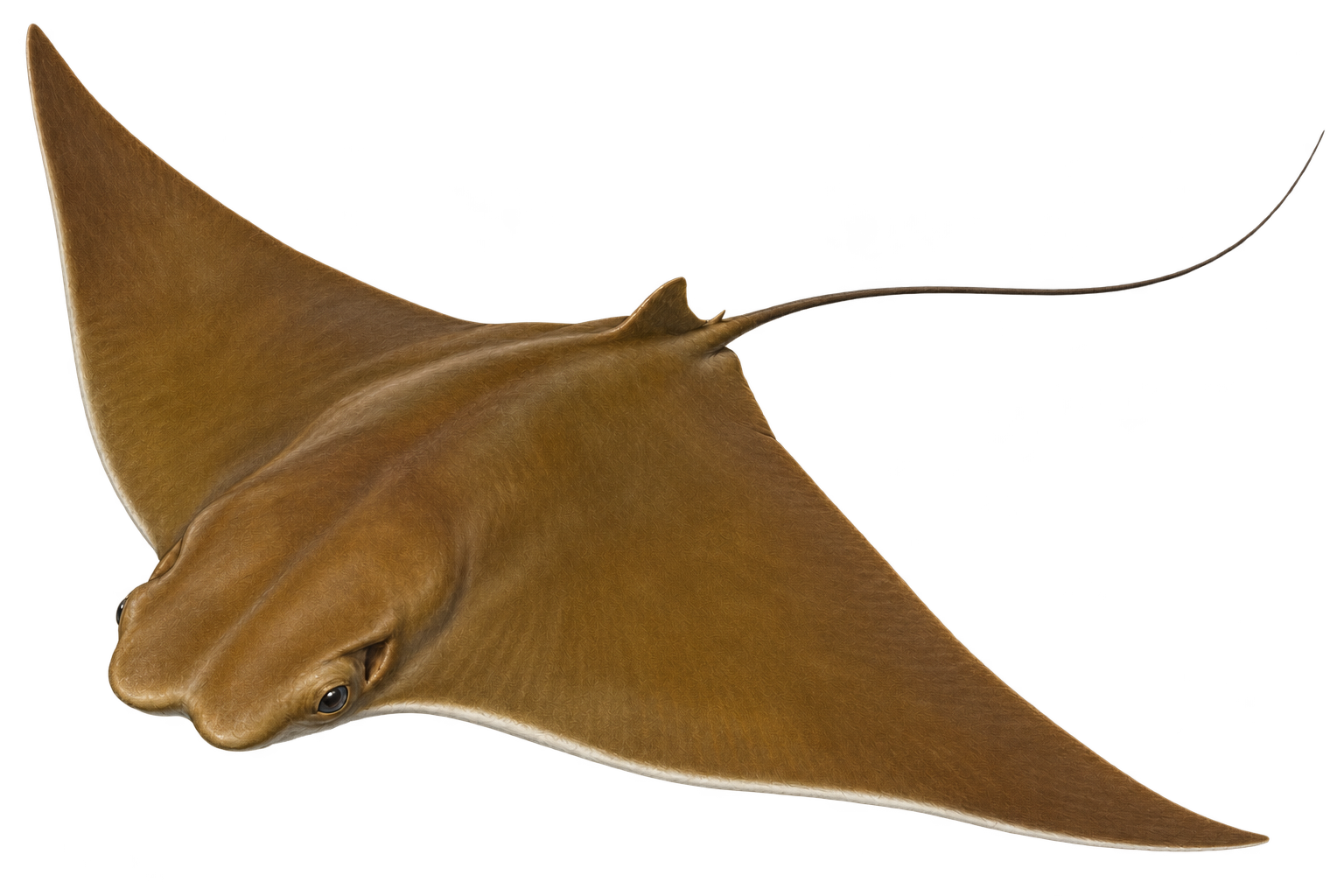
Fun facts for your next surface interval
- The name tells a story: its cowlike name comes from the notched, two-lobed front of the head.
- Built-in shell crushers: flat tooth plates work like crushing surfaces for hard-shelled prey.
- A crowd does not mean a big litter: a female usually produces just one pup, even though schools can look enormous.
Florida and local context
Florida regional occurrence; no site-level or abundance claim: FWC documents cownose rays in Florida and seasonal movement. Similar Brazilian cownose rays mean some diver photographs cannot be assigned confidently to species.
Documented regional presence is not a guarantee of an encounter or a measure of how common this animal is at your dive site.
How to recognize this animal
A cownose ray has angular wings, a plain brown to olive back and a projecting head with a central notch that forms two rounded lobes. The mouth is underneath rather than at the front of a huge open funnel. A long whip-like tail follows a small dorsal fin, with a defensive spine near the tail base. White spots are absent.
Size and life stages
FWC’s current American cownose-ray profile gives a maximum disc width around 4 feet (1.2 meters). Disc width means wingtip to wingtip, not nose to tail. A long tail can make total length look much greater. Larger females and smaller animals can occur together, but a distant outline or size guess alone should not be used to assign sex.
Habitat and where to look
Cownose rays swim through coastal bays, estuaries and open water, while feeding can bring them close to the bottom. Their wing-driven swimming differs from the undulating motion of many bottom-resting stingrays. An animal gliding above sand may be traveling between feeding areas rather than living on that exact patch. Watch both water column and seabed context.
Range and local context
FWC documents cownose rays in Florida. Seasonal movements in the broader western Atlantic include northward travel in warmer months and southward movement as conditions cool. That regional pattern does not promise a school at a particular Palm Beach dive. Group size and timing vary, so record an actual encounter rather than treating migration as a fixed local appointment.
What is on the menu?
Bivalves, crustaceans and worms are among the foods taken from the bottom. Flattened tooth plates help crush hard prey. The head’s fleshy lobes can assist feeding, but they are not the long rolled cephalic fins seen on devil rays. A cloud of disturbed sediment may reveal feeding activity; do not add to it by kicking the bottom.
Daily habits and behavior
Cownose rays are famous for schooling, sometimes in very large groups. A lone animal is also possible, and schooling alone does not prove the species. Keep a school intact by observing from the side rather than swimming through its middle. The tail spine is defensive equipment, so a ray’s graceful swimming should not encourage handling or close pursuit.
Mating and the next generation
Females give birth to live young, usually a single pup. Embryos receive nourishment within the mother rather than developing in a skate-like egg case on the seabed. Males carry pelvic claspers. The low number of young is relevant to conservation and should temper assumptions that a visually impressive school means the species can quickly replace losses.
Look-alikes and identification traps
Spotted eagle rays carry conspicuous pale spots; devil rays have projecting cephalic fins and a different mouth arrangement. The Brazilian cownose ray, Rhinoptera brasiliensis, is much harder to separate externally: tooth-plate differences are not a safe diver identification method. Some photographs may need to remain ‘cownose ray’ without a fully certain species assignment. Never handle one to count teeth.
Observe without disturbing
Allow a ray or school to pass without surrounding it, and keep away from the tail base. A useful photograph includes the notched snout, unspotted upper disc and full wing shape. Record uncertainty where the Brazilian relative cannot be excluded. Do not feed shellfish to draw rays closer or lift a resting animal for a ventral photograph.
Harvest, protection and eating safety
Harvest conditional; food safety unverified
Florida state waters: default harvest, license and lawful-location/gear rules apply; no species-specific annual state closed months were identified. Federal and local restrictions require separate checks. This review does not establish species-specific eating safety, and FDA advice for skate must not be substituted. FWC postponed its proposed two-ray limit in August 2026; that proposal is not treated as law.
This color is a qualified summary, not permission to collect or a guarantee that a particular catch is safe to eat. Read the current rules and health guidance below.
Harvest may be allowed; default limits and site rules apply
Can it be hunted or harvested?
In Florida state waters, the reviewed default recreational limit is two fish or 100 pounds per person per day, whichever is greater, unless a special rule applies. No species-specific statewide minimum size was identified. Use lawful gear and the required saltwater fishing license unless exempt. This does not authorize collection at a dive site. FWC reports that the cownose-ray final-rule decision was postponed in August 2026. The proposed two-ray limit is not treated here as effective law.
Florida seasons and areas
No species-specific annual Florida state-water closed months were identified in the reviewed rules. That is not an all-waters opening: park, sanctuary, refuge and local restrictions can apply. Verify the actual location, current notices and any federal rules for the trip before harvest.
Can it be speared?
Potentially allowed where otherwise lawful, because this species is not on FWC’s no-spearing list. Bag and site rules still apply. Spearing is prohibited within 100 yards of public swimming beaches, public or commercial fishing piers, and bridge portions open to public fishing, with additional area restrictions. No powerheads, bangsticks or rebreathers. This is not permission to spear at Blue Heron Bridge.
Is it safe to eat?
No blanket safe-to-eat claim is made. Check current Florida DOH species, catch-area and population-specific advice before eating a lawfully retained ray. Do not substitute FDA’s skate category for this species or assume that a lack of a prominent advisory establishes safety.
Before you act: This recreational overview is not permission to collect or spear at your dive site. Confirm the species, date, management area, state or federal waters, gear, licenses and current local closures. Identification artwork cannot establish an identification or guarantee seafood safety.
Official rules and health guidance
- FWC default recreational limits and lawful gear
- FWC saltwater recreational licensing
- FWC current workshops: cownose final rule postponed
- FWC prohibited species, gear and spearing locations
- Florida DOH current fish-consumption advisory portal
- FDA advice about eating fish
Reviewed 2026-11-10. Rules and advisories can change; check the linked authorities before harvesting or eating.
Sources and review
Reviewed 2026-11-10.
Make your next dive happen
Dive With Us
Explore local charters and plan a dive suited to your experience.
View dive calendarTrain With Us
Build your fish identification, buoyancy and diving skills.
Explore trainingTravel With Us
Discover upcoming dive adventures and trip details.
Explore dive travelShop With Us
Browse equipment for your diving and ask our team for help choosing.
Explore dive gearReview current dates, availability, prices, inclusions and requirements on each listing before booking or buying.
Call us now
Ask about marine life identification
Marine Life Identification
Ask about dates, prerequisites or your next step. An inquiry does not reserve a place. Please provide your own contact details; do not include medical, payment or a child's personal information.
We use these details to respond to your inquiry. This form does not sign you up for marketing.
Explore more with Stuart Scuba
Open Water course options · Advanced Adventure training · Technical training · Professional training · All courses · Local dives · Dive trips · Facebook · Instagram · YouTube
Your surface-interval essentials
Questions for Stuart Scuba? info@stuartscuba.com
Check the Stuart Scuba Weather Center · Play scuba trivia
Weather and wildlife vary. Confirm current conditions, trip requirements and departure details with the operator.
Plan Your Next Dive with Stuart Scuba
Dive With Us
Explore upcoming local charters and choose a dive that fits your experience.
Before you book
Check the individual listing for departure time, requirements and availability.
Travel With Us
Find upcoming dive adventures and start planning your next trip.
Plan your trip
Review dates, inclusions and trip details on the travel calendar.
Stay Connected with Stuart Scuba
 Follow pageShare
YouTube
SubscribeWatch & shareFollow on InstagramView & share post
Follow company news, training updates, and dive stories.
Follow on LinkedInGoogle Reviews
See Stuart Scuba’s current Google rating and review count below. Open the listing in Google Maps to browse customer reviews.



