

Fish identification archive / Common Snook
Common Snook
Centropomus undecimalis
I saw this
Spotted this fish? Share the guide with your dive buddies. Review your caption before posting.
For Instagram, copy the caption and link into your own post or message. Nothing is posted automatically and this does not record a verified sighting.
Fun facts for your next surface interval
- Its black side stripe makes a remarkably practical name tag.
- Some adults change from male to female: a genuine life-history plot twist.
- The same species can use mangrove nurseries, beaches and nearshore reefs: quite a coastal address book.
Palm Beach connection
Lake Worth Lagoon / Blue Heron Bridge, Palm Beach County: Verified local record.
Documented regional presence is not a guarantee of an encounter or a measure of how common this fish is at your dive site.
How to recognize this fish
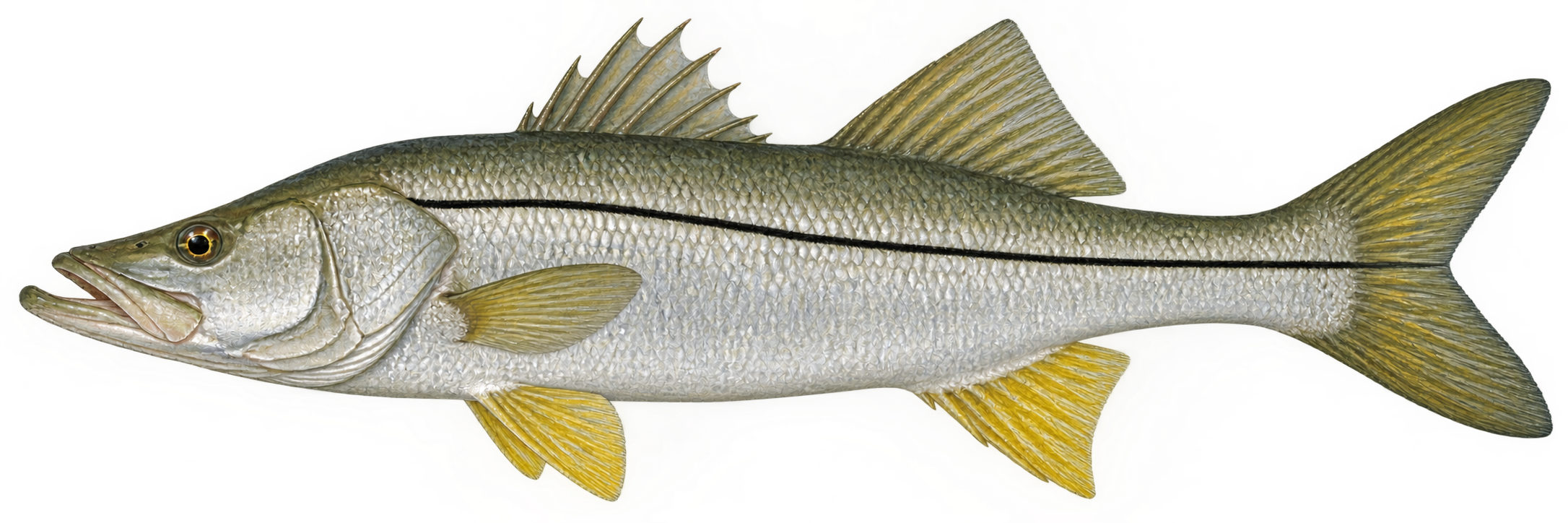
The most useful feature is a bold black lateral line running along a long silver body toward the tail. Add the sloping forehead, large mouth and projecting lower jaw, then check for two separate dorsal fins. Yellowish tones may occur in the lower fins. The stripe is memorable, but combining it with body and fin shape makes the identification stronger.
Size and life stages
Adults can exceed 3 feet, and published maximum records exceed 4 feet. Smaller fish may be juveniles, but length alone cannot identify a species or tell you its sex. Make an estimate from a safe distance and note whether it is approximate. Perspective, water clarity and the fish's angle can make an impressive animal appear larger than it is.
Habitat and where to look
Common snook use estuaries, mangrove shorelines, beaches, river mouths, seagrass and nearshore reef habitats. Juveniles depend heavily on sheltered nursery areas. Structure and coastal connections are therefore worth noticing during a dive, not just the fish itself. Do not follow an animal into a channel or beneath a structure outside the agreed plan in order to keep watching it.
Range and local context
The species occurs in the western Atlantic, including Florida, the Gulf region and the Caribbean. Lake Worth Lagoon has a verified local record. That confirms regional presence without promising a particular bridge or reef encounter. Snook are sensitive to cold conditions, so distribution and behavior cannot be reduced to a single year-round viewing expectation.
What is on the menu?
Fishes and crustaceans such as shrimp and crabs form an important part of the adult diet. Very young stages feed on much smaller organisms. Watch natural hunting without supplying bait or moving prey into reach. A motionless fish near structure is not necessarily inactive; a patient observer can learn more by watching than by trying to make it move.
Daily habits and behavior
Movement between estuarine habitat and more saline spawning areas is part of the life history. Individuals may also respond to temperature and other conditions. A group seen on one dive should not automatically be called a spawning aggregation. Record the setting and behavior you actually observed, then let evidence support any more specific interpretation.
Mating and the next generation
Common snook generally mature first as males, and some later become females. Larger individuals are therefore more likely to be female, but appearance alone cannot reliably establish sex. Spawning involves eggs released into the water. The link between sheltered juvenile habitat and coastal spawning water is an important reason to protect connected habitats rather than viewing each dive site in isolation.
Look-alikes and identification traps
Tarpon have enormous reflective scales, an upturned mouth and a trailing dorsal ray rather than the snook's dark stripe and separate dorsal fins. Other snook species require more careful comparison of proportions and fin details. If the available view supports only 'snook,' use that label rather than treating every related fish as a confirmed common snook.
Observe without disturbing
Give fish space beside pilings and shore structure, avoid baiting or touching, and remain alert to line and boat traffic. Never sacrifice buoyancy or your buddy's position for a closer look. A useful sighting photo shows the side stripe and fins without forcing the animal out of shelter. Keep location and size notes honest, especially when sharing a quick identification from a passing school.
Harvest, protection and eating safety
Seasonal harvest; hook-and-line only
Can it be hunted or harvested?
Recreational harvest is allowed only in season and within the regional slot. Palm Beach/Southeast, Indian River Lagoon and Northeast regions allow one fish per person daily, 28–32 inches total length. A saltwater license and snook permit are required unless exempt. Release fish outside the season or slot.
Florida seasons and areas
East-coast annual pattern: harvest February 1–May 31 and September 1–December 14; closed June 1–August 31 and December 15–January 31. Palm Beach is in the Southeast region. Panhandle, Big Bend, Tampa Bay and Sarasota Bay have December–February and May–August closures. Charlotte Harbor and Southwest, including the Keys, extend the summer closure through September. These regional rules also cover adjacent federal waters. Check the exact region and Biscayne National Park exceptions.
Can it be speared?
Spearfishing prohibited. Hook-and-line is the only authorized harvest method, including in adjacent federal waters.
Is it safe to eat?
Legally retained snook can be eaten, but Florida DOH lists mercury advisories that vary by waterbody and consumer group. Check the current local recommendation, especially for children and anyone pregnant or breastfeeding. Chill promptly and cook thoroughly; cooking cannot remove mercury.
Before you act: This recreational overview is not permission to collect or spear at your dive site. Confirm the species, date, management area, state or federal waters, gear, licenses and current local closures. A fish illustration cannot establish an identification or guarantee seafood safety.
Official rules and health guidance
- FWC snook regions and seasons
- FWC spearfishing restrictions
- Florida DOH linked fish-advisory booklet
- Florida DOH eating healthy seafood
- Florida DOH local fish advisory search
- FDA safe seafood handling
- FDA/EPA questions about mercury and preparation
Reviewed 2026-11-10. Rules and advisories can change; check the linked authorities before harvesting or eating.
Sources and review
Reviewed 2026-11-10.
Make your next dive happen
Dive With Us
Explore local charters and plan a dive suited to your experience.
View dive calendarTrain With Us
Build your fish identification, buoyancy and diving skills.
Explore trainingTravel With Us
Discover upcoming dive adventures and trip details.
Explore dive travelShop With Us
Browse equipment for your diving and ask our team for help choosing.
Explore dive gearReview current dates, availability, prices, inclusions and requirements on each listing before booking or buying.
Call us now
Ask about fish identification training
Reef Fish Identification
Ask about dates, prerequisites or your next step. An inquiry does not reserve a place. Please provide your own contact details; do not include medical, payment or a child's personal information.
We use these details to respond to your inquiry. This form does not sign you up for marketing.
Explore more with Stuart Scuba
Open Water course options · Advanced Adventure training · Technical training · Professional training · All courses · Local dives · Dive trips · Facebook · Instagram · YouTube
Your surface-interval essentials
Questions for Stuart Scuba? info@stuartscuba.com
Check the Stuart Scuba Weather Center · Play scuba trivia
Weather and wildlife vary. Confirm current conditions, trip requirements and departure details with the operator.
Plan Your Next Dive with Stuart Scuba
Dive With Us
Explore upcoming local charters and choose a dive that fits your experience.
Before you book
Check the individual listing for departure time, requirements and availability.
Travel With Us
Find upcoming dive adventures and start planning your next trip.
Plan your trip
Review dates, inclusions and trip details on the travel calendar.
Stay Connected with Stuart Scuba
 Follow pageShare
YouTube
SubscribeWatch & shareFollow on InstagramView & share post
Follow company news, training updates, and dive stories.
Follow on LinkedInGoogle Reviews
See Stuart Scuba’s current Google rating and review count below. Open the listing in Google Maps to browse customer reviews.



