

Fish identification archive / Christmas Tree Worm
Christmas Tree Worm
Spirobranchus giganteus · Serpulidae
I saw this
Spotted this marine life? Share the guide with your dive buddies. Review your caption before posting.
For Instagram, copy the caption and link into your own post or message. Nothing is posted automatically and this does not record a verified sighting.
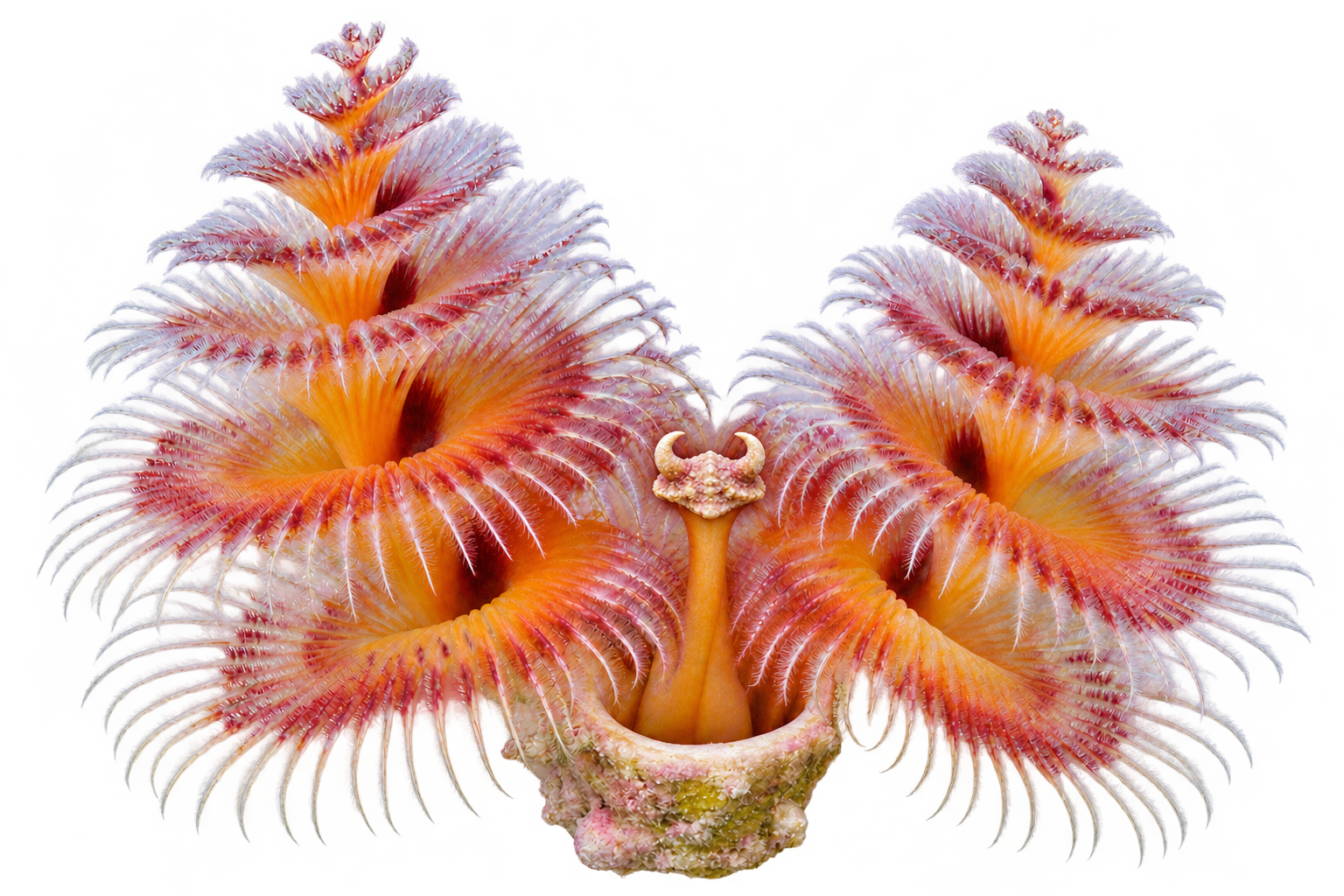
The Christmas tree worm is a small reef animal with a surprisingly architectural appearance. Each Spirobranchus giganteus displays two spiraling crowns above a hard tube. The paired crowns can be orange, white, brown, maroon or mixed in color. They belong to one segmented worm, not to a tiny coral colony, and most of that animal remains concealed below the visible spirals.
Local South Florida evidence
A published underwater photograph collection identifies living Christmas tree worms at the Benwood wreck and French Reef off Key Largo. These provide specific Upper Keys field records rather than relying on a broad Caribbean range. Farther north, the 2014 St. Lucie Inlet Preserve State Park inventory lists the species. That inventory is historical evidence, not a current census or a guarantee of visibility on a Stuart dive.
Think of this as a reef and hard-substrate subject, not a sand-flat burrower to seek by disturbing the bottom. A colony of host coral may support several worms, but two adjacent crowns can be the feeding apparatus of a single animal. Take time to trace the pairing visually without touching the surrounding coral.
How the crowns work
The finely divided structures are called radioles. They help the worm exchange gases and intercept food suspended in passing water, including microscopic phytoplankton. A stationary animal can therefore feed without chasing its meal. The attractive “trees” are working body parts, not decorative growths.
When startled, the worm can pull the crowns into its tube. A protective lid, the operculum, closes the opening; the Caribbean identification guide describes its two horn-like projections. An animal that disappears has not detached from the coral or vanished into another burrow. It has withdrawn into its own shelter.
Reproduction and recognition
Christmas tree worms reproduce by releasing eggs and sperm into the water. Their larvae spend a period in the plankton before settlement. This general life history does not establish a particular spawning month for Key Largo, so no local breeding calendar is implied here.
Look for two tightly spiraled crowns, rather than the more open fans of many feather-duster worms. Color alone is not a species diagnosis. If photographing one, make a wide habitat image and a closer view from the same non-contact position. Avoid repeatedly waving a hand over it to force retraction.
Responsible diving
Do not chip coral or pull out a worm to see its tube. FWC regulates marine-life collection and prohibits harvest of stony corals; local sanctuary and park restrictions also matter. Enjoy this animal in place and consult the applicable current rules rather than treating an identification guide as collecting permission.
References
Collection and habitat protection
Calcareous tube worms are regulated marine life. Do not chip host coral or remove live rock; FWC prohibits stony-coral harvest and recreational live-rock harvest. Current FWC marine-life guidance. Guidance reviewed November 12, 2026. No location-specific collection clearance is given.
Make your next dive happen
Dive With Us
Explore local charters and plan a dive suited to your experience.
View dive calendarTrain With Us
Build your fish identification, buoyancy and diving skills.
Explore trainingTravel With Us
Discover upcoming dive adventures and trip details.
Explore dive travelShop With Us
Browse equipment for your diving and ask our team for help choosing.
Explore dive gearReview current dates, availability, prices, inclusions and requirements on each listing before booking or buying.
Call us now
Ask about fish identification training
Reef Fish Identification
Ask about dates, prerequisites or your next step. An inquiry does not reserve a place. Please provide your own contact details; do not include medical, payment or a child's personal information.
We use these details to respond to your inquiry. This form does not sign you up for marketing.
Explore more with Stuart Scuba
Open Water course options · Advanced Adventure training · Technical training · Professional training · All courses · Local dives · Dive trips · Facebook · Instagram · YouTube
Your surface-interval essentials
Questions for Stuart Scuba? info@stuartscuba.com
Check the Stuart Scuba Weather Center · Play scuba trivia
Weather and wildlife vary. Confirm current conditions, trip requirements and departure details with the operator.
Plan Your Next Dive with Stuart Scuba
Dive With Us
Explore upcoming local charters and choose a dive that fits your experience.
Before you book
Check the individual listing for departure time, requirements and availability.
Travel With Us
Find upcoming dive adventures and start planning your next trip.
Plan your trip
Review dates, inclusions and trip details on the travel calendar.
Stay Connected with Stuart Scuba
 Follow pageShare
YouTube
SubscribeWatch & shareFollow on InstagramView & share post
Follow company news, training updates, and dive stories.
Follow on LinkedInGoogle Reviews
See Stuart Scuba’s current Google rating and review count below. Open the listing in Google Maps to browse customer reviews.



